
File Taxes for Business The Dubai Property Investor Tax Filing Guide
· 17 min read

Introduction: Navigating Dubai’s Tax Landscape as a Property Investor
Let us be honest. You invested in Dubai property because the tax environment is incredibly friendly. For individuals, it still is. But if you own a company that manages or rents out properties, you need to file taxes for business income. The rules are real.
The problem is, many investors overlook this. They do not realize that filing taxes business owners face strict deadlines and specific obligations. In 2026, the UAE corporate tax rate is 9% on taxable profits over AED 375,000 according to the UAE Corporate Tax Guide 2026. If you earn rental income through a licensed company, this applies directly to you as noted by EGSH. Missing these steps means penalties.
This guide changes that. Think of it as your step-by-step roadmap for preparing small business taxes in Dubai.

We help you understand exactly what to do, when to do it, and how to stay compliant.
Want to make sure your structure is correct from the start? Read our deep dive on how UAE corporate tax affects your Dubai property investment structure.
Not sure where your business stands right now? Get a FREE Dubai Real Estate Consultation to check if you are on track.
Understanding Your Tax Obligations as a Property Investor
So you know you need to file taxes for business income if you run your property portfolio through a company.
But what exactly are you on the hook for? Let’s break it down simply.
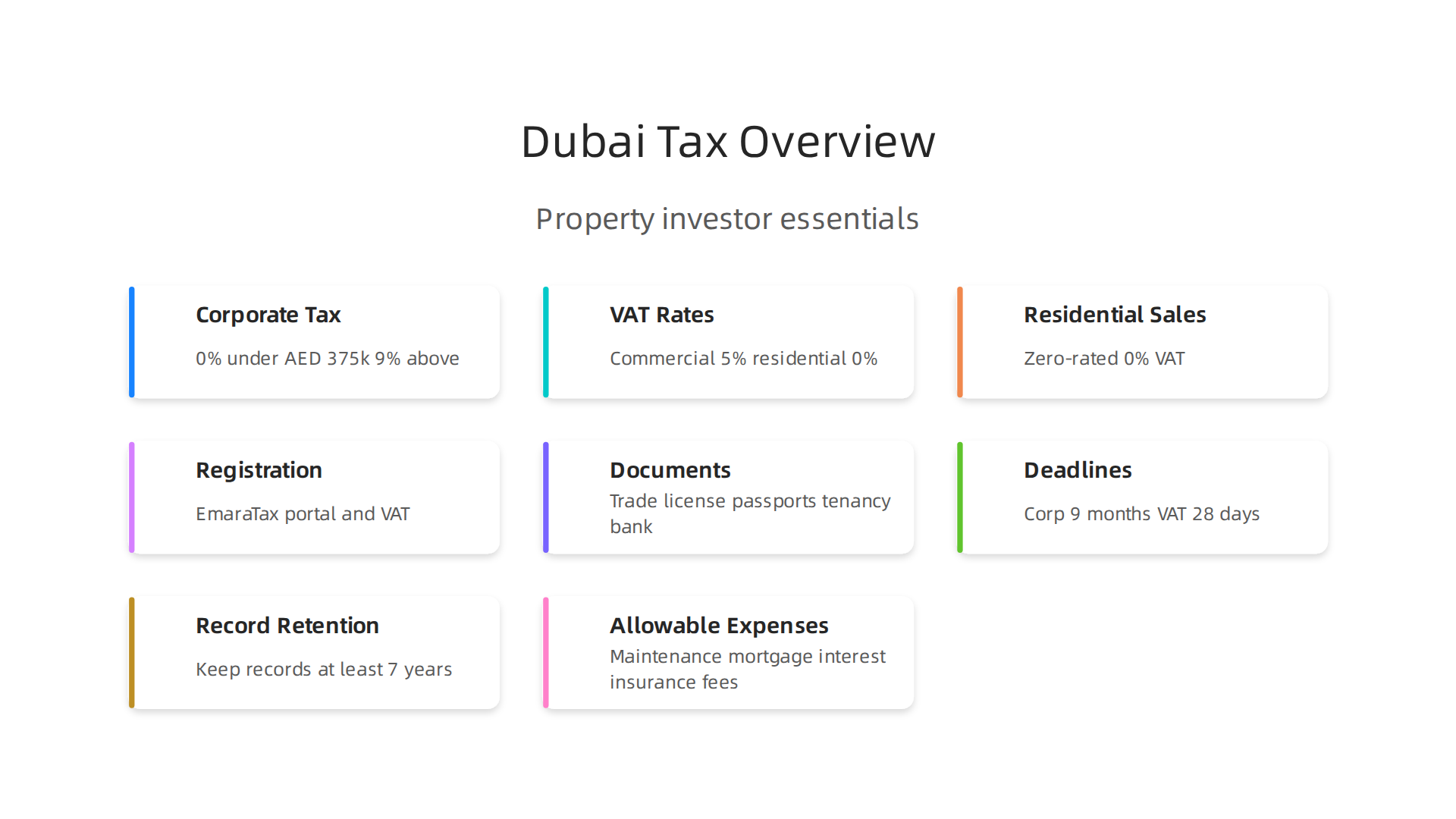
First is corporate tax. If your property investment company makes a profit above AED 375,000, you pay 9% on the amount over that threshold. Profits below AED 375,000 are taxed at 0%, according to the UAE Corporate Tax Guide. The UAE government’s official site confirms the same rates. This applies to rental income earned through a licensed company, as EGSH explains. So if your company manages rental properties and clears profit, you’re looking at a 9% corporate tax bill on the portion above AED 375,000.
Next up is VAT. The rules depend on the property type and transaction:
- Residential property sales are zero-rated (0% VAT).
- Commercial property sales are subject to 5% VAT.
- Rental income from commercial properties also attracts 5% VAT. Residential rental income is generally exempt.
For a full breakdown, the VAT on Real Estate in the UAE guide covers the details. And Rhk Properties notes that real estate agency services always carry 5% VAT, no matter the property type.
Now here’s a big one. The difference between owning property personally versus through a company changes your filing taxes business obligations. As Skrooge.ai explains, corporate tax does not apply to real estate investments held by individuals in their personal capacity. So if you personally own a villa and rent it out, you don’t need to file corporate tax. But if you set up a company to hold the property and earn rental income, then you must file and pay corporate tax on profits over AED 375,000. This is why getting the structure right from day one matters so much.
You might be wondering how to actually do the filing. That’s your next step. We’ve put together a complete guide on how to file business taxes for your Dubai property company that walks you through the entire process, step by step.
Not sure if you’re holding property in the right structure? Get a FREE Dubai Real Estate Consultation to check your setup before you face penalties.
Step-by-Step Guide to Register for Business Taxes in Dubai
Now you know the tax rules. The next step is to actually register. The process is simpler than it sounds. You just need to follow a few clear steps.
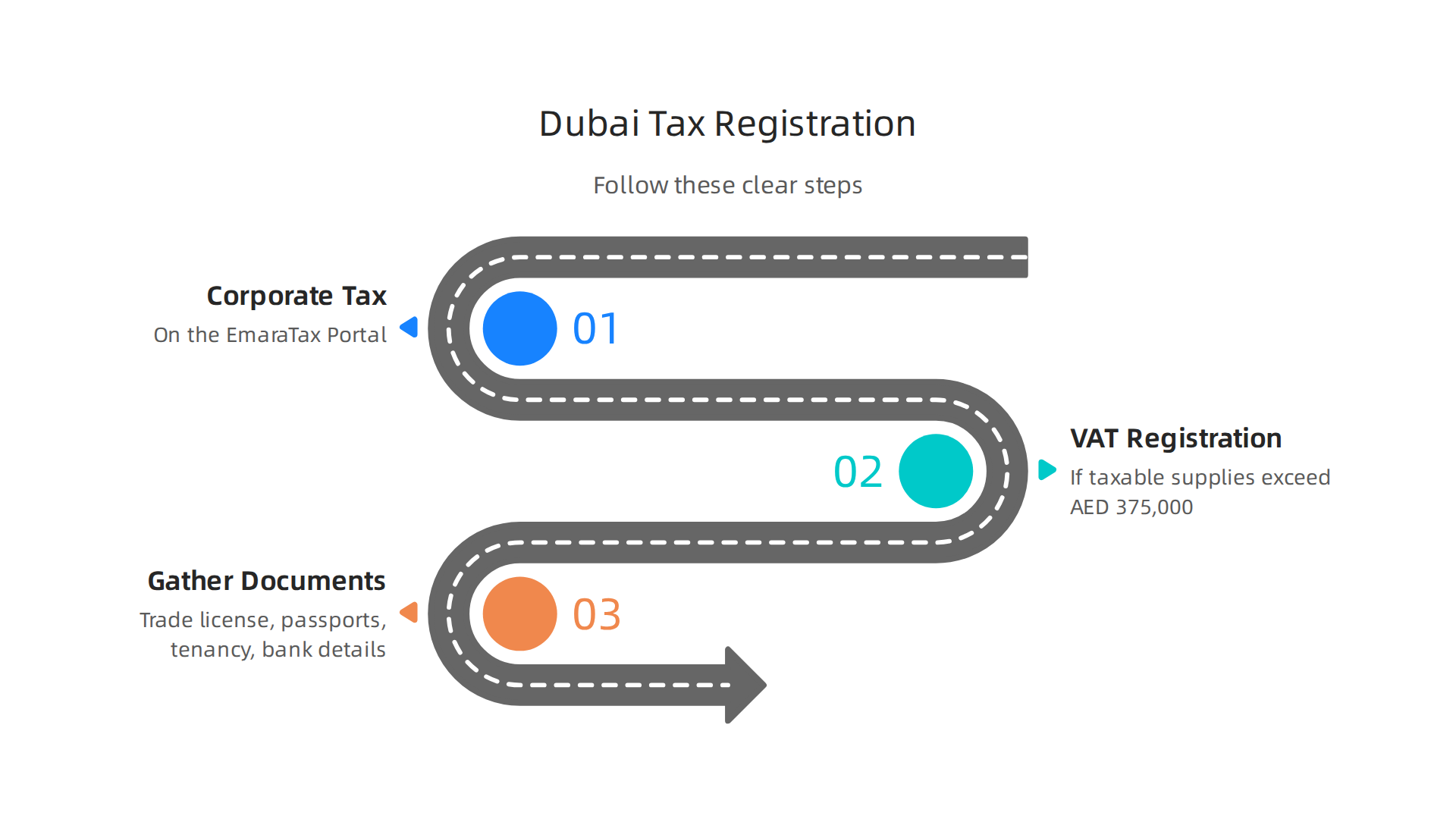
1. Register for Corporate Tax on the EmaraTax Portal
The Federal Tax Authority (FTA) uses an online system called EmaraTax. You must register your property company here for corporate tax. To do this, you need a valid business license and your Tax Registration Number (TRN). If you already have a TRN from VAT, you can use the same login. If not, you create a new account.
Log in to EmaraTax, fill in your business details, and submit. The UAE Corporate Tax Compliance Requirements guide for 2026 walks through each step, from registration to filing. The EmaraTax Corporate Tax submission guide also breaks down the process clearly.
2. Register for VAT If You Need To
Not every property company must register for VAT. You only need to register if your taxable supplies exceed AED 375,000 per year. Taxable supplies include commercial property rent, agency fees, and other services. If your total stays under that threshold, registration is optional but can be smart if you want to reclaim VAT on your costs.
The VAT Registration UAE procedure guide explains the exact steps and timelines. For property investors, keep in mind that residential rental income is exempt from VAT, so it does not count toward the AED 375,000 threshold. The VAT on Real Estate in the UAE guide covers these rules in detail.
3. Gather Your Documents
Before you start either registration, collect these items:
- Your trade license
- Passport copies of all partners or shareholders
- A tenancy contract for your office or company address
- Bank account details (IBAN and bank letter)
Having these ready makes the process go much faster.
Why getting this right matters
If you miss the registration deadlines, you could face fines. The FTA expects all qualifying businesses to register for corporate tax within a set period after incorporation. The same goes for VAT. To learn how your investment structure affects your tax obligations, check out this guide on how UAE corporate tax affects your Dubai property investment structure.
Not sure if you have everything you need? Registration can feel confusing, especially if you are new to Dubai. You do not have to figure it out alone. Get a FREE Dubai Real Estate Consultation so an expert can walk you through every step and help you avoid mistakes.
Key Tax Filing Deadlines and Documentation
Great, you are registered. Now you need to know when to file taxes for business and what paperwork to keep. Missing a deadline can lead to fines, so let’s break down the key dates.
Corporate tax return deadline
Your corporate tax return must be filed within 9 months from the end of your financial year. For example, if your financial year ends on December 31, your return is due by September 30 of the next year. This is a fixed rule from the Federal Tax Authority. The UAE Corporate Tax Compliance Requirements guide for 2026 explains how to count the months and what happens if you miss the date.
VAT return deadlines
If you registered for VAT, you need to file returns quarterly. Each return is due within 28 days after the quarter ends. So if your quarter ends on March 31, your VAT return is due by April 28. The VAT Registration UAE procedure guide gives a full timeline and shows how to submit on time.
Record-keeping rules
You must keep all your tax records for at least 7 years. This includes invoices, receipts, contracts, bank statements, and any documents that support your income or expenses. The UAE Corporate Tax 2026 guide states that the FTA can ask for records going back several years, so do not throw anything away early.
Here is a quick summary of the key deadlines:
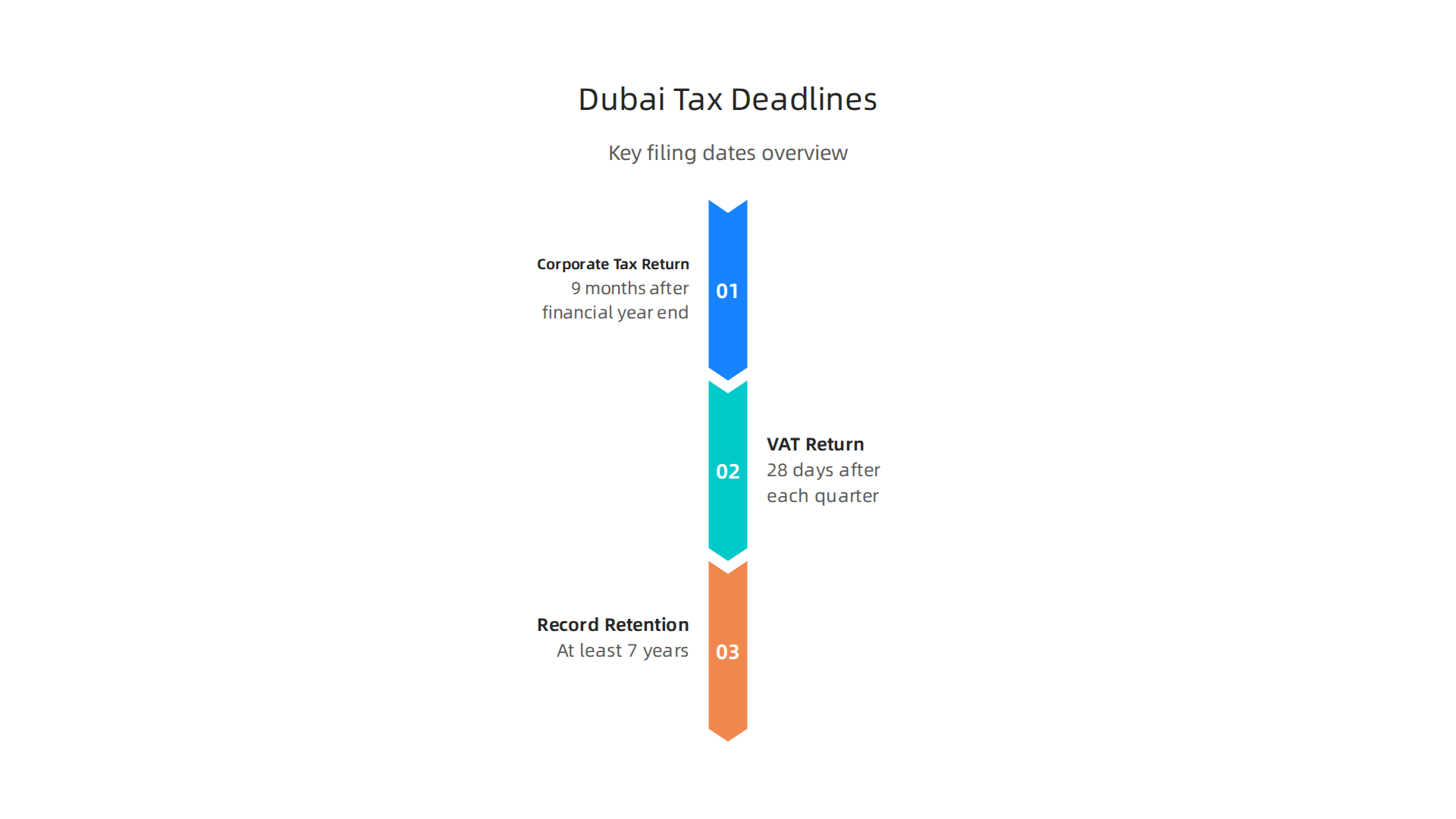
- Corporate tax return: 9 months after financial year end.
- VAT return: 28 days after each quarter.
- Record retention: at least 7 years.
Why documentation matters
Having clean records makes filing taxes business much smoother.

When your paperwork is organized, you can calculate your taxable income accurately and avoid mistakes. It also helps if the FTA ever audits your company. Good records show that you followed the law.
Need help staying on track?
The rules for help with small business taxes can feel overwhelming, especially when you are managing a property company and chasing rent payments. You do not have to manage all this alone. A quick chat with an expert can save you time and stress.
Get a FREE Dubai Real Estate Consultation and let someone help you set up a calendar and document system that works for your business. You will sleep better knowing you will not miss a deadline.
Tax Deductions and Reliefs for Property Investors
Now that you know when to file taxes for business, let’s talk about the good part: the expenses you can subtract from your income. Every dirham you save in taxes stays in your pocket or goes back into your property portfolio. So what exactly can you deduct?
Allowable expenses for property companies
The UAE corporate tax law lets you deduct costs that are wholly and exclusively for generating taxable income. For property investors, this covers many common expenses:
- Property management fees you pay to agents or companies
- Maintenance and repair costs for your buildings and fixtures
- Mortgage interest on loans used to finance rental properties
- Insurance premiums for your properties
- Municipal and local property taxes are generally deductible as well, according to the UAE Corporate Tax Deductible Expenses guide
The key rule is that the expense must be for your business. Personal costs do not count.
Depreciation: a hidden benefit
You can also claim depreciation on buildings and fixtures over time. This lets you spread the cost of a big asset across its useful life. For example, if you buy an air conditioning unit for one of your rental villas, you can deduct a portion of its cost each year instead of all at once. The UAE Corporate Tax Exemptions page for 2026 explains that interest, depreciation, and other permitted items are subtracted from your income to find your taxable figure. This can significantly lower what you owe.
What about selling a property?
Here is some great news: the UAE has no capital gains tax on the sale of investment properties held as capital assets. That means if you buy a villa and sell it five years later for a profit, you generally do not pay tax on that gain.
But there is a catch. If you are a property developer or trader and you hold properties as stock-in-trade (inventory for sale), then the profit from selling those properties is taxable as business income. This is a critical distinction. The PWC UAE Corporate Tax Deductions summary notes that certain expenses are disallowed or restricted, so you need to classify your properties correctly from the start.
How to file taxes as a business with confidence
Understanding these deductions makes preparing small business taxes much less stressful. But the rules can get tricky, especially when you start mixing personal and business properties or claiming depreciation.
If you want to make sure you are not missing any deductions or accidentally claiming something you should not, get expert help.
Book a FREE Dubai Real Estate Consultation and let a professional review your expenses, your property classification, and your tax strategy. It could save you thousands of dirhams.
And to see how your property structure affects your tax bill, read our guide on how UAE corporate tax affects your Dubai property investment structure.
Off-Plan vs Ready Property – Tax Considerations
Choosing between off-plan and ready properties is not just about price or timeline. It also changes how you handle taxes. When you file taxes for business, the type of property you own affects both VAT and corporate tax. Let us walk through the key differences.
VAT on off-plan purchases
If you buy an off-plan residential property, VAT applies at the standard rate of 5% on the purchase price. This VAT is usually included in the payment plan from the developer. According to the VAT on Real Estate in the UAE 2026 guide, yes, VAT applies to off-plan property purchases in Dubai.
But here is the tricky part. If you are a VAT-registered investor and you sell that off-plan property before completion, you are making a taxable supply. That means you must charge VAT on the resale. The Oliva guide on VAT timing for off-plan purchases notes that off-plan residential purchases follow the zero rating in some cases, but you need to check your specific situation. This matters a lot when filing taxes business style, because getting VAT wrong can lead to penalties.
VAT on ready properties
Ready properties work differently depending on use. If you own a residential unit and rent it to individuals, the rental income is exempt from VAT. You cannot charge VAT on the rent, and you cannot recover VAT on related expenses. As the Meraas guide on residential property VAT explains, if the property is purely residential, it is exempt from VAT.
Commercial properties are the opposite. Renting out a shop, office, or warehouse is a taxable supply at 5% VAT. You charge VAT to your tenant and can recover VAT on your costs. This difference is critical when you are preparing small business taxes for your property company.
Corporate tax and your intention
Beyond VAT, your holding period and intention matter for corporate tax. If you buy off-plan with the intent to flip it quickly for a profit, tax authorities may view you as a trader. That means the profit is taxable as business income. If you hold a ready property long-term as an investment for rental income, it is a capital asset and gains on sale are generally not taxable.
This is why you need to document your intention from day one. The PWC UAE Corporate Tax Deductions summary reminds us that certain expenses are disallowed if you classify your properties incorrectly.
If you want to avoid surprises when you file taxes as a business, get clear advice on how your property type affects your taxes. Read our guide on how UAE corporate tax affects your Dubai property investment structure for a deeper look.
And if you need help with your specific situation, book a FREE Dubai Real Estate Consultation and get personalized guidance on off-plan vs ready property tax planning.
Common Pitfalls and How to Avoid Them
Even smart investors slip up when it comes to taxes. The rules in Dubai are clear, but they are not always easy to follow. Let us look at three common mistakes and how you can avoid them so you can file taxes for business correctly every time.
Missing filing deadlines
Dubai gives you some grace periods, but that does not mean you can wait forever. Many investors assume they have all the time in the world. Then the deadline passes and penalties start piling up. The best way to avoid this is to mark your calendar early. Set reminders for your VAT returns, corporate tax filings, and any other reporting dates. If you need help, a good accountant can keep you on track. Taking time to understand the deadlines is a big part of preparing small business taxes without stress.
Classifying income the wrong way
This is a big one. If you buy a property with the plan to sell it fast, the tax office may see you as a trader. That means your profit counts as business income and is taxable. But if you hold the property for rent over the long term, it is an investment. The gain when you sell is usually not taxed. So how do you get it right? You need to show your intention from the start. Keep records, use clear contracts, and make sure your actions match your plan. A common mistake is flipping a property without changing your tax classification. As the Avoiding Typical Pitfalls in Dubai Real Estate Investing guide explains, overlooking legal and tax details can cost you. When you file taxes as a business, get clear on whether you are trading or investing.
Forgetting to register for VAT
If your rental income from commercial properties goes over the AED 375,000 threshold, you must register for VAT. Some investors miss this step because they think it only applies to big companies. But the law applies to you too. If you fail to register, you could face backdated VAT liabilities and fines. The 5 Common Mistakes Global Buyers Make in Dubai article points out that ignoring legal and regulatory details is a major error. So check your income regularly. If you are close to the threshold, register early. And remember, you cannot charge VAT to tenants unless you are registered.
How to stay safe
The best protection is good planning.

Work with a tax advisor who knows Dubai real estate. Keep clean records of every purchase, sale, and rental transaction. And never assume a rule does not apply to you. For more detailed guidance, read our article on how to file business taxes for your Dubai property company. It covers the exact steps to keep your taxes correct.
If you want personal help with small business taxes for your property investments, reach out for a free chat. Book a FREE Dubai Real Estate Consultation and get clear answers for your situation.
Working with a Tax Consultant – When and Why
So you have learned the common pitfalls. Now you might wonder if you can handle everything on your own. The short answer is yes, for simple cases. But when your setup gets complex, a tax consultant becomes a smart investment.

When do you really need a consultant?
You should think about hiring help when your property business involves more than one entity. If you own properties through a company, a trust, or a partnership, the rules change. The same goes for cross-border investments. When money flows between countries, you need someone who understands both sides.
Another big reason is the pace of change. The UAE updates its tax rules often. In 2026, corporate tax compliance is a hot topic. The UAE Corporate Tax Compliance Requirements for Businesses in 2026 guide shows exactly how many steps are involved. From registering on EmaraTax to keeping proper records, one mistake can cost you. A consultant stays on top of these changes so you do not have to.
Why pay for advice when you can do it yourself?
Here is the thing. A consultant’s fee is almost always less than the penalties you could face. Missing a deadline or classifying income wrong can lead to fines that hurt your bottom line. And once you have a problem, fixing it costs more than preventing it.
A good tax advisor also helps you file taxes as a business in the most efficient way. They spot deductions you might miss and make sure you are not overpaying. For example, if you have multiple properties across different emirates, a consultant can help you structure everything to save money.
If you want to understand how corporate tax affects your property structure, read our guide on how UAE corporate tax affects your Dubai property investment structure. It dives deep into the details.
The bottom line
For simple setups, you can manage your own taxes with the right tools and discipline. But if you have multiple entities, international income, or just want peace of mind, hiring a tax consultant is a wise move. The cost is small compared to the risk of getting it wrong.
And if you are not sure where to start, that is exactly when a free chat can help. Get a FREE Dubai Real Estate Consultation and talk to someone who knows the tax rules for property investors in Dubai. It could save you time, money, and stress.
Summary
This guide explains how property investors who operate through a company must prepare and file business taxes in Dubai under the UAE’s 2026 rules. It covers corporate tax (9% on taxable profits above AED 375,000), when VAT applies (5% for commercial supplies, residential exemptions), and the practical steps to register on EmaraTax and, if needed, for VAT. The article lays out key deadlines — corporate returns due 9 months after year‑end and VAT returns within 28 days of each quarter — and shows which documents to keep for at least seven years. You will also learn what expenses and depreciation you can deduct, how off‑plan versus ready properties change VAT and tax treatment, and common filing mistakes to avoid. Finally, the guide explains when hiring a tax consultant makes sense and where to get a free consultation to check your structure and compliance.