
Crombie REIT Portfolio Performance Dividend Sustainability and Growth Strategy
· 17 min read

Introduction: Why You Need a Deep Dive into Crombie REIT
Real estate investment trusts, or REITs, give you a way to earn income from property without buying, fixing, or managing buildings yourself.

You get regular payouts and the chance for long-term growth. But here is the catch. Each REIT comes with its own risks and opportunities. You cannot treat them all the same.
One trust that often gets overlooked is the crombie real estate investment trust. Founded in 1964 as part of the Sobeys family, Crombie REIT now owns 310 properties across Canada, totaling about 19.4 million square feet. Its focus on retail and mixed‑use properties, many anchored by grocery stores, gives it a steady, defensive feel. That stability has helped the trust pay consistent monthly distributions to its unitholders for years.
Whether you already own shares or are just learning about this option, this article gives you an independent, evidence‑based look at Crombie REIT. We will cover its financial health, portfolio strengths, and growth strategy. And if you want to understand how REITs work in other markets, you might find our guide on real estate trust investment in Dubai helpful.

For personalized advice on your own property goals, reach out for a free Dubai real estate consultation.
What Is Crombie Real Estate Investment Trust?
So what exactly is the crombie real estate investment trust? At its core, it is an unincorporated open‑end real estate investment trust that trades on the Toronto Stock Exchange under the symbol CRR.UN. The trust was originally set up in 1964 as part of the Sobeys grocery family and has since grown into a major Canadian property owner.

You can read the official details in its annual information form to get the full legal picture.
Crombie REIT focuses mainly on retail properties across Canada. Most of these properties are anchored by grocery stores, especially Sobeys, which is owned by Empire Company Limited. In fact, as of May 2025, Empire owned an indirect 41.5% interest in the trust. This connection gives Crombie a very stable base because people need groceries no matter what the economy does.
The structure of the trust is also important. It is set up as a mutual fund trust. That means it can pass along most of its taxable income directly to unitholders as monthly distributions. Instead of paying corporate income tax itself, the trust shares its profits with you. This is a common setup for many REITs and it is why investors often choose them for steady cash flow.
If you are learning how trust structures work in different markets, you might find our step‑by‑step guide for real estate investment in Dubai helpful. It explains similar vehicles used in another big market.
To sum up, Crombie REIT gives you a way to own a slice of Canadian retail real estate through a trust that has been around for more than 60 years.

Its strong ties to grocery anchor tenants and its tax‑efficient structure make it a solid option for income‑focused investors.
Crombie’s Property Portfolio: A Diverse Mix of Retail, Industrial & Mixed‑Use
Now you know the basics of the crombie real estate investment trust and how it is structured. So what does it actually own? The answer is a broad and carefully balanced collection of properties across Canada that helps generate steady cash flow for unitholders like you.
As of March 31, 2026, Crombie REIT owned 310 properties totaling about 19.4 million square feet of leasable space, according to its stock listing data on TMX Group.
That is a lot of real estate. But the real strength is in the mix of property types and locations.
Grocery-anchored retail is the core of this portfolio. Most of Crombie’s properties are shopping centres where a grocery store is the main tenant. Sobeys, owned by Empire Company Limited, plays a huge role here. In fact, as noted in the trust’s annual information form, Empire indirectly owns a large interest in Crombie. This connection gives the trust a very stable tenant that pays rent consistently, even when shopping trends shift. People always need food, so these grocery stores keep running no matter what the economy does.
But the portfolio is not just about retail. Crombie also owns industrial properties and mixed-use developments. Industrial spaces include warehouses and distribution centres. Mixed-use projects combine retail with offices or residential units. This diversification means the trust does not rely on just one type of tenant or one type of building to earn income.
Location-wise, Crombie spreads its properties across all Canadian provinces. There is a heavy focus on Ontario and Atlantic Canada, where the trust has its roots. The original company started in New Glasgow, Nova Scotia back in 1964 as a subsidiary of Sobeys. Today, that connection still shapes where the best properties are located.
Having properties spread across different regions helps protect your investment. If one province has a slow economy, the others can pick up the slack. And with Empire Company as the largest tenant, the credit quality of the rent is very strong. You get reliable income from a top-tier grocery anchor combined with the growth potential of industrial and mixed-use properties.
If you are curious how a real estate investment trust like this compares to owning property directly in a growing global market, check out our step-by-step guide on how to start real estate investment in Dubai. It breaks down a different way to build property wealth.
Crombie’s diverse portfolio, anchored by grocery stores and spread across Canada, is a big reason why the trust can offer those monthly distributions we talked about earlier. It is built to last.
Here is the section you requested.
Financial Performance: Revenue, FFO, and Dividend Sustainability
A diverse property portfolio is great, but the real question is whether it makes money. When you invest in a real estate investment reit like Crombie, the numbers that matter most are different from what you might track for a regular company. Let us look at the key financial metrics that tell you if this trust is healthy and if your dividend is safe.
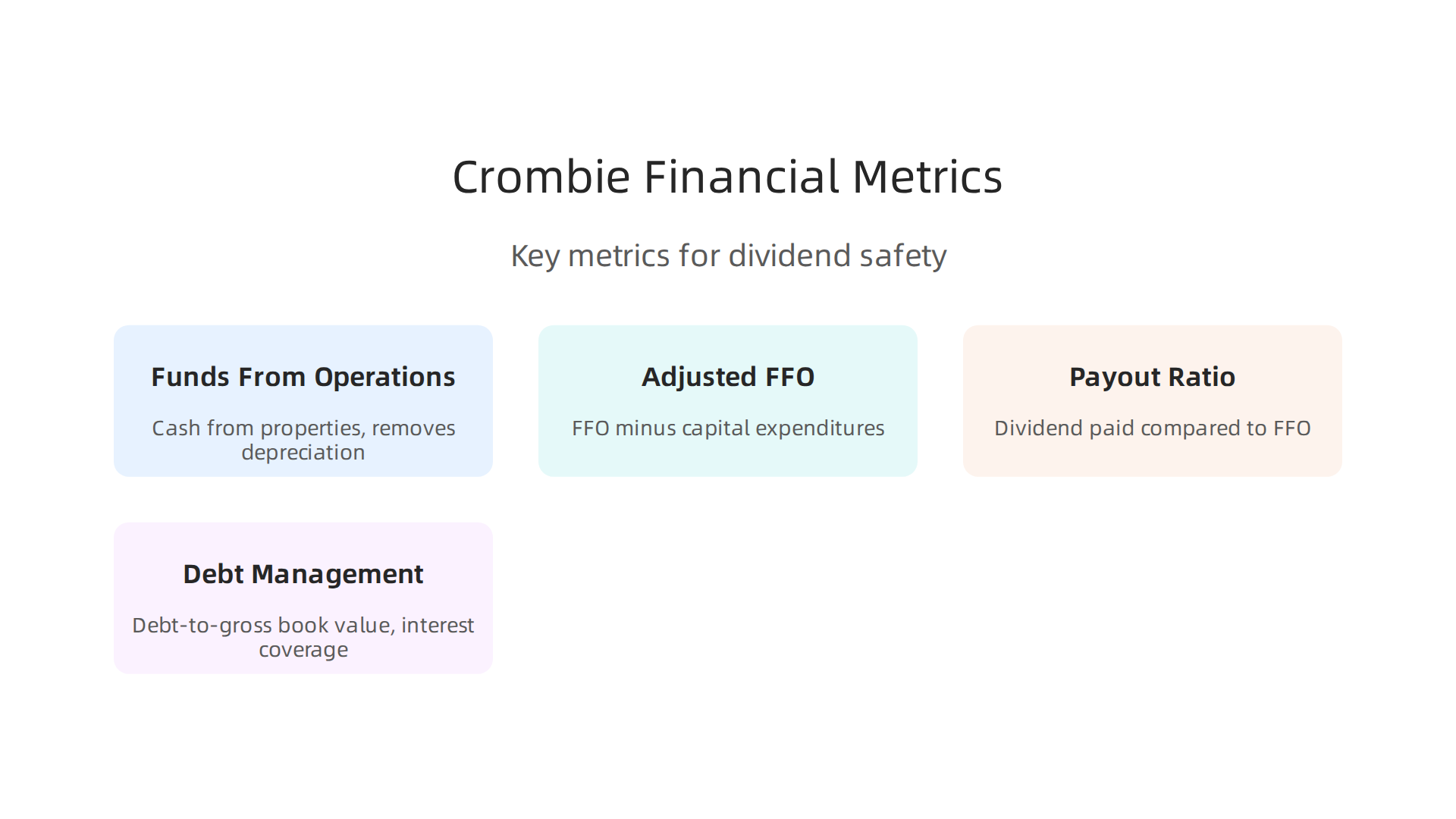
For real estate investment trusts, the most important number is Funds From Operations, or FFO. This metric removes the effect of property depreciation, which is a non-cash cost, to show how much cash the trust actually generates from its properties. In Q4 2025, Crombie REIT reported FFO of C$0.33 per unit, according to its earnings release. For the full year 2025, the trust generated solid property revenue, with the fourth quarter alone bringing in about C$122 million from properties plus additional revenue from management and development services.
Adjusted FFO, or AFFO, is even more important for dividend safety. AFFO subtracts capital expenditures needed to maintain properties, giving you a clearer picture of truly distributable cash. Looking at the latest data from early 2026, net income rose 16% in the first quarter compared to the same period last year, reaching C$27.8 million. Profit margins also improved slightly, moving from 20% to 21% as revenue grew.
How sustainable is the dividend? That is where the payout ratio comes in. The payout ratio compares the dividend paid to FFO or AFFO. A ratio under 100% means the trust is generating enough cash to cover its distributions without borrowing. Crombie has historically maintained a healthy payout ratio, and management continues to focus on keeping it sustainable. As of 2026, the trust offers a competitive dividend yield for income-focused investors.
Debt is another critical piece of the puzzle. Crombie manages its borrowing carefully. Key metrics to watch include debt-to-gross book value, which shows how much the trust owes relative to the value of its properties, and interest coverage ratio, which measures how easily Crombie can pay interest on its debt. The trust has maintained investment-grade credit ratings, reflecting its stable cash flows from grocery-anchored properties and strong tenant relationships.
Management guidance for 2026 emphasizes continued focus on portfolio optimization and maintaining strong financial discipline. The trust benefits from long-term leases with built-in rent escalations, which supports predictable revenue growth.
Investing in a real estate investment trust requires understanding these metrics.

If you want to compare this approach to other ways of investing in property, you might find our guide on how to start real estate investment in Dubai useful for seeing a different market structure.
For now, the numbers show that Crombie’s financial foundation is built on reliable cash flow from grocery-anchored properties, manageable debt, and a dividend that has been consistently supported by operations. That is a strong combination for long-term income investors.
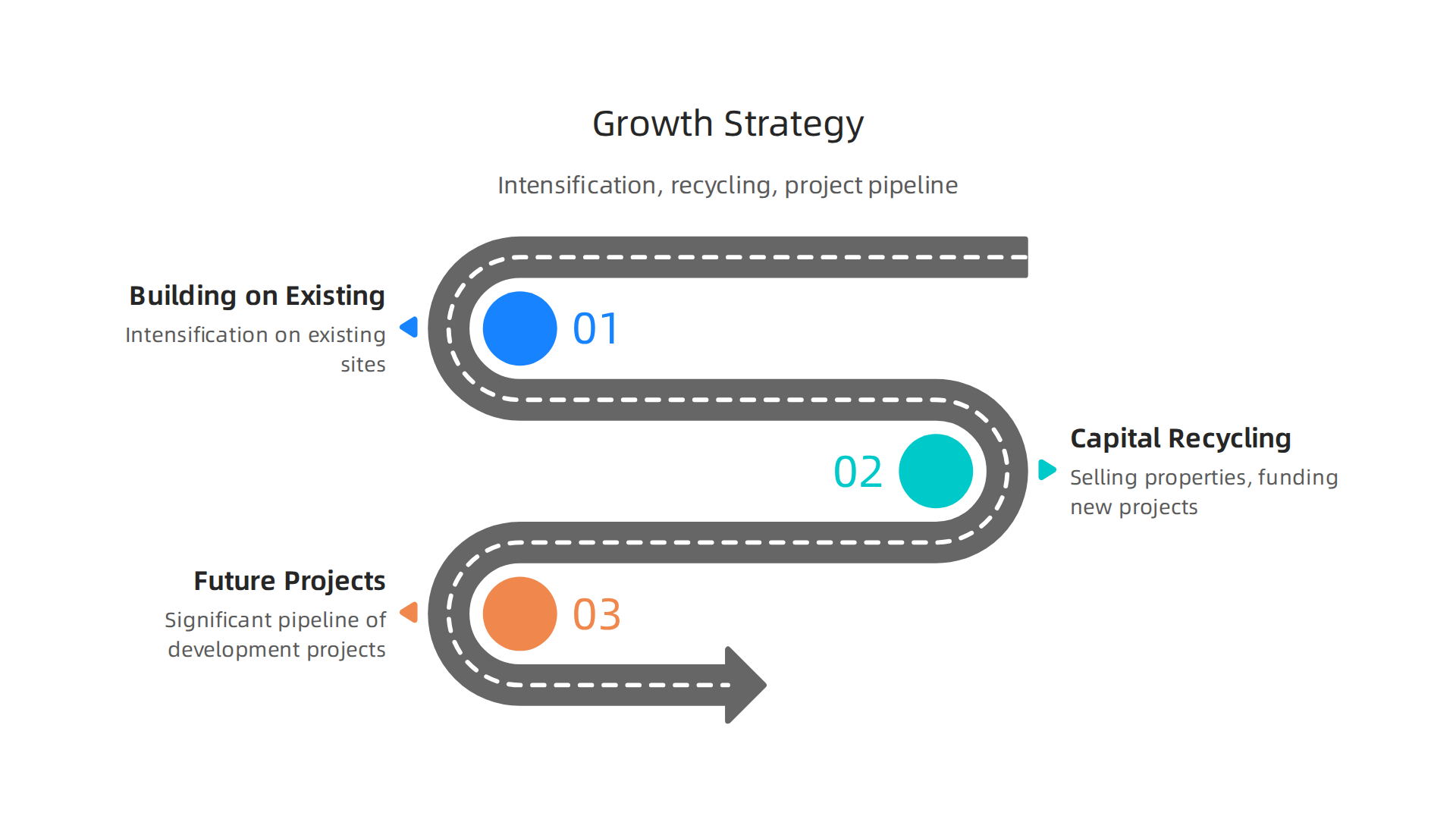
Now that you understand how Crombie’s financials hold up, the next question is how does this crombie real estate investment trust plan to keep growing? The answer lies in three smart strategies: building on land it already owns, buying the right properties, and selling the ones that no longer fit the plan.
Building on What You Already Have
Crombie has a big advantage. It owns land next to many of its grocery-anchored shopping centers. Instead of buying new land, the trust focuses on intensification on existing sites. That means adding apartments, offices, or more retail space on the same property. This approach is called mixed-use development, and it is handled by a dedicated team called "Crombie REIT Development."
As of March 31, 2026, Crombie’s portfolio contained 310 properties totaling about 19.4 million square feet, according to its investors page. A big part of the future growth will come from developing the unused parts of these sites. This is cheaper and faster than starting from scratch somewhere new.
Capital Recycling: Sell Low, Buy Higher
You do not grow by holding onto everything. Capital recycling means selling properties that are not performing as well or that do not fit the long-term vision. The cash from those sales then funds new acquisitions or development projects that promise better returns.
Crombie has been active on this front. In early 2026, the trust announced the acquisition of additional mixed-use properties, as noted in press releases. By selling older assets and buying into stronger markets or higher-yield projects, the trust keeps its portfolio fresh and profitable.
A Full Pipeline of Future Projects
The trust has a significant pipeline of future development projects, as stated in its press releases. These projects take years to plan and build, but they give investors a clear picture of where the growth will come from. Management has shared its strategy with unitholders at the 2026 Annual General Meeting, reinforcing the focus on grocery-anchored development.
If you are exploring real estate investment trusts in other regions, you might find our guide on real estate trust investment in Dubai helpful for comparing different markets.
For now, the key takeaway is that Crombie is not just sitting on its properties. It is actively building, buying, and selling to create long-term value for unitholders. That is the kind of growth strategy that supports reliable dividends year after year.
How Does Crombie Compare to Other Canadian Retail REITs?
You now understand how the crombie real estate investment trust plans to grow. But how does it stack up against its biggest Canadian peers? The main competitors are RioCan REIT, SmartCentres REIT, and Choice Properties REIT. Each has its own strengths, so comparing them helps you see where Crombie fits.
Key Metrics at a Glance
Here are some numbers that matter to investors:
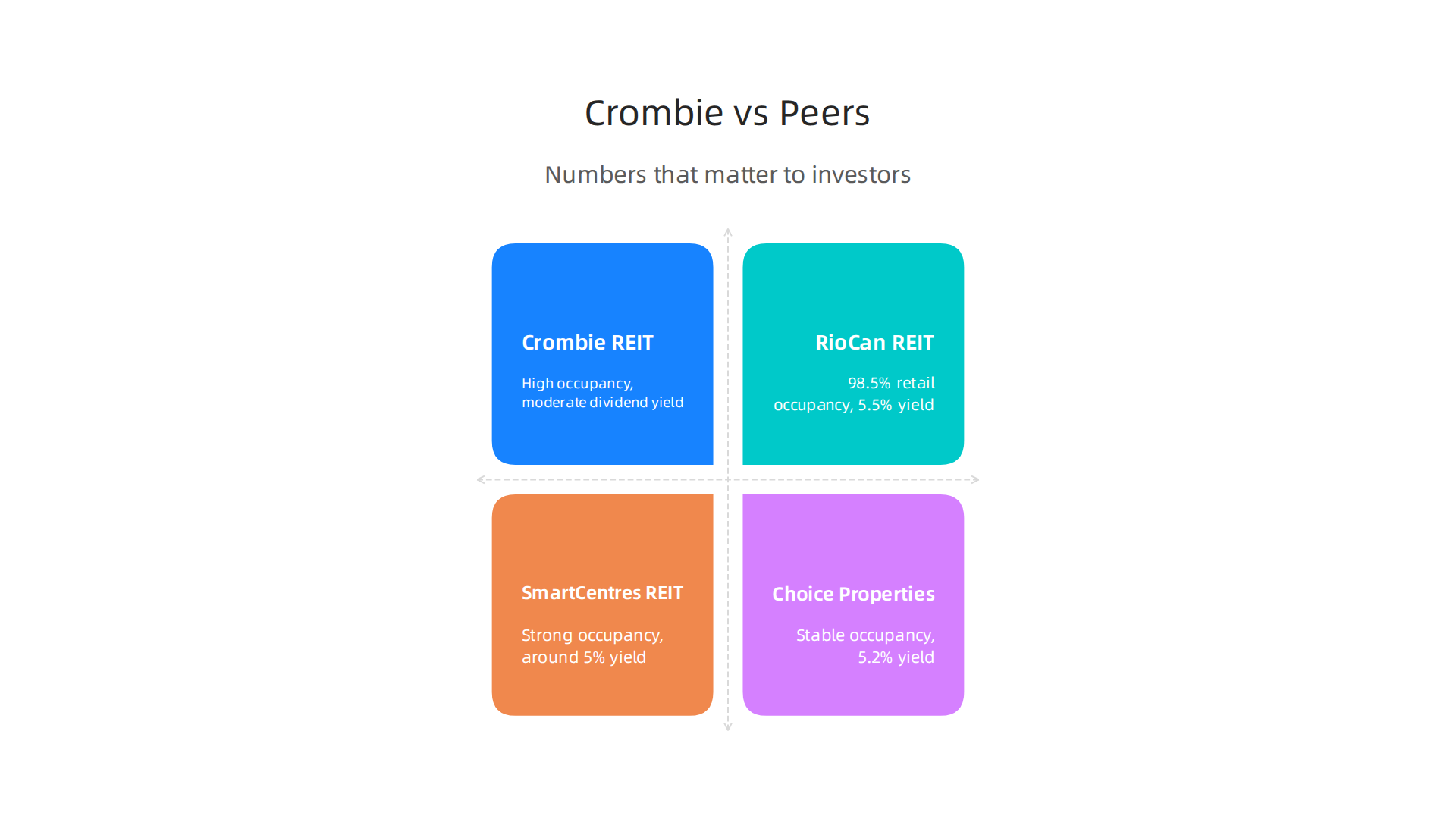
| Metric | Crombie REIT | RioCan REIT | SmartCentres REIT | Choice Properties REIT |
|---|---|---|---|---|
| Occupancy | High (grocery‑anchored) | 98.5% retail occupancy (from 2025 results) | Strong (Walmart‑anchored) | Stable (Loblaw‑anchored) |
| Dividend Yield | Moderate | 5.5% (from April 2026) | Around 5% | 5.2% (from May 2026) |
| P/FFO Multiple | Reasonable | 12.98 P/E (Morningstar) | Slightly higher | Comparable |
| Debt Ratio | Conservative | Manageable | Manageable | Low |
RioCan reported 3.6% same‑property NOI growth and 98.5% retail occupancy in its 2025 results. SmartCentres posted FFO per unit of $0.54 in Q4 2025, up from $0.53 a year earlier. Choice Properties offers a dividend yield of 5.2%. For a deeper dive into these competitors, you can use the Investing.com comparison tool.
Where Crombie Stands Out
Crombie’s big advantage is its grocery‑anchored focus. About 68% of its rent comes from grocery and pharmacy tenants. That makes it more defensive than RioCan or SmartCentres, which have more exposure to fashion, restaurants, and entertainment. When the economy slows, people still buy food and medicine. That steady cash flow supports Crombie’s dividend.
RioCan and SmartCentres go after higher growth by redeveloping sites into mixed‑use projects. Crombie does that too, but at a slower, steadier pace. Choice Properties, backed by Loblaw, is similar to Crombie in its grocery focus but has a larger industrial portfolio.
International Perspective
Whether you are looking at a Vanguard real estate investment trust for U.S. exposure or a Suntec real estate investment trust for Singapore, comparing Canadian retail REITs helps you understand different markets. If you want to explore another stable market, check out our guide on real estate trust investment in Dubai for a different type of defensive income.
When you invest in a real estate investment trust like Crombie, you are betting on stability. Its grocery‑anchored portfolio gives it a buffer that many peers lack. For risk‑focused investors, that can be a very good thing.
Risks to Consider Before Investing in Crombie REIT
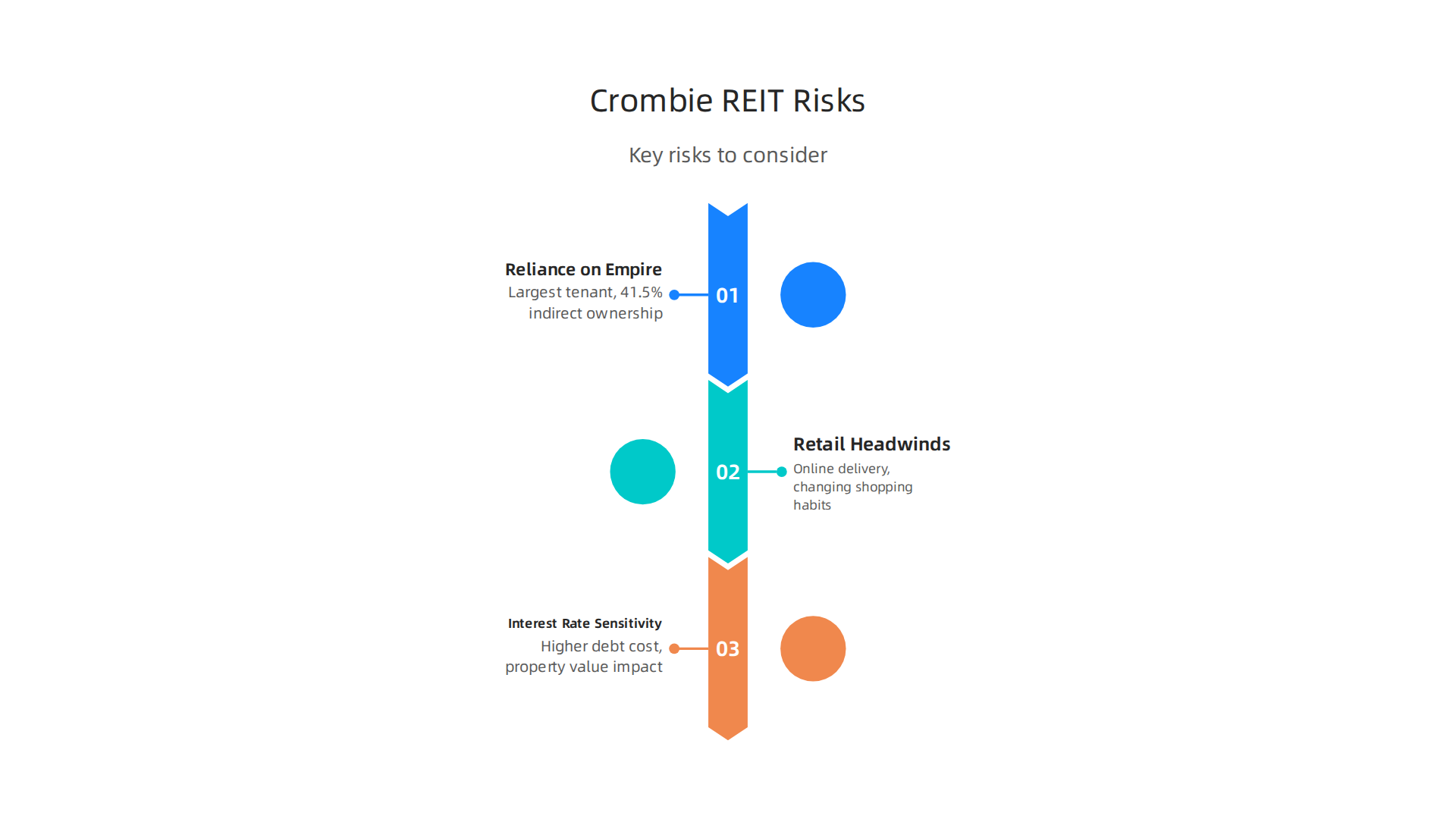
Crombie’s grocery-anchored focus gives it a defensive edge, as we just saw. But no investment is risk-free. Before you put money into this crombie real estate investment trust, you need to look at the full picture. Here are the main risks that could affect your returns.
1. Heavy Reliance on Empire Company (Sobeys)
This is the biggest risk. Empire Company Limited, which owns Sobeys, is by far Crombie’s largest tenant. As of May 2025, Empire held a 41.5% indirect ownership interest in the REIT and leases a huge portion of its properties. You can see this concentration risk detailed in Empire’s 2025 Annual Report. If Sobeys ran into financial trouble or decided to close stores, Crombie’s rental income would take a direct hit. That kind of tenant concentration is something smart investors always watch for.
2. Retail Headwinds Are Real
Even necessity-based retail is not bulletproof. Online grocery delivery keeps growing. Shopping habits keep changing. And some retailers may close stores even in busy plazas. Crombie might have to spend more money to renovate spaces or find new tenants. These costs can slowly eat into profits over time. The company’s management discussed some of these challenges in their 2025 year-end results release. It is a risk that affects the whole sector.
3. Interest Rate Sensitivity
Crombie uses debt to buy and improve properties. When interest rates go up, the cost of that debt goes up too. Higher costs mean less cash left over for distributions. Rates also affect property values. When rates rise, property values often fall. Crombie’s management team is known for being careful with debt. But they cannot escape the effects of the broader economy. If rates stay high for a long time, it becomes harder to grow.
Understanding these risks does not mean you should avoid this real estate investment reit. It just means you should go in with your eyes open. Applying a careful due diligence process, similar to what we recommend for investing in real estate trust markets like Dubai, helps you spot these weaknesses early. A defensive portfolio can still have soft spots.
How to Invest in Crombie REIT Units
Now you know the risks. So how do you actually buy into this crombie real estate investment trust? The good news is that the process is simple, especially if you already have a brokerage account.
Buying CRR.UN on the TSX
Crombie REIT trades on the Toronto Stock Exchange under the ticker symbol CRR.UN. You can buy units through any Canadian brokerage account. Think of it like buying shares of any other stock.
Here is what you need to do:
- Open a brokerage account if you do not have one already. Popular options include Questrade, Wealthsimple, TD Direct Investing, and RBC Direct Investing.
- Fund the account with Canadian dollars.
- Search for the ticker CRR.UN.
- Place a buy order for the number of units you want.
That is really all there is to it. You can compare Crombie’s performance against other real estate investment reit options using a tool like Investing.com’s comparison charts. This helps you see how Crombie stacks up against competitors like RioCan and SmartCentres.
Using Tax-Advantaged Accounts
Here is a smart move. You can hold Crombie REIT units inside a Tax-Free Savings Account (TFSA) or a Registered Retirement Savings Plan (RRSP). This protects your distributions from taxes while they grow.
If you hold a real estate investment reit inside a TFSA, any income you earn is tax-free when you withdraw it. Inside an RRSP, you get a tax deduction now, and your money grows tax-deferred until retirement. This makes a huge difference for long-term investors.
Dividend Reinvestment Plan (DRIP)
Crombie offers a dividend reinvestment plan (DRIP). This lets you use your distributions to buy more units automatically. Over time, this compounds your returns without you having to do anything extra.
Just remember that distributions from any real estate investment reit are usually taxed as regular income, not as Canadian dividend income. Make sure you understand the tax treatment before you start investing.
If you want to learn more about the due diligence process for any kind of real estate trust investment, you can check out our guide on due diligence for real estate trust investments. The same principles apply to Canadian REITs.
Buying CRR.UN is straightforward. The harder part is deciding if it fits your portfolio.

If you are interested in exploring other real estate markets, you can connect with an expert for a free Dubai real estate consultation. But for now, focus on getting your first CRR.UN trade done the smart way.
Expert Outlook: Analyst Ratings and Price Targets for 2026
You know how to buy into this crombie real estate investment trust. But what do the experts think about its outlook for 2026?
Most analysts covering CRR.UN rate it as a Buy or Hold with a positive price target. They point to three big drivers that could move the stock this year.
First, interest rate trends in Canada. Lower rates help REITs by cutting borrowing costs and making their payouts more attractive. Second, retail property fundamentals look strong. Crombie’s grocery anchored centers keep high occupancy and steady rent growth. Third, the development pipeline adds future value.
The company’s recent results back this up. Funds from operations hit C$0.33 per unit in Q4 2025. Net income reached CA$27.8 million, up 16% from the year before. The profit margin rose to 21% as revenue grew.
The bull case says lower rates and stable retail demand will push the stock higher. The bear case points to slow project timelines and competition from other real estate investment reit options like the vanguard real estate investment trust or suntec real estate investment trust.
If you want to compare different ways to invest real estate investment trust units, read our guide on core principles for smart real estate returns.
The outlook for CRR.UN in 2026 is cautiously positive. Just make sure it fits your own goals before you buy.
Summary
This article gives a practical, investor-focused deep dive into Crombie Real Estate Investment Trust (CRR.UN), a Canadian REIT known for grocery‑anchored retail and mixed‑use properties. It explains Crombie’s background, portfolio mix (310 properties, ~19.4 million sq ft), and why grocery anchors like Sobeys provide defensive, steady cash flow. You’ll find clear coverage of the REIT’s key financial metrics—FFO, AFFO, payout ratios—and how management balances debt, distributions and development projects to sustain growth. The piece outlines Crombie’s three-pronged growth plan (intensification, capital recycling, development pipeline), compares it with peers like RioCan and SmartCentres, and flags the main risks: tenant concentration, retail headwinds, and interest‑rate sensitivity. Practical guidance shows how to buy CRR.UN, use TFSA/RRSP accounts, and enroll in a DRIP, while the analyst outlook explains scenarios that could move the unit price in 2026. Overall, readers will be able to assess whether Crombie fits an income or defensive allocation and which metrics to watch in ongoing due diligence.