
Real Estate Trust Investment in Dubai Your Guide to Due Diligence and Smart Returns
· 18 min read

Introduction
Dubai draws in people from all over the world who want to invest in property. The numbers are huge. Experts predict that real estate you can buy in smaller digital pieces could be worth up to AED 60 billion by 2033 [kayrouzandassociates]. That kind of growth brings a lot of opportunities. But it also brings one big question. How do you know who to trust?

Here is the problem. There is so much scattered information out there. The rules from RERA and DLD change often. In 2026, many new regulations came into effect to make things safer for buyers [danubeproperties]. But understanding them all can feel like a full time job. It is hard to tell the good opportunities from the risky ones without a solid plan.
That is where this guide comes in. Think of it as your own real estate investment course. We cut through the noise. We explain how the legal framework works [has.law] and what a real estate trust investment actually looks like in practice. The UAE has worked hard to build a system with clear rules and strong investor protections [kaizenams]. You just need to know how to use them.
If you want to start with even bigger picture ideas, we have a helpful guide on the 6 core principles for smart returns in the Dubai market. It covers the basics of building a strong portfolio from the ground up.
By the end of this article, you will have a simple, fact based plan to invest with real confidence. Let us get started.
What Are Real Estate Trust Investments?
You might hear the term real estate trust investment and wonder what it actually means. It sounds official, maybe even a bit confusing. But the idea is simple.
A real estate trust investment means you place money or property under the legal control of a trustee. That trustee manages the asset for your benefit. You are the beneficiary. You get the rewards without managing the property yourself.
Think of it like taking a real estate investment course. You learn the structure first. Then you apply it.
The Key Players
Here is how it works in practice.
- The investor. That is you. You put in the capital.
- The trustee. A licensed entity holds the legal title. They follow strict rules.
- The beneficiary. You receive the income and gains from the property.
This structure creates separation. Your money is protected even if the trustee runs into trouble.
Common Types in Dubai
Dubai offers several ways to use this model.
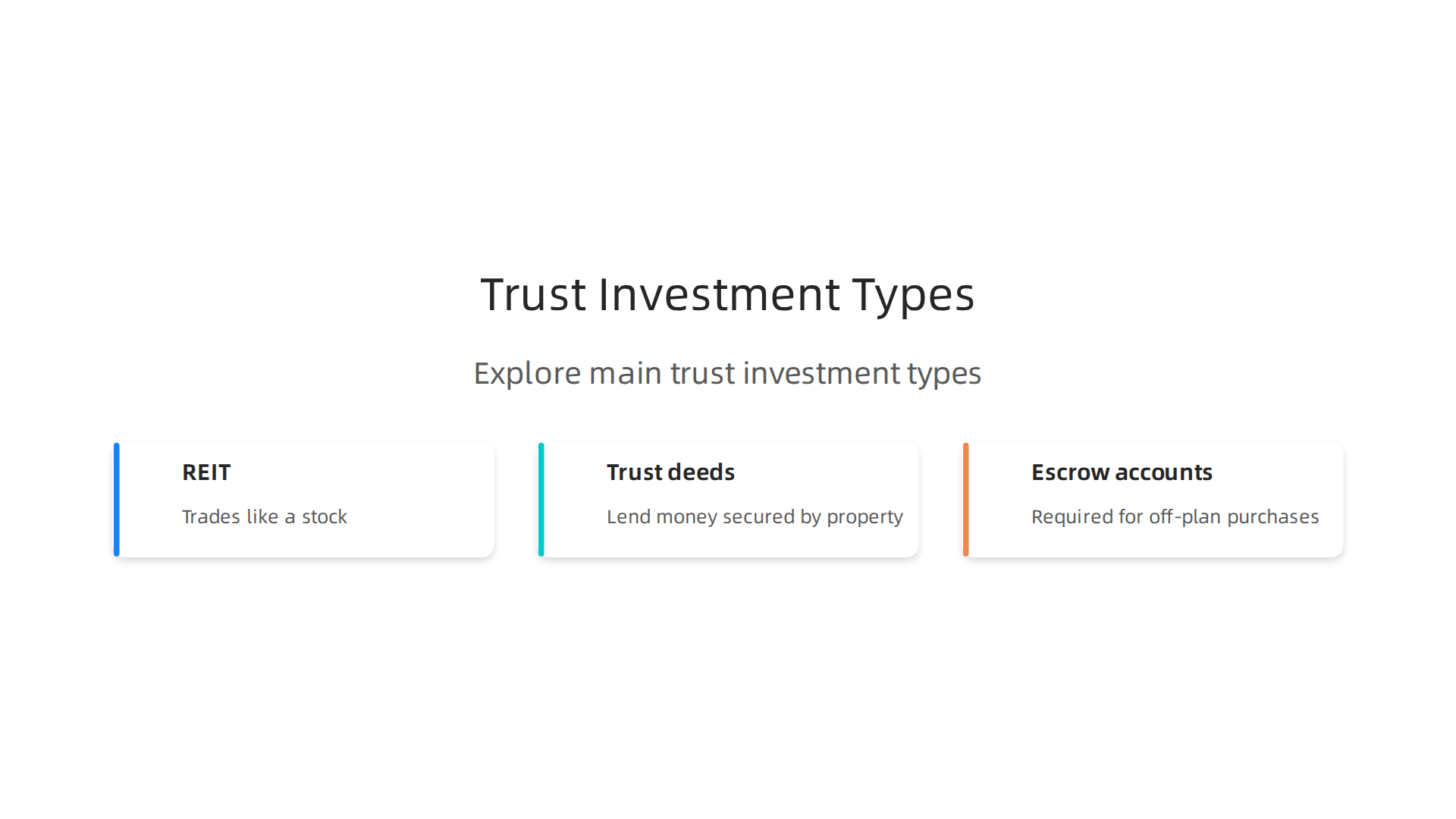
| Type | How It Works | Where It Fits |
|---|---|---|
| REIT | A Real Estate Investment Trust trades like a stock. You own shares in a portfolio of properties. | Great for easy diversification. Dubai Financial Market has specific REIT listing rules [gulfcapitalmarket]. |
| Trust deeds | You lend money secured by property. The trustee holds the deed. | Good for fixed returns without buying property directly. |
| Escrow accounts | Required for all off-plan purchases in Dubai. Your funds go into a regulated trust account. | Essential safety net. RERA and DLD oversee these accounts [danubeproperties]. |
For off plan buying, the Dubai Land Department mandates that your money goes into an escrow account. That is a real estate trust investment in action. Your money is held by a third party until the developer finishes your unit. This keeps you safe from unfinished projects.
Why Investors Like It
People choose this path for a few strong reasons.
- Passive income. The trustee handles the work. You collect the returns.
- Diversification. You can own a slice of many properties instead of buying one whole villa.
- Legal protection. The UAE has built a system with clear rules to protect buyers [kaizenams].
- Sharia alignment. When structured correctly, trust investments follow Islamic finance principles.
This kind of trust arrangement works very similarly to co-investment models. You share ownership and reduce your risk. You can read more about how co-investment real estate in Dubai lets you own premium property for less.
Understanding these basic types is your first step. Now you know what a real estate trust investment actually is. Next, we will look at how to choose the right one for your goals.
Key Types of Real Estate Trust Structures in Dubai
Now that you understand the basics, let us look at the main structures available in Dubai. Each one works a little differently. Your choice depends on your goals.
Dubai International Financial Centre (DIFC) Trust Law
This law gives you a clear legal framework. Many investors use it to set up a formal trust for holding property. It offers strong asset protection and clear rules for trustees and beneficiaries. If you want a custom setup, this is often the best path.
Real Estate Investment Trusts (REITs)
A REIT is a public trust that trades on the Dubai Financial Market. The Dubai Financial Services Authority (DFSA) regulates it. When you buy shares in a REIT, you own a piece of a large property portfolio. No need to manage anything. It is a passive way to earn income from commercial or residential buildings.
Private Trust Deeds with Escrow Accounts
For off-plan projects, developers must use an escrow account. All your payments go into this account. The Dubai Land Department (DLD) approves every account before it opens [bhomes.com]. Your money is released only as construction progresses. This protects you from delays or unfinished projects. RERA and DLD monitor these accounts closely [danubeproperties.com].
Each structure has its own rules and benefits. Taking a real estate investment class can help you decide which one fits your plan. To learn more about choosing the right partner, check out our guide on due diligence for real estate investment companies.
Next, we will compare these options so you can pick the best one for your goals.
Dubai’s Regulatory Framework: DLD, RERA, and Trust Accounts
By now you have seen the main trust structures available in Dubai. But who actually watches over them? That is where the Dubai Land Department (DLD) and the Real Estate Regulatory Authority (RERA) come in. These two bodies create the safety net that makes real estate trust investment in Dubai secure.
The DLD is the top authority for all property matters in the emirate. It registers ownership, approves projects, and oversees every escrow account. According to the DLD’s own FAQ, an escrow account is a bank account where money from off-plan buyers is held [dubailand.gov.ae].
No developer can open one without DLD approval first [bhomes.com]. This step alone stops misuse of your funds.
RERA works under the DLD as the rule maker and enforcer. It sets the laws, licenses developers, and checks that everyone follows the rules. One of its biggest wins is making escrow accounts mandatory for all off-plan sales in Dubai [trustin.ae]. That law, Dubai Law No. 8 of 2007, means your payments cannot be spent on anything except building your project [tamimi.com]. RERA also monitors the flow of money closely with help from trustee banks [danubeproperties.com].
Then there is the Oqood registration system. Think of it as a digital ledger for off-plan property. Every sale gets recorded electronically, so there is a clear, public record of who owns what. This adds a layer of transparency that helps prevent disputes [joinoliva.com].
All of this might sound like a lot of paperwork. But really, it is your protection. When you invest in a trust structure that uses escrow accounts, you know your money is safe until the property is ready. To make sure you pick the right developer or partner that follows these rules, check out our guide on due diligence for real estate investment companies. Understanding the regulatory framework is a key part of any solid real estate investment course or class. And now you have the basics down.
Off‑Plan Investments: Trust, Risk, and Due Diligence
When you buy a property that hasn’t been built yet, you are placing a lot of trust in the developer. That trust is backed by Dubai’s strong regulatory system, but you still need to do your homework. Off‑plan investments can deliver great returns, but only if you take the right precautions.

The first layer of protection is the escrow account. Every off‑plan project in Dubai must have one under Law No. 8 of 2007 [trustin.ae]. Your money goes into that account, and the developer can only withdraw funds as construction progresses [westgatedubai.com]. That is a solid safety net, but it is not a magic shield.
Your Due Diligence Checklist
Here is what you need to check before handing over any money:
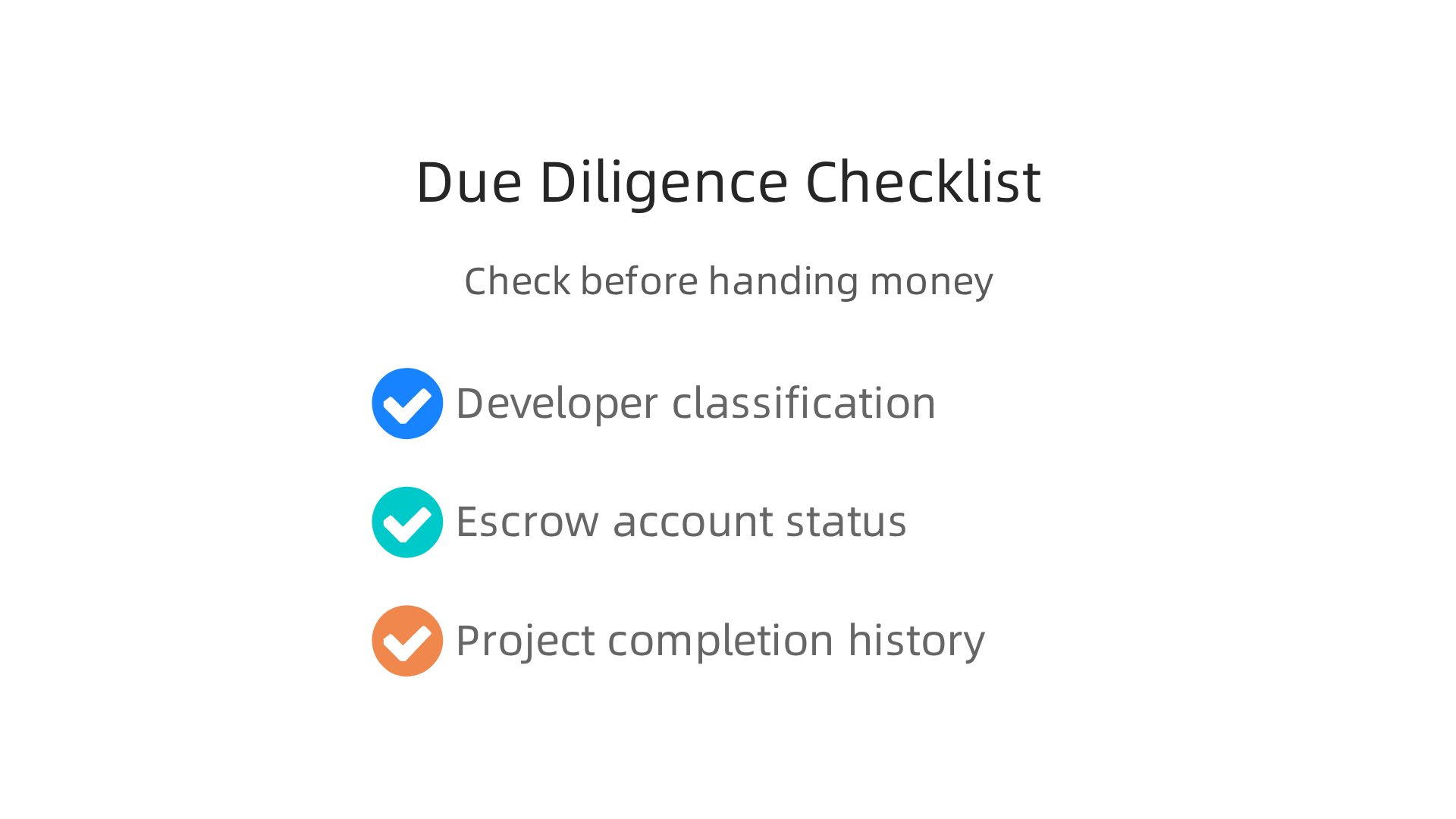
- Developer classification. RERA rates developers with a color system. A "green" rating means a strong track record. Avoid developers with lower ratings.
- Escrow account status. Make sure the project has an active escrow account with DLD approval. You can verify this through the DLD website. A developer cannot legally sell off‑plan without one [bhomes.com].
- Project completion history. Look at the developer’s past projects. Did they finish on time? Were buyers happy? Delays and quality issues are the biggest risks in off‑plan investing [tarafholding.com].
Market fluctuations also pose a risk. Property values can drop before your unit is ready. But choosing a top‑tier developer in a prime location reduces that risk significantly.
Putting It All Together
Off‑plan investing is not for everyone, but with proper due diligence it can be a smart move. The escrow system gives you a strong safety net, and RERA’s oversight keeps developers honest. To dive deeper into the vetting process, read our guide on due diligence for real estate investment companies. Part of any good real estate investment course covers exactly this kind of research. Taking a real estate investment class before you commit can save you from costly mistakes.
Escrow Account Mechanics in Dubai
You already know an escrow account is mandatory for off plan sales. But the real value of real estate trust investment lies in how the account actually works. Here are the key mechanics that protect your money.
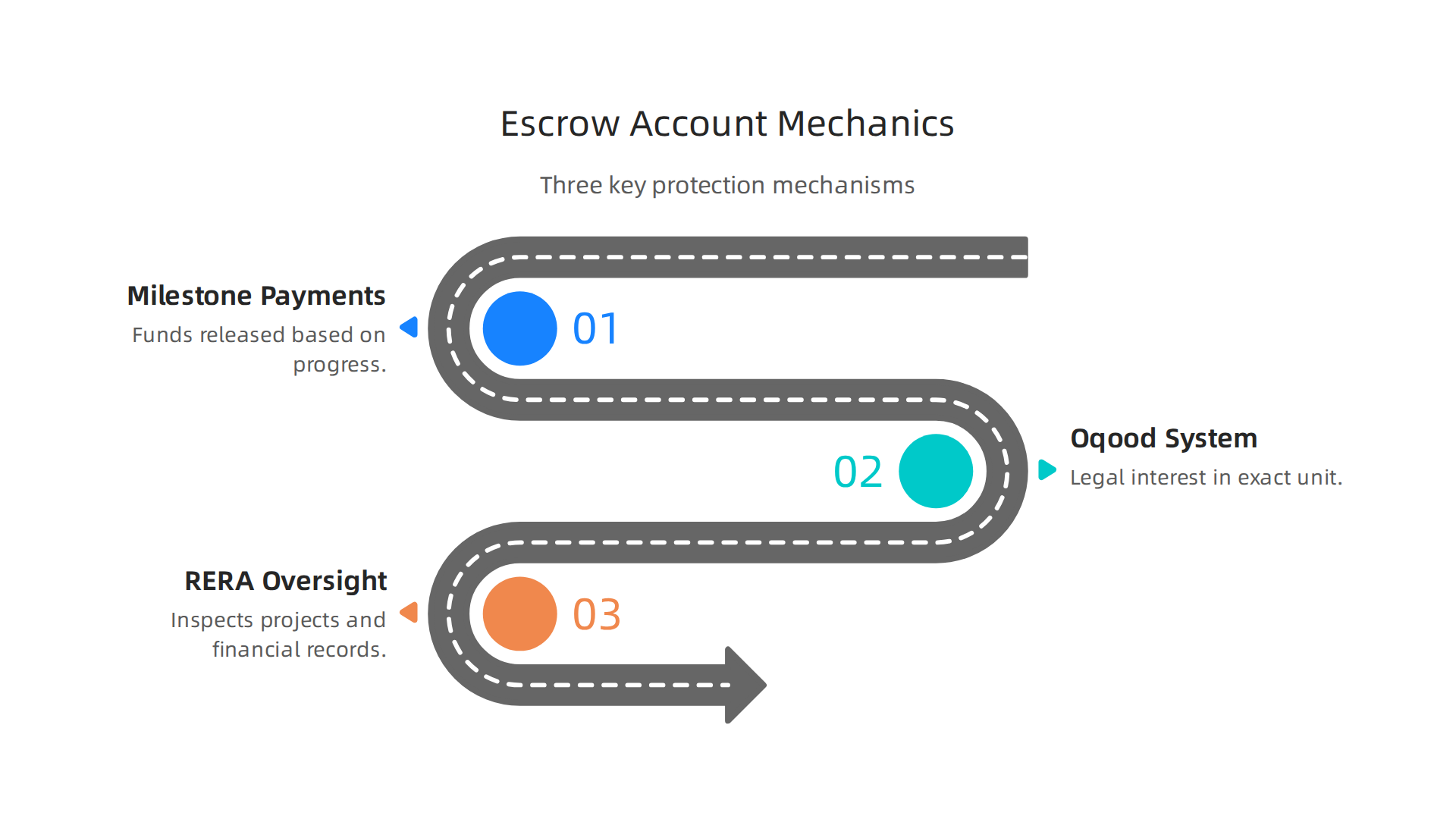
Milestone Based Payments
Your payment goes into a bank account approved by the Dubai Land Department. The developer does not get this money all at once. Instead, funds are released in tranches based on verified construction milestones [westgatedubai.com]. For example, money is released after the foundation is complete and again after the structure is finished. This links your investment directly to physical progress [tarafholding.com].
The Oqood System
Every off plan sale is registered through the Oqood system. This gives you a legal interest in the exact unit you bought, even before the building exists. The registration increases transparency and protects your claim in case of any dispute [bhomes.com].
RERA Oversight and Inspections
RERA does not just set rules. They actively inspect projects and financial records. They make sure the developer uses the escrow money strictly for the intended project, preventing funds from being diverted elsewhere [elplegal.com].
This three part system is the foundation of a secure real estate trust investment in Dubai. Understanding these steps is exactly what a quality real estate investment course should teach you. If you are ready to build a full strategy, read our guide on the 6 core principles for smart returns in 2026.
Evaluating Rental Yields and Capital Growth Across Dubai’s Micro‑Markets
Not every neighborhood in Dubai delivers the same returns. For a real estate trust investment to work well, you need to know which micro‑markets offer strong rental yields and which ones promise long‑term capital growth.
Right now, the citywide gross rental yield sits around 5.5% to 7%, according to market data luxhabitat.ae. But the numbers look very different depending on where you buy. Mid‑market apartments in areas like Dubai Sports City, JLT, and Dubai Marina often yield between 6.5% and 8% propertyfinder.ae.
Budget communities like JVC and International City can push yields up to 9% guestready.com. Meanwhile, prime luxury locations such as Downtown Dubai typically return less in yield but offer stronger capital appreciation over time.
Capital growth depends on different factors. Infrastructure projects, new metro lines, and proximity to Expo City Dubai drive prices higher. New supply also matters; too many new units in one area can slow appreciation.
Smart trust investments focus on properties that balance both sides. Many investors target stabilized assets with proven rental histories. Others go for pre‑vetted off‑plan projects in high‑growth zones. If you want to compare options safely, our due diligence guide to choosing a real estate investment company walks you through the vetting process step by step.
The key is matching the micro‑market to your goal. Do you want steady monthly income or long‑term price gains? A good real estate investment course will help you decide which path fits your strategy.
Hidden Costs Every Investor Must Account For
The purchase price is just the start. Many beginners forget that a real estate trust investment comes with extra costs that eat into your returns. Here are the three main categories to watch out for.
Upfront costs. When you buy, the Dubai Land Department charges a 4% transfer fee. You also pay registration fees, agent commissions around 2%, and bank fees if you use a mortgage. These can add 6% to 8% to your initial cash outlay. A good real estate investment course will teach you to budget for these before you commit.
Ongoing costs. Service charges cover building maintenance, security, and common areas. They vary by community. Property management fees also apply if you use a firm to handle tenants and repairs. In a trust structure, trustee administration fees add another layer. These yearly costs typically range from 1% to 3% of the property value, according to market data luxhabitat.ae. Always ask for a full breakdown before you invest.
Exit costs. Dubai has no capital gains tax, which is great. But some trust agreements include early termination fees if you sell or leave before a certain period. Check the fine print carefully.
Understanding these costs is part of any solid courses in real estate investment curriculum. The more you learn upfront, the less likely you are to be surprised later.
Breakdown of DLD and Trust-Related Fees
You already know hidden costs exist. But seeing them side by side makes it real. Here is a quick breakdown of the main fees tied to a real estate trust investment in Dubai.
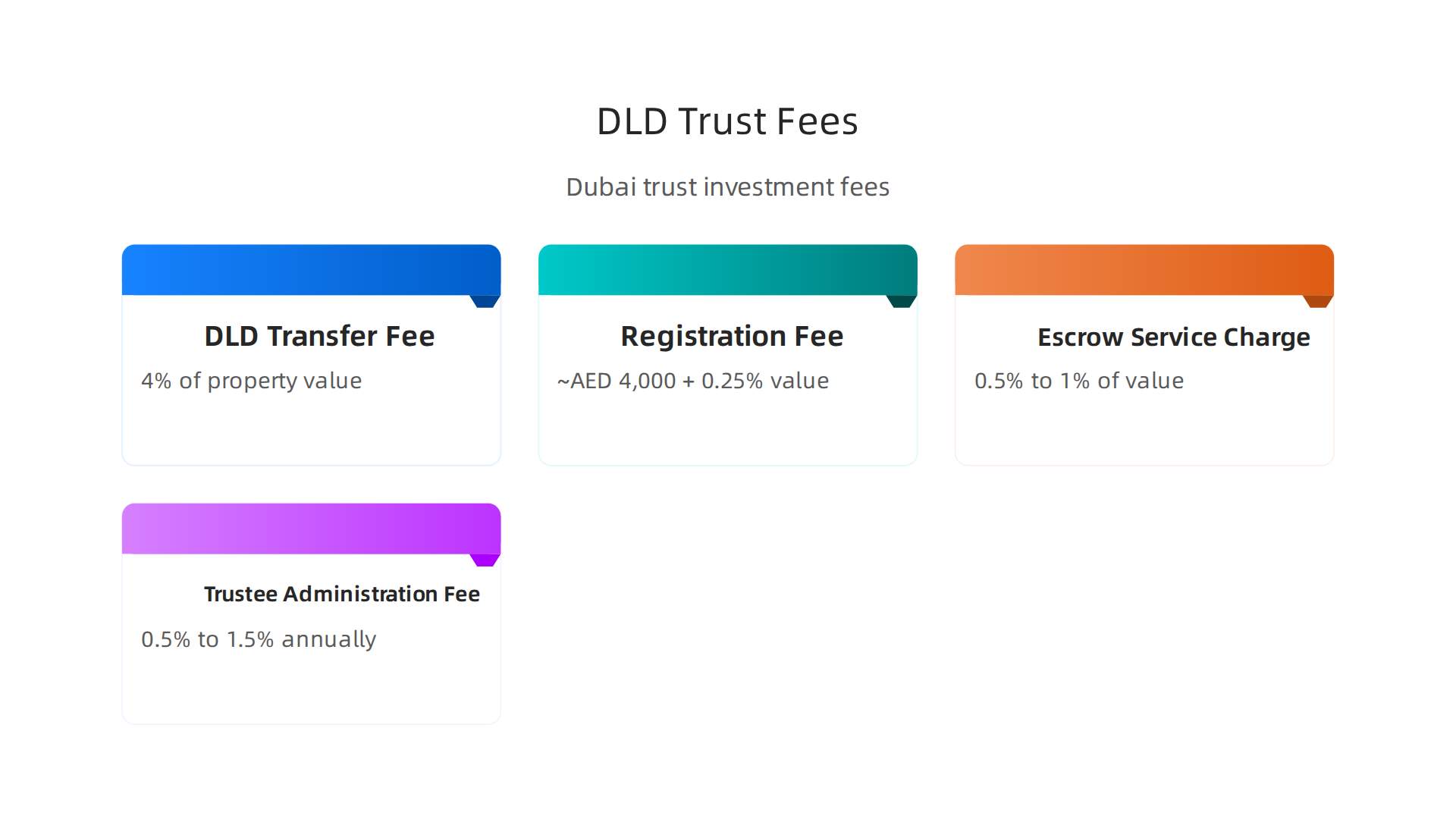
| Fee Type | Typical Cost | Who Pays |
|---|---|---|
| DLD Transfer Fee | 4% of property value | Buyer |
| Registration Fee | ~AED 4,000 + 0.25% of value | Buyer |
| Escrow Service Charge | 0.5% to 1% of property value | Buyer or Developer |
| Trustee Administration Fee | 0.5% to 1.5% of asset value per year | Trust Beneficiary |
The DLD transfer fee and registration costs hit you upfront. The Dubai Land Department issues your title deed once these are paid. Trust administration fees then recur every year, reducing your net rental income.
How these fees change your ROI. A 4% transfer fee plus 1% other closing costs means you need 5% appreciation or income just to break even in year one. The trustee fee then takes another slice off your annual returns. You must bake these into your investment plan from the start, or your numbers will be wrong.
Direct ownership vs. trust structure. With direct freehold ownership, you avoid trustee fees but handle all management yourself. A trust adds that administration layer, which can be worth it if you want hands off management. To learn more about choosing the right structure, see our guide on co-investment real estate in Dubai.
Compare the fee table with the property’s projected returns. If the numbers still make sense, you are ready to move forward. If they feel tight, look for lower fee properties. The RERA service charge index is a good tool to compare community costs before you buy.
Finding Trustworthy Advisors and Avoiding Pitfalls
Now that you know the real costs, you need people you can trust.

Dubai’s property market is full of great opportunities, but it also has advisors who are not always looking out for you.
The first thing to check is a RERA certification. Every licensed real estate professional in Dubai must have a RERA card number. You can ask to see it. If they cannot show you one, walk away. If you want to understand the licensing process better, this step-by-step guide on how to get your RERA card in Dubai explains what credentials really matter. Membership in groups like the Dubai Real Estate Institute is another good sign. For more on how to properly vet a firm, read our due diligence guide to choosing a real estate investment company in Dubai.
Watch for red flags. Anyone who promises "guaranteed" returns in a real estate trust investment is not being honest. No investment is guaranteed. Also be careful if an advisor pushes one specific developer without explaining why. And if they are unclear about their commission structure, that is another warning sign.
Here is the best practice. Ask for independent references from past clients. Then verify the project’s escrow account directly with the developer or the Dubai Land Department. Finally, get a written trust agreement reviewed by a Dubai licensed lawyer before you sign anything. The Dubai Real Estate Laws, Rules for 2026, and Regulations for Investors resource can help you understand the legal side.
Taking these steps will protect your money and your peace of mind.
How to Conduct Your Own Due Diligence for Trust Investments
Okay, you have vetted your advisor. Now it is your turn to do some homework. Doing your own due diligence is the best way to protect your money in a real estate trust investment.

It might sound complicated, but it is just a few simple checks.
Here is a step by step checklist you can follow.
Step 1: Check the developer on the RERA website.
Every developer in Dubai has a classification on the RERA site. You can see how many projects they have completed and if any complaints were filed. This is the same system used for off plan projects. For a deeper look, this video on the 4 pillars of due diligence for Dubai off plan properties walks you through exactly what to check.
Step 2: Confirm the escrow account with the bank.
Your money must go into a regulated escrow account. Ask the developer for the bank name and account number. Then call the bank to confirm it is the correct account for your project. Do not rely on a screenshot. Verify it yourself.
Step 3: Review project permits and approvals.
All projects need approvals from the Dubai Land Department and other authorities. You can find these on the DLD website or at DubaiLand.gov.ae. Look for the permit number and match it to the project you are buying.
Step 4: Cross reference performance data.
Do not just listen to one advisor. Look at independent market reports. Check rental yields and sales data on public portals. If you see big differences between what your advisor says and what the reports show, ask more questions.
If you want to learn more about the basics of investing, taking a real estate investment course can be a smart move. Many courses in real estate investment cover how to read financial documents and assess risk. One useful resource is the 2026 investment due diligence checklist that includes a free template you can use.
Also, compare multiple opinions. Talk to at least two or three different advisors and ask them the same questions. If their answers are very different, that is a red flag.
Due diligence is not hard. It just takes a little time. And that time can save you from a bad investment. For more on the big picture of investing wisely, read our guide on 6 core principles for smart returns in Dubai real estate in 2026.
Take these steps and you will feel much more confident about your real estate trust investment.
Summary
This guide explains how real estate trust investments work in Dubai and shows you how to invest with confidence. It covers the main trust structures—REITs, DIFC trusts, escrow-based deeds—plus the regulatory safety net from the Dubai Land Department and RERA that enforces escrow accounts and project transparency. You will learn how escrow milestone payments, Oqood registration and RERA inspections protect off‑plan buyers, and how to run practical due diligence on developers, escrow accounts and permits. The article also breaks down hidden costs (DLD 4% transfer fee, registration fees, trustee and service charges), compares rental yields across micro‑markets, and lists red flags to spot when choosing advisors. After reading, you’ll have a clear checklist to vet trust investments, calculate realistic returns, and pick structures and partners that match your goals.