
Claim These Taxes Business Expenses to Lower Your Dubai Property Tax
· 20 min read

If you own rental property in Dubai or run a real estate business here, you have probably heard a lot about taxes. Some people say Dubai has no taxes at all. Others warn that the rules have changed. The truth sits somewhere in the middle. Dubai still offers a tax friendly environment compared to most global cities. But in 2026, understanding your taxes business expenses is no longer optional. It is the difference between keeping more of your profits and losing money to avoidable mistakes.
The UAE now has a corporate tax system. If your taxable income stays under AED 375,000, the rate is 0%. Above that threshold, you pay 9%.

This applies to most property investors and real estate companies. You can find the full breakdown of current UAE corporate tax rates and rules on the official UAE government website.
The system is not complicated, but it does require you to track your numbers correctly.
Many investors focus on rental income or capital gains. They forget to think about their income taxes business obligations and what they can actually deduct. The truth is, you can lower your tax bill by claiming the right calculating business taxes deductions. Things like maintenance costs, property management fees, mortgage interest, and even some marketing expenses may qualify. You just need to know which ones count.
The problem is that most advice out there is scattered or biased. Brokers want you to buy. Developers want you to sign. Nobody sits down and gives you a clear picture of what counts as a deductible taxes on business income expense and how to stay on the right side of the law.
This guide changes that. We cover every major deduction category, the latest 2026 tax rules, and practical ways to keep your books clean. You will also learn when it makes sense to hire an accountant for small business taxes and how to structure your investments for maximum tax efficiency.
Start by understanding how UAE corporate tax affects your investment structure so you know exactly where you stand.
Ready to get clear on your numbers? Take the first step and get a FREE Dubai Real Estate Consultation to review your situation with an expert who knows the local market inside and out.
Dubai’s Tax Framework for Property Investors
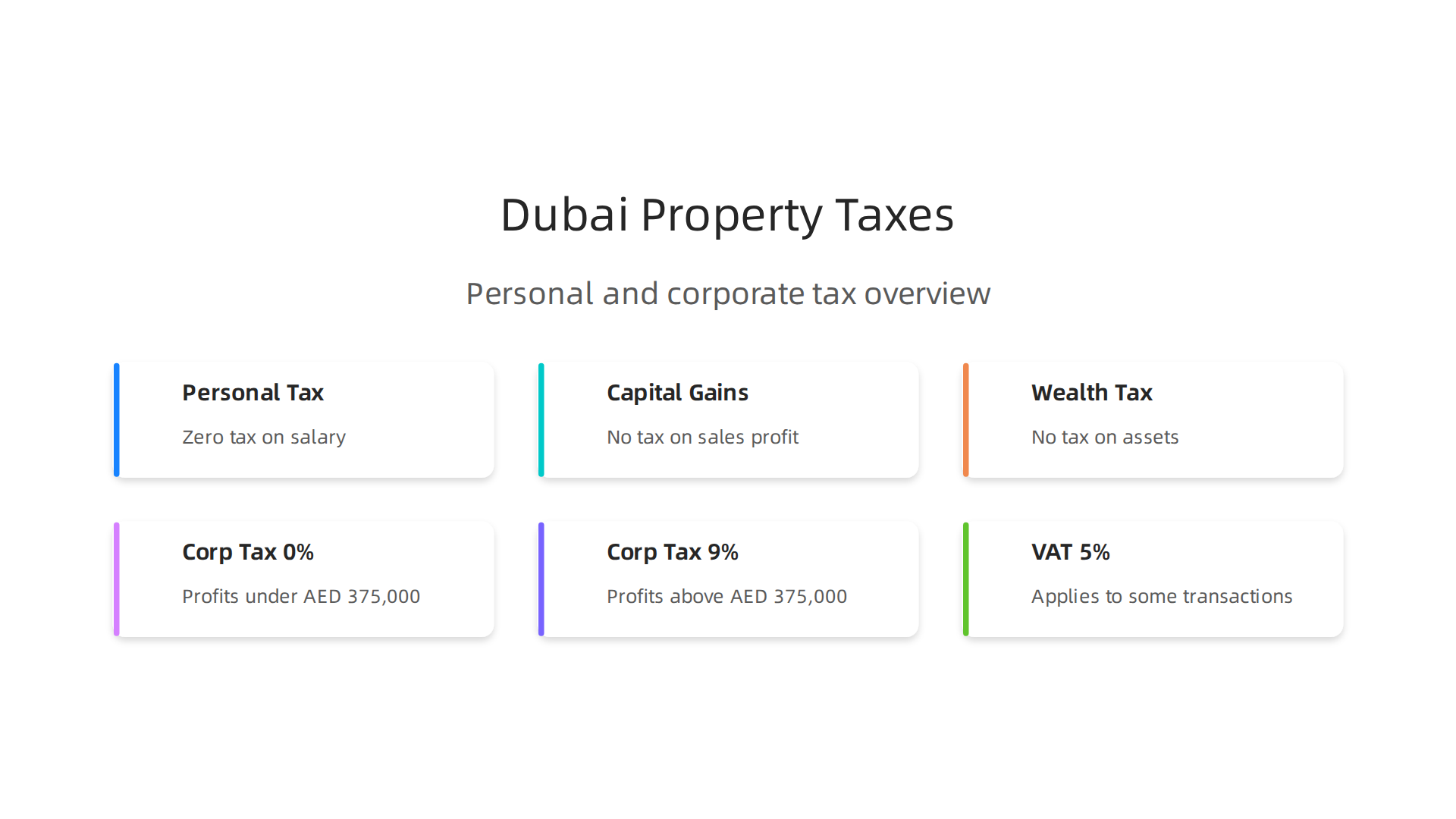
Here is the good news that attracts so many international buyers. Dubai still has no personal income tax. You pay zero tax on your salary or personal earnings. There is also no capital gains tax when you sell a property for profit. And there is no wealth tax on the assets you hold.
That is a huge advantage compared to cities like London, New York, or Singapore. In those markets, taxes can eat up 20% to 50% of your gains. In Dubai, the government keeps things simple on purpose.
But simple does not mean zero obligations.
If you own property through a business structure, you need to understand corporate tax. As outlined on the official UAE government site, the Corporate tax (CT) rules apply to companies. If your business makes taxable profits above AED 375,000, you pay 9% on the excess. Below that line, the rate stays at 0%. Many property investors structure their holdings as companies for liability or inheritance reasons. If that is you, this threshold matters.
You can find a deeper breakdown of rates and qualifying conditions in the UAE Corporate Tax Rates 2026 Explained overview. It covers who pays, who gets exemptions, and how free zone entities fit into the picture.
There is one more layer to track. Value Added Tax (VAT) applies at 5% to certain property transactions. If you buy a commercial property or rent out a residential unit, VAT may be due on the sale price or the rental income. This is not a profit tax. It is a consumption tax that you collect and pass to the government. But if you do not file correctly, you can end up paying penalties out of your own pocket.
The overall picture is this. Dubai gives you a clean tax slate in most personal scenarios.
The rules only get specific when you operate as a business or cross certain income thresholds. The smartest investors learn those thresholds early and plan around them.
Need help understanding which structure fits your situation? Check out our guide on mastering Dubai real estate business taxes for investment growth to see how tax rules affect your bottom line.
Key Business Expenses: What Property Investors Can Deduct
Now you know the tax rates. But here is where the real savings happen. When you run your property investments through a company, the government does not tax your total revenue. You only pay tax on your profit after you subtract legitimate business costs.
This is where understanding your taxes business expenses makes a direct difference to your bottom line.
So what counts as a deductible expense for a Dubai property company? The list is generous if you keep proper records.
Property management fees are a big one. If you hire a firm to handle tenants, collect rent, and deal with maintenance calls, that cost comes off your taxable income. The same goes for maintenance and repair costs. When you fix an AC unit or repaint a villa hallway, that expense reduces what you owe.
Mortgage interest on business properties is also deductible. If you took a loan to buy a rental building, the interest portion of your payments qualifies. Just keep the loan paperwork clean and tied to the property. Our guide on real estate investment property loans in Dubai rates and requirements explains the financing side in more detail.
Utility bills for your investment properties count too. DEWA charges, cooling fees, and water bills all reduce your taxable profit.
The list goes further. Marketing costs like photography, listing fees, and online ads are deductible. So are brokerage commissions you pay to find tenants or buyers. According to the latest guidance on real estate commission deductibility in UAE, these are fully allowable as long as they are directly related to your business.
Travel expenses matter too. If you fly to another emirate to inspect a property or meet a client, those transport costs can be claimed. Just keep receipts and link every trip to a specific business purpose.
One of the most powerful deductions is depreciation. You can claim the gradual wear and tear on the building structure itself over time. The land underneath is not depreciable, but the building is. This is a non-cash deduction that reduces your taxable income without costing you a single dirham out of pocket.
The key rule from the UAE corporate tax deduction rules is simple. Every expense must be incurred wholly and exclusively for your business. Personal costs mixed with business costs create problems. Keep separate accounts, track every receipt, and do not guess.
Getting this right is how smart investors turn a good return into a great one. If you want personalized guidance on your specific portfolio, reach out for a FREE Dubai Real Estate Consultation with Ayaz Salman.
For a deeper walkthrough on exactly how to document and claim these deductions step by step, check out our guide on how to claim business write-offs for taxes on Dubai property.
Non-Deductible Expenses and Common Tax Mistakes
Knowing what you can deduct is only half the picture. The other half is knowing what you cannot.
Plenty of property investors in Dubai lose money to audits because they claimed the wrong things.
So let us look at the expenses that do not count when you calculate your taxes business expenses.
Personal living expenses are the biggest trap. If you own a villa and live in part of it while renting out rooms, the costs tied to your personal living area are not deductible. You need to split the bills by square footage. The same goes for a car you use for both personal trips and property inspections. Only the business-use portion qualifies. Keep a mileage log to prove it.
Fines and penalties are also off limits. If the Dubai Municipality fines you for a building violation, or the RERA hits you with a late fee, those costs cannot reduce your taxable income. The FTA sees them as punishment, not business costs.
Capital expenditures work differently too. When you buy a new property or make a major upgrade like adding a swimming pool, you cannot deduct the full cost in one year. Instead, you depreciate it over time. This is a common mistake. Investors try to write off a big renovation as a repair, but the tax authorities classify it as an improvement. The difference matters. Repairs fix existing damage. Improvements add new value.
Entertainment costs also face restrictions. The UAE corporate tax rules limit how much you can claim for client meals, events, and hospitality. According to the detailed guidance on UAE corporate tax non-deductible expenses from PwC, entertainment deductions are capped at 50% of the total incurred.
Another frequent error involves VAT input tax. If you claim VAT refunds on costs that relate to personal use or non-business activities, the FTA will push back hard. The same applies to missing invoices. You cannot deduct any expense without a proper tax invoice from your supplier. A receipt from a corner shop will not cut it.
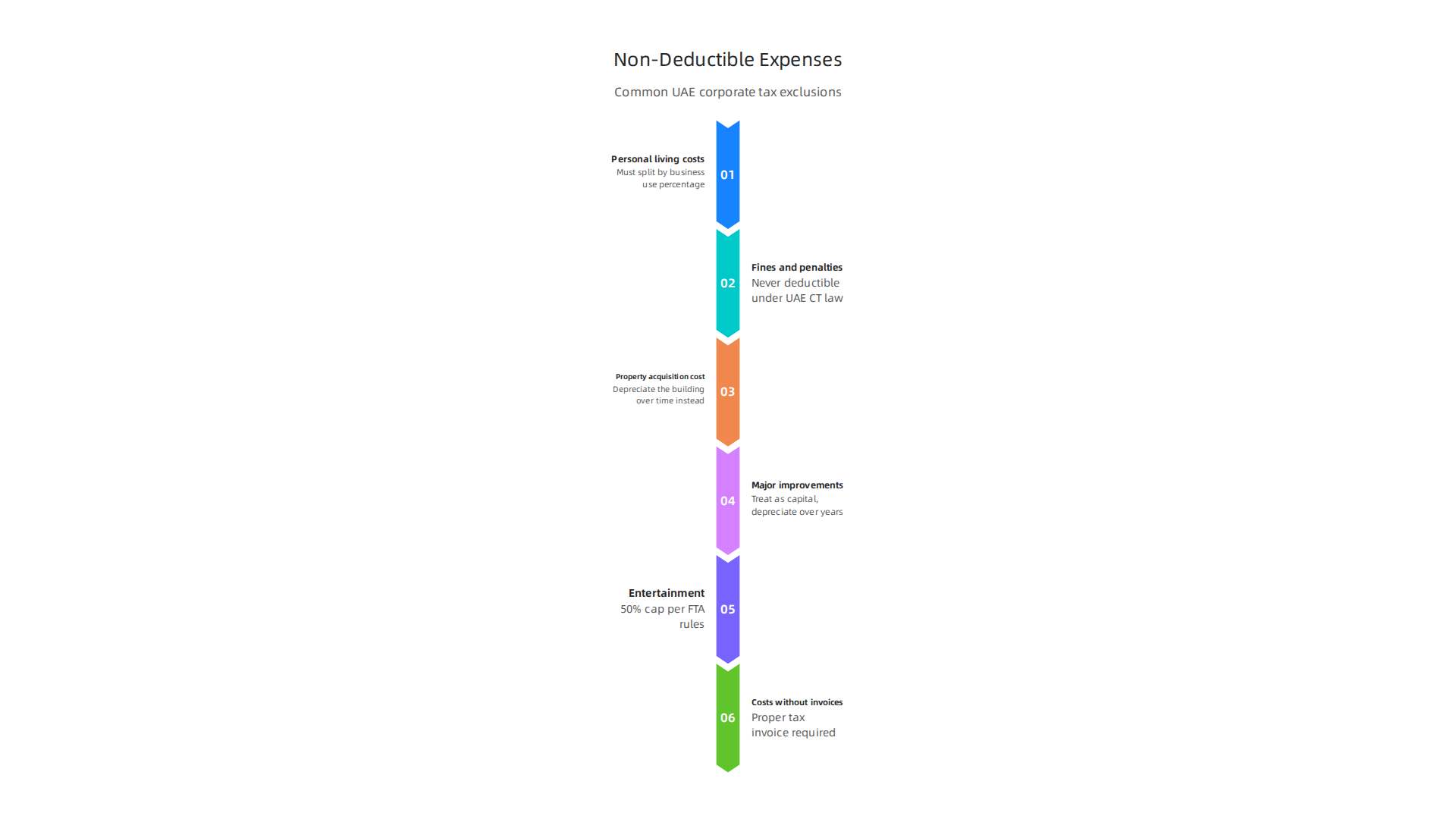
Here is a quick reference table to keep you on track:
| Expense Type | Deductible? | Key Rule |
|---|---|---|
| Personal living costs | No | Must split by business use percentage |
| Fines and penalties | No | Never deductible under UAE CT law |
| Property acquisition cost | No | Depreciate the building over time instead |
| Minor repairs | Yes | As long as they fix existing damage |
| Major improvements | No | Treat as capital, depreciate over years |
| Entertainment | Partial | 50% cap per FTA rules |
| Costs without invoices | No | Proper tax invoice required |
Mistakes in any of these areas draw attention from auditors. The FTA is actively reviewing filings in 2026, so accuracy matters more than ever. Our guide on how to file business taxes for your Dubai property company walks through the complete filing process with real examples.
Get this right and your taxes on business income stay low. Get it wrong and you could face penalties that wipe out your savings.
Record Keeping Best Practices for Tax Compliance
So you know what counts as a deductible expense and what does not. Good. But none of that matters if you cannot prove it to the tax authorities.
Your taxes business expenses only count if you have the paperwork to back them up. The Federal Tax Authority expects you to keep everything organized and available.
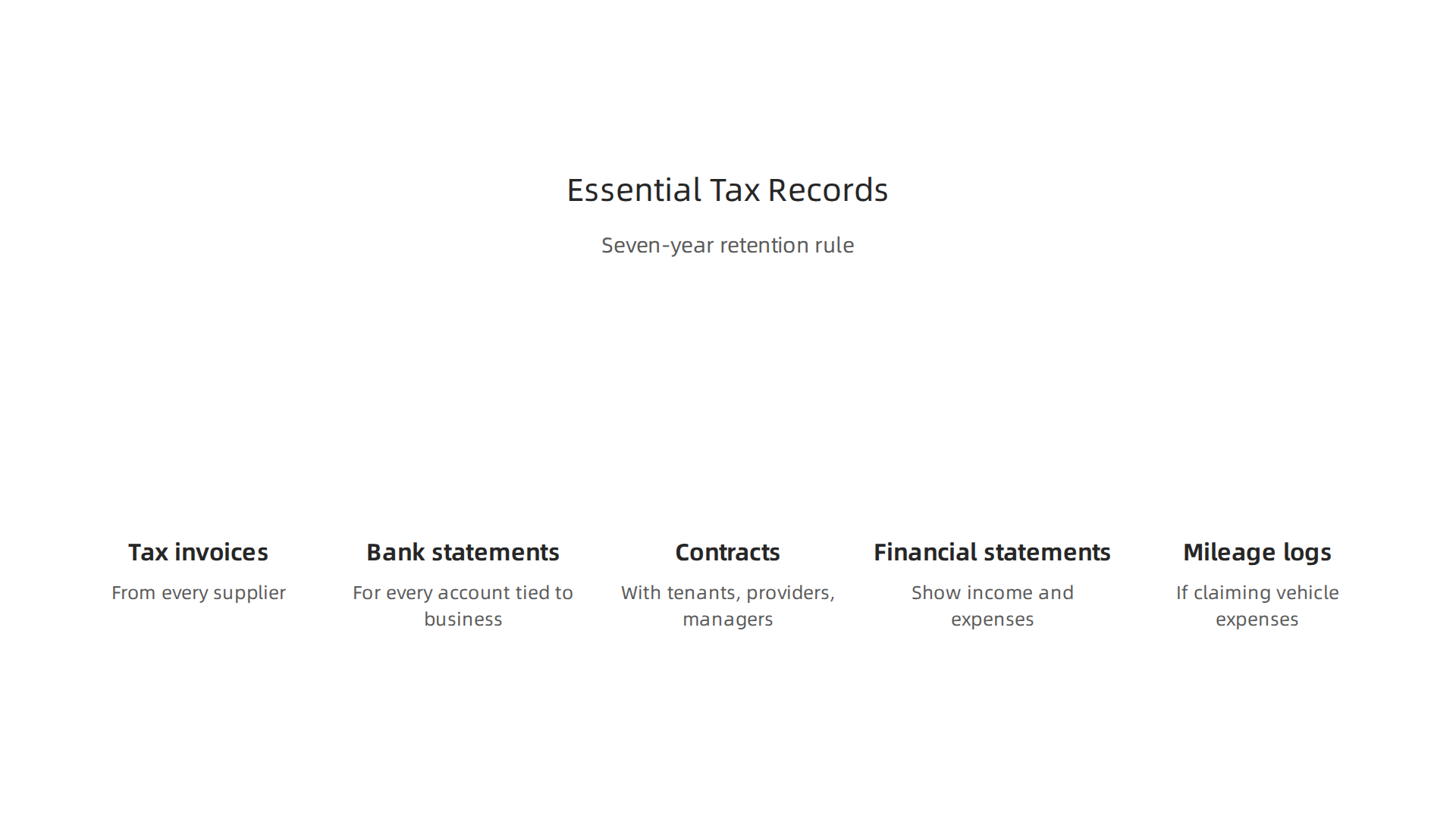
The FTA has clear rules on this. According to the corporate tax on rental income in Dubai 2026 guide from EGSH, you must keep all financial records, supporting documents, invoices, and contracts for seven years after the end of the relevant tax period.

Seven years is a long time. A shoebox full of crumpled receipts will not work.
Here is what the FTA wants you to keep:
- Tax invoices from every supplier. No invoice means no deduction for your taxes business expenses.
- Bank statements for every account tied to your property business.
- Contracts with tenants, maintenance providers, and property managers.
- Financial statements that show your income and expenses clearly.
- Mileage logs if you claim vehicle expenses for property inspections.
Digital record keeping makes this much easier. Using accounting software built for property investors helps you track everything in real time. Look into the best small business tax software for Dubai 2026 to compare tools that handle rental income, expense tracking, and tax calculations automatically.
Separate bank accounts are another smart move. Open a dedicated account for each property or investment entity you own. When all your rental income goes into one account and all expenses come out of the same one, your records stay clean. No mixing personal spending with business costs. No guessing which transaction belongs to which property.
This separation makes audit readiness simple. If the FTA ever asks to see your records, you hand them a clear folder with everything labeled and organized. No stress. No last-minute scrambling.
Get your record keeping right and your taxes on business income stay accurate year after year. Get it wrong and even valid deductions become impossible to claim.
Need help setting up your property investment records the right way? Connect with Ayaz Salman for a FREE Dubai Real Estate Consultation and get expert advice on keeping your tax filing smooth.
Understanding VAT on Rental Income and Property Sales
Record keeping is one piece of the puzzle. VAT is another. And it trips up a lot of property investors who are just getting comfortable with their taxes business expenses.
Here is the simple version. VAT rules for property in the UAE depend on the type of property and what you are doing with it.
Commercial rentals are subject to 5% VAT. If you own a shop, office, or warehouse that you rent out, you must charge your tenant 5% VAT on top of the rent. You collect that VAT and pay it to the FTA.
Residential rentals are exempt from VAT. When you rent out an apartment or villa, you do not charge VAT. Sounds easy, right? But here is the catch. Because residential rental is exempt, you cannot reclaim the input VAT you paid on costs like maintenance, repairs, or property management fees for that residential property.
This affects your income taxes business calculations in a real way. Say you spend AED 10,000 fixing up a residential unit and that includes AED 500 in VAT. You cannot get that AED 500 back from the FTA. That lost VAT becomes a true cost of doing business.
Property sales have their own rules. The first sale of a residential property within three years of its completion is zero-rated. Zero-rated means you do not charge VAT to the buyer, but you can still reclaim input VAT on costs related to the sale. After three years, the sale becomes exempt. Exempt means no output VAT, but also no input VAT recovery. That distinction matters a lot for calculating business taxes over the long term.
When do you need to register? You must register for VAT if your taxable supplies go over AED 375,000 in any 12-month period. This includes your commercial rental income and any zero-rated property sales. Once registered, you file returns and keep proper records.
The FTA requires VAT-registered businesses to hold onto records for at least five years, with longer periods for real estate. The complete Record Keeping for VAT guidelines explain exactly what the FTA expects.
Getting VAT right from the beginning keeps your taxes on business income accurate and your filings stress free. It also helps you plan which properties to buy and how to structure your sales.
If you want to see how VAT rules fit into the bigger picture of your portfolio, read more about how corporate tax affects property investment structures in Dubai.
Corporate Tax Registration and Filing for Real Estate Businesses
Once you have VAT sorted, the next big piece is corporate tax. And this is where many property investors get confused about their taxes business expenses. Let me break it down simply.
You must register for corporate tax if you are a taxable person. This includes property investment companies, real estate holding firms, and individual investors who operate through a business structure. The FTA requires all taxable persons to register and file returns. There are no exceptions for small portfolios.
Filing deadlines are firm. Your corporate tax return is due within nine months after the end of your financial year. If your financial year ends on December 31, your return is due by September 30 of the following year. Plan your record keeping accordingly. Late filing penalties add up fast, and the FTA has been enforcing them strictly in 2026. The latest UAE Corporate Tax Changes 2026 detail the current deadlines and penalty amounts.
Free zone entities get special treatment. If you hold your property through a free zone company, you may qualify for a 0% corporate tax rate on your qualifying income. To get this rate, you must be a Qualifying Free Zone Person (QFZP). That means maintaining adequate substance in the UAE, earning only qualifying income, and meeting all compliance requirements. The conditions for qualifying are specific, so checking whether your free zone company qualifies for 0% corporate tax is worth your time.
Non-qualifying income from your free zone entity gets taxed at the standard 9% rate. And if you earn income from residential property sales that are now exempt, that income falls outside the qualifying bucket.
Transfer pricing rules apply to your real estate business. If you transact with related parties — family members, affiliated companies, or connected entities — you must transact at arm’s length. That means the price, terms, and conditions must be the same as if you were dealing with an unrelated third party. This matters most when you buy or sell property between related entities or charge management fees within your group.
Proper transfer pricing documentation protects your taxes on business income calculations. Without it, the FTA can adjust your profits and impose penalties.
What does this mean for your day to day? Your expenses related to earning taxable income are generally deductible. This includes property management fees, maintenance costs, financing costs, and professional fees. But expenses related to exempt income — like residential rental activities — may not be fully deductible. That makes calculating business taxes more complex than a simple subtraction.
If you want to get your filing right the first time, working with an accountant for small business taxes who knows UAE real estate is a smart move.

They can help you structure your portfolio to minimize your overall tax bill while staying fully compliant.
For a complete walkthrough of the filing process, check out this detailed guide on how to file corporate tax and claim key deductions for your Dubai property investments.
Ready to get expert help with your Dubai property taxes? FREE Dubai Real Estate Consultation — Connect with Ayaz Salman for a free consultation on buying, selling, or structuring your real estate investments in Dubai.
Tax Planning Strategies for Off-Plan vs Ready Properties
The choice between off-plan and ready properties is not just about price and timing. It also affects your taxes business expenses in big ways. Here is how to plan for each scenario.
Off-plan investments give you more control over cash flow. You pay in staggered installments during construction instead of one lump sum. This helps with calculating business taxes because you can match your expenses to your payment schedule. If you buy the property for commercial use, you may also recover VAT earlier on each construction payment. Your accountant for small business taxes can help you time those VAT recovery claims correctly.
Ready properties offer immediate rental income. That is great for cash flow, but it changes how you handle income taxes business. You need to register for VAT quickly if your rental income crosses the threshold. And you must track your expense deductions carefully from day one. Maintenance costs, management fees, and financing charges all reduce your taxable income. But you can only deduct expenses related to taxable income. If the property earns exempt residential rental income, those deductions get restricted.
Free zone ownership can lower your tax bill on property profits. If you structure your property purchase through a free zone company, you may pay 0% corporate tax on qualifying income. This includes capital gains from selling the property and profit distributions. The rules for being a Qualifying Free Zone Person are strict, as explained in the guide on Corporate Tax in UAE Free Zone by Shuraa Tax. You must maintain real substance in the UAE and earn only qualifying income to keep that 0% rate.
The mix of exempt and taxable income changes your strategy. If you hold a ready property that produces exempt residential rent, that income does not count toward your taxable profits. But your related expenses become non deductible. So taxes on business income get calculated only on your commercial activities. A smart plan is to separate your residential and commercial properties into different legal entities. That way, your taxes business expenses stay clean and easy to track.
For a full breakdown of how different ownership structures affect your tax position, read this guide on how UAE corporate tax affects your Dubai property investment structure. It walks through each entity type and its tax outcomes.
Ready to plan your property tax strategy the right way? FREE Dubai Real Estate Consultation — Connect with Ayaz Salman for a free consultation on structuring your off-plan or ready property investments for maximum tax efficiency.
Working with Tax Advisors: When and Why to Seek Professional Help
Handling your own property taxes might feel doable at first. But once you mix off-plan payments, ready property rental income, and free zone rules, things get complicated fast. That is when you need a professional.
Get a tax advisor involved before you buy, not after. The best time to consult a qualified expert is when you set up your property investment entity. They can help you choose between a mainland company and a free zone setup. They will also guide you on how to structure your taxes business expenses so you get the most deductions from day one. A small mistake here can cost you thousands in missed savings.
VAT and corporate tax filings are not DIY tasks for large portfolios. If you own multiple properties, your calculating business taxes gets complex fast. Each property may have a different tax treatment. Some earn exempt residential rent. Others earn taxable commercial income. You need someone who can track all of it without errors. The Federal Tax Authority requires that registered tax advisors hold accredited qualifications. A guide on registered tax advisors in Dubai walks through what credentials to look for.
Advisors also protect you during audits and corrections. If you already filed your income taxes business incorrectly, a professional can help with voluntary disclosure to the FTA. They can represent you during audits and negotiate on your behalf. This is especially important if you made honest mistakes with taxes on business income that need fixing.
For a step-by-step guide on filing your yearly returns, read this breakdown on how to file business taxes for your Dubai property company. It explains exactly what documents you need and how to submit them.
Finding the right accountant for small business taxes in Dubai takes some research. Look for someone who has worked with property investors before.

Ask about their experience with off-plan transactions and free zone structures. A good advisor pays for themselves many times over.
Summary
This article explains how UAE corporate tax, VAT, and deduction rules affect Dubai property investors and real estate businesses in 2026. It shows that while individuals still pay no personal income or capital gains tax, companies face a 0% rate up to AED 375,000 and 9% above that, and certain property transactions attract 5% VAT. The guide details which business expenses are deductible—such as management fees, maintenance, mortgage interest, utilities, marketing, commissions, travel and depreciation—and which are not, including personal costs, fines, and capital expenditures treated as improvements. It stresses strict record-keeping (invoices, contracts, bank statements, mileage logs) and retention periods to survive FTA reviews, explains VAT registration and treatment for commercial versus residential rentals, and outlines filing deadlines and free zone rules. Practical planning tips cover structuring investments, off‑plan versus ready property considerations, and when to engage a tax advisor or accountant. After reading, you will know what counts as a deductible expense, how to document it, when to register or file, and how to reduce your tax bill legally.