
How to Claim Business Write Offs for Taxes on Dubai Property
· 29 min read

Introduction: Turn Your Property Expenses into Tax Savings
You have probably heard that Dubai is a tax-free paradise for property investors. And in many ways, that is true. Income from personal real estate investments is excluded from corporate tax. But there is a catch. If you run a property business things look different. When your activities require a business license, your company becomes subject to the UAE’s 9% corporate tax on profits above AED 375,000. That is clearly outlined in the latest UAE corporate tax rules for real estate businesses. So understanding business write-offs for taxes is not just smart it is essential.
Many property investors overpay or miss valuable deductions simply because they do not know what qualifies as a legitimate business expense. They assume there is nothing to worry about and never look for savings. But the truth is the UAE tax system allows you to deduct a wide range of costs related to generating income. Knowing these rules can turn your everyday property expenses into real tax savings.

This guide reveals the official expense categories and strategies backed by UAE corporate tax regulations for 2026. We cover practical tax mitigation strategies that help lower your taxable profit and keep more of your hard-earned money. Whether you own rental properties, manage a portfolio, or run a real estate agency, understanding how business and taxes work together in Dubai is key to long-term success.
For a step-by-step walkthrough on filing your returns, check out our guide on how to file corporate tax and claim deductions.
Ready to maximize your savings and get personalized advice? Connect with Ayaz Salman for a FREE Dubai Real Estate Consultation to review your specific property tax situation and uncover opportunities you might be missing.
Understanding the UAE Tax Landscape for Property Investors
Dubai’s tax system is not one size fits all. To claim the right business write-offs for taxes, you first need to know exactly where you stand. The UAE has three main tax layers that affect property investors.
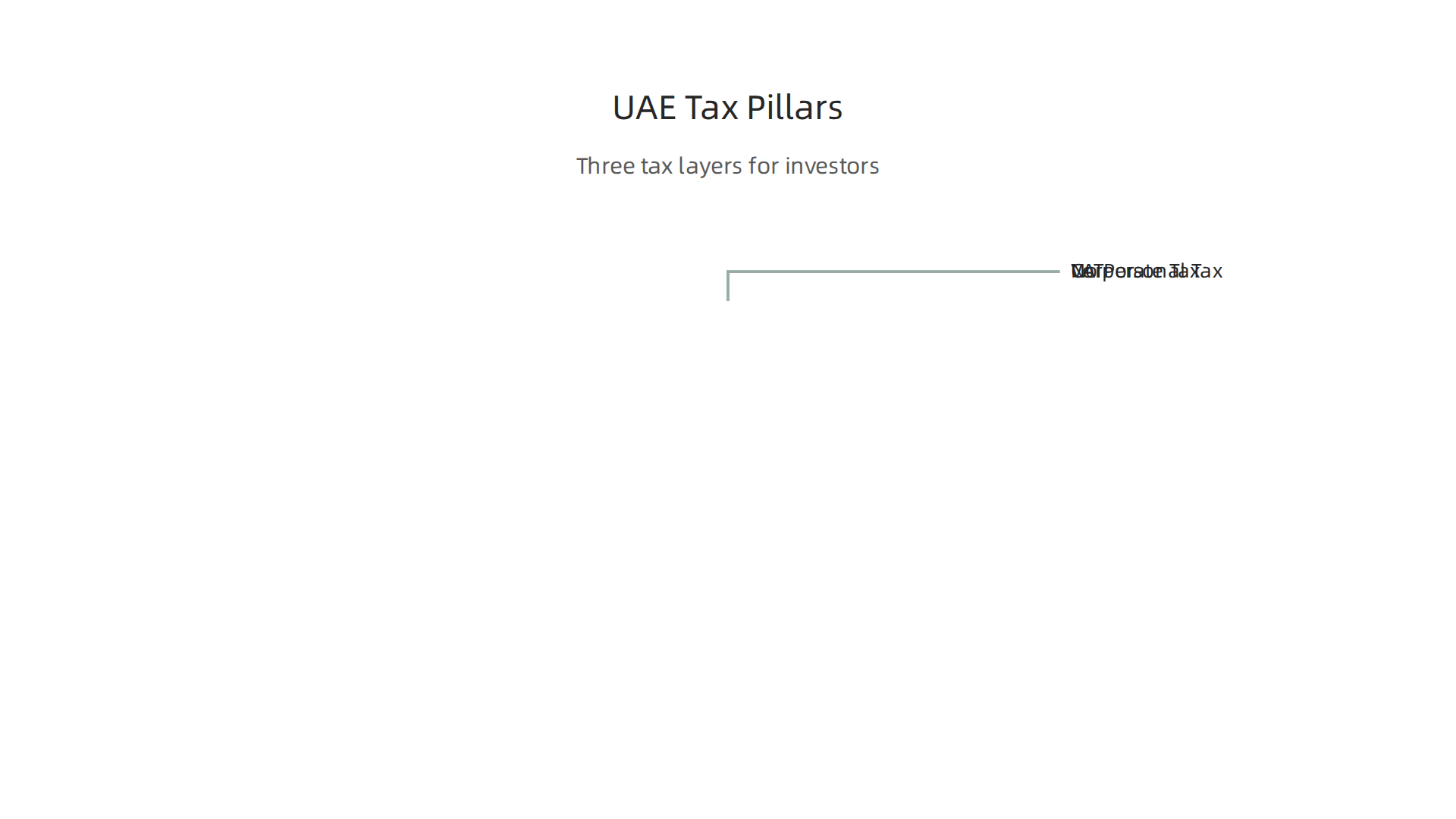
And each one works differently depending on your situation.
The Three Key Tax Pillars
1. No personal income tax. That is still true in 2026. If you own property personally and rent it out or sell it for a gain, you pay zero tax on that income. The UAE government confirms that personal real estate investment income is completely excluded from corporate tax. According to the UAE Real Estate Investment Income and Tax Liability guide, wages, personal investment income, and real estate investment income are all excluded as long as the activity does not require a business license.
2. Corporate tax at 9%. If your property activities require a business license, you fall under corporate tax. The rate is 9% on taxable profits above AED 375,000. For profits below that, the rate is 0%. This applies to real estate companies, property management firms, agencies, and any corporate entity holding income-producing property. The official Taxation of UAE real estate structures page makes this very clear.
3. VAT at 5%. Value Added Tax applies to many property transactions. The first sale of a new residential property within three years of completion is zero-rated. But commercial property sales and some rental activities are subject to the standard 5% rate. The UAE Real Estate Tax Guide 2026 explains these rules in detail.
Why Your Classification Matters
The Federal Tax Authority (FTA) draws a clear line between individual investors and business operators. If you are an individual, your rental income and capital gains are tax-free, and you do not need to worry about write-offs. But if you operate through a company, everything changes. Your company is a taxable person, and every expense that helps generate income becomes a potential deduction.
In many cases, even sole proprietors with a trade license fall into the corporate regime. The FTA requires businesses to register for VAT if their annual turnover exceeds AED 375,000. For corporate tax, the registration threshold is AED 1 million in revenue for individuals engaged in business activities. But remember, income from personal real estate does not count toward that threshold.
The Link to Write-Offs
The regime you are in directly controls which business and taxes deductions you can claim. Individuals with personal property cannot deduct expenses because their income is not taxable. Corporate entities, on the other hand, can deduct a wide range of costs. This includes maintenance, management fees, insurance, depreciation, and more.
Understanding this landscape is the first step toward smart tax mitigation strategies.

To dive deeper into how corporate tax rules affect your specific setup, check out this guide on how UAE corporate tax affects your property investment structure. It walks you through the key decisions you need to make.
Now that you know how the tax system is organized, the next section will list every deductible expense you can claim for your Dubai property business.
Top Deductible Business Expenses for Landlords
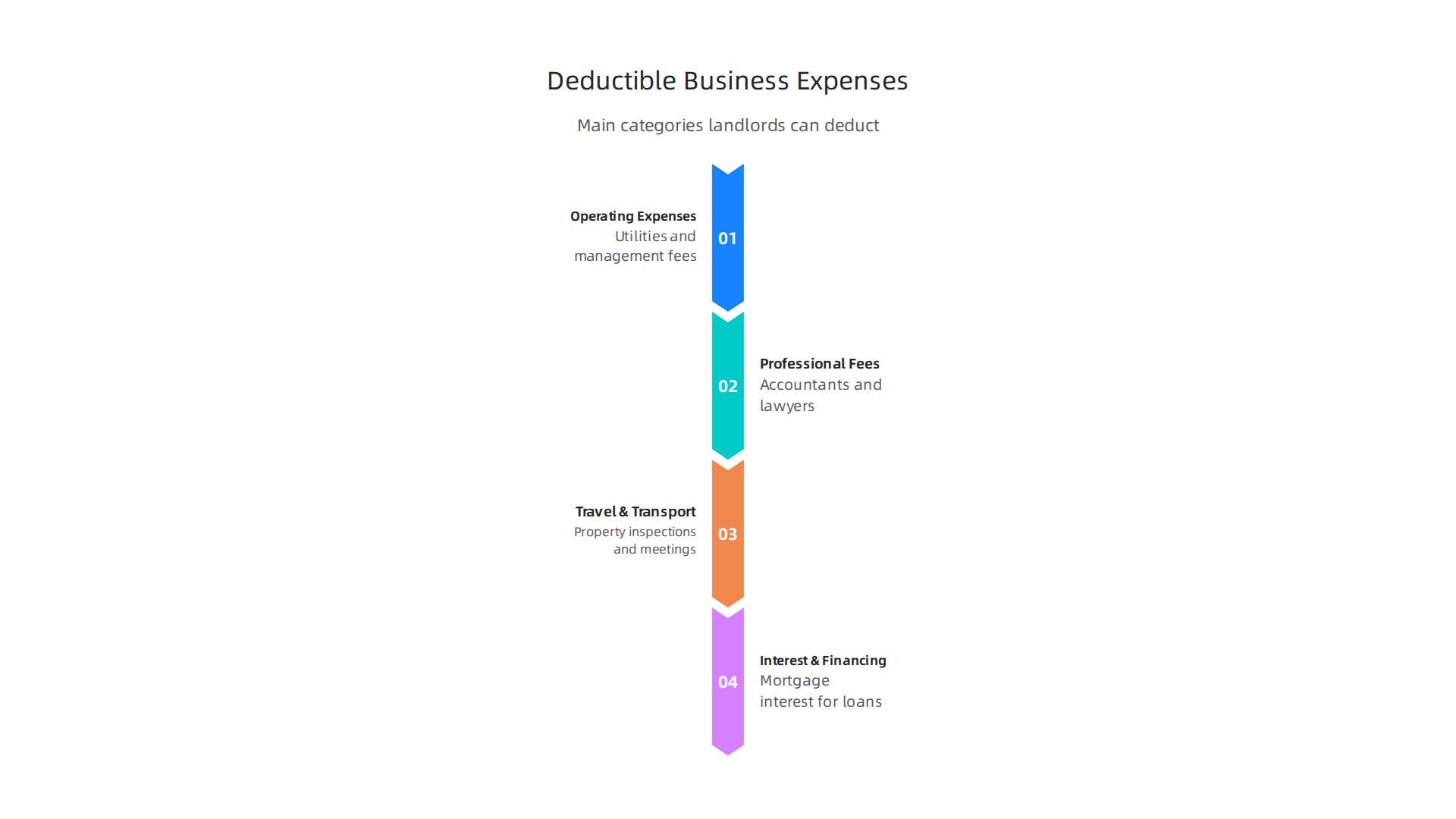
Now that you know how the tax system is organized, it is time to get into the specific costs you can actually write off. If you operate your property investment through a company, every expense that meets the UAE’s strict rules becomes a potential deduction. Here are the main categories you need to know.
Operating Expenses
These are the day-to-day costs of running your rental property business. They are fully deductible in the year you spend the money. The complete guide to 2026 Rental Property Business Expenses confirms that items like utilities, property management fees, HOA fees, advertising, cleaning, and maintenance all qualify for 100% deduction.
Think of these as the basics. If your company pays for electricity, water, or gas in a rental unit, that is deductible. If you pay a property management company to handle tenants and maintenance, that cost goes right off your taxable income too.
Professional and Legal Fees
You can deduct fees paid to accountants, tax preparers, lawyers, and property advisors. These professionals help you stay compliant and maximize your returns. The Guidelines for Taxable Income under UAE Corporate Tax Law makes it clear that professional services directly tied to your business are fully deductible operating expenses.
Travel and Transportation
If you travel to inspect your property, meet contractors, or visit tenants, those travel costs can be deductible. This includes flights, hotel stays, mileage when driving to your property, and even rental cars used for business purposes. Just remember, the trip must be directly related to your rental business. Personal side trips do not count.
Interest and Financing Costs
Mortgage interest is deductible, but only for loans used for business purposes. The UAE corporate tax law follows international standards here. According to the United Arab Emirates Corporate Deductions summary, net interest expense up to 30% of your tax-adjusted EBITDA is deductible. There is also an important threshold. If your net interest expense stays below AED 12 million, this restriction does not apply. That is helpful for many smaller property companies.
The Golden Rule: Wholly and Exclusively
Here is the most important rule to remember. Every expense you deduct must be incurred wholly and exclusively for your business. The UAE Federal Tax Authority is strict about this. If you use a property partly for personal purposes and partly for business, you can only deduct the business portion. You need to calculate that proportion on a fair and reasonable basis.
For example, if your company owns a villa that you also use for personal holidays, you can only deduct the costs that relate to the days it was rented out or used for business. Keep clear records of occupancy and usage.
How to Track Everything
A simple category system saves you a lot of headache during tax season. Set up separate accounts or spreadsheet categories for each type of expense. Track them monthly, not yearly. This makes filing your corporate tax return much smoother.
If you want a complete walkthrough of the filing process, check out this guide on how to file corporate tax and claim key deductions. It covers exactly what documents you need and how to report each deduction.
One More Tip on Allocation
If you co-own a property with someone else, make sure you allocate expenses correctly. Each co-owner can only deduct their share of the costs. The same applies if you own both personal and business properties. Keep separate books for each. This prevents mistakes during a tax audit.
If you need personalized help building a tax-efficient strategy for your Dubai property investments, you can book a FREE Dubai Real Estate Consultation with Ayaz Salman. He can walk you through the exact deductions that apply to your situation.
Maximizing Deductions on Travel and Vehicle Expenses for Property Inspections
One of the most practical business write-offs for taxes involves the travel you do to manage your rental properties. If you drive to a unit to meet a contractor, fly to another emirate to inspect a new acquisition, or take a taxi to handle an emergency repair, those costs are deductible. The connection between your business and taxes is simple: every trip with a clear business purpose reduces your taxable income. But only if you document it correctly.
Two Ways to Claim Vehicle Expenses
When you use your personal car for property inspections, the UAE tax law gives you two methods to claim deductions. Pick the one that works best for your situation.
Actual cost method: You track all vehicle expenses for the year. Fuel, insurance, registration, maintenance, and even depreciation are included. Then you calculate what percentage of your total kilometers were driven for business. If you drove 30,000 kilometers total and 8,000 were for property inspections, you deduct 27% of your total vehicle costs. This method requires more paperwork but can maximize your deduction if your car has high operating costs.
Per-kilometer rate method: The Federal Tax Authority approves a standard rate per business kilometer. You multiply your total business kilometers by that rate. No need to keep every fuel receipt. Just maintain a clean log of business trips.
Both methods are valid. The key is choosing one and using it consistently for the full tax year.
What About International Travel?
Landlords sometimes travel abroad for property-related business. Maybe you attend a real estate conference in another country to learn about market trends. Or you visit a manufacturer of building materials you plan to use in your Dubai units. These trips can qualify as deductible expenses.
The rule remains the same: the primary purpose must be business. If you attend a two-day exhibition and stay an extra five days for vacation, only the business portion is deductible. That includes flights, hotel costs during the conference days, and meals at 50% deductibility. The personal days stay out of your books.
To prepare for an audit, save every boarding pass, hotel invoice, conference badge, and meeting agenda. The Corporate Tax on Real Estate Investment for Natural Persons guide stresses keeping clear separate records for business and personal expenses. That same discipline applies to travel.
Building a Solid Travel Log
Without a written record, even a real business trip can be rejected by the FTA.

Here is what your log should include for each trip:
- Date and time of departure and return
- Exact destination and property address
- Business purpose (inspection, meeting, maintenance)
- Name of the person you met (if applicable)
- Kilometers driven or receipt amount
- Proof of payment
Update this log on the day of the trip. A simple spreadsheet in your phone or a dedicated mileage tracking app works well. Do not wait until tax season to reconstruct your trips.
For a complete system that covers all your property tax deductions, take a look at this guide on mastering Dubai real estate business taxes for investment growth. It walks you through record keeping, filing, and maximizing every legal deduction.
Smart Tax Mitigation Strategies for Travel
One simple tax mitigation strategies move is to group multiple property visits into a single trip. If you own units in three different areas, plan a route that hits all of them in one day. You claim one round of mileage instead of three separate trips. This cuts down your paperwork and keeps your logs clean.
Another tip: if you co-own a property, agree on who claims the travel costs. Each co-owner can only claim their own share. Splitting trips properly avoids confusion during an audit.
The most important thing to remember about taxes business operations in the UAE is that the rules reward organization. When you pair a clear travel log with the right deduction method, you create a solid, defensible claim. And that is exactly the kind of business write-offs for taxes that keeps your property company running profitably.
Legal, Professional, and Advisory Fees as Deductible Expenses
Beyond the travel costs you claim for property inspections, there is another big category of business write-offs for taxes that many landlords overlook. The fees you pay to professionals who help you run your rental business are fully deductible. And that can add up to serious savings each year.
Think about the people you hire. Lawyers who review your lease agreements. Accountants who prepare your corporate tax return. Property consultants who advise on market rents. RERA-registered agents who find qualified tenants. Every single one of these experts costs money. But under UAE tax law, those costs reduce your taxable income. So you are not paying for advice with after-tax dollars. You are paying with pre-tax money.
This is one of those places where business and taxes work together in your favor. The more you invest in getting the right guidance, the more you can save on your final tax bill.
Which Professional Fees Qualify?
Almost any fee paid to a licensed professional for a service related to your property business is deductible. Here are the most common ones:
- Legal fees for drafting or reviewing tenancy contracts
- Accounting fees for preparing financial statements and tax filings
- Property management fees paid to RERA-registered firms
- Consultation fees for market analysis or investment strategy
- Fees for valuation reports required by banks or regulators
- Costs of engaging a quantity surveyor for depreciation schedules
One specific area that surprises many landlords is tenant dispute costs. If a tenant stops paying rent or damages your unit, you may need a lawyer to handle the eviction. Those legal fees are deductible because they protect an income-producing asset. The same goes for any court filing fees or mediation costs. The key is that the expense must be tied directly to your rental business.
Professional accountants can help you navigate complex tax rules, such as the depreciation rules covered in the 2025 UAE Depreciation Guide. That kind of expert advice is itself a deductible expense.
Can You Recover VAT on Professional Fees?
This is where things get interesting. If you are registered for VAT in the UAE, you can often reclaim the VAT charged on professional fees. For example, if your accountant charges you AED 1,000 plus AED 50 VAT, you can deduct the AED 1,000 as an expense AND reclaim the AED 50 from the Federal Tax Authority. That means the net cost to you is even lower.
But you must have a valid tax invoice from the service provider. The invoice must show their VAT registration number, your details, and the VAT amount clearly. Without that document, the FTA will not allow the recovery.
Keeping Records for Professional Fees
As with every other deduction, documentation is everything. Save every invoice and receipt. Note the date, the service provided, and how it connects to your property business. If you later face an audit, you will need to show that each fee was for a genuine business purpose.
For a full walkthrough of how to organize your deductible expenses and file correctly, check out this guide on how to file business taxes for your Dubai property company. It covers exactly what records you need and how to claim every legal deduction.
A Smart Tax Mitigation Strategies Move
Here is a simple way to make professional fees work harder for you. Instead of paying for advice out of pocket, plan your professional engagements at the start of the tax year. Set a budget for legal and accounting services. That way, you know exactly how much you will spend, and you can time your payments to maximize your deductions in the current year.
Another tip: if you co-own a property with a partner or family member, agree on who will pay the professional fees and claim the deduction. Only the person who actually pays the bill can deduct it. Clear agreements prevent confusion and ensure you both get the full benefit.
When you view professional fees not as an expense but as an investment in your taxes business health, you start making smarter spending decisions. Every dirham you pay to a qualified advisor should bring you at least one dirham back in tax savings or better business outcomes.
Get Expert Help With Your Property Taxes
The rules around deductible fees can get complicated, especially when you add VAT recovery and multi-property structures. Working with someone who knows Dubai real estate tax inside and out makes a big difference.
For personalized guidance on which fees to deduct and how to structure your tax filings, consider a FREE Dubai Real Estate Consultation with Ayaz Salman. He can review your specific situation and point you toward the best business write-offs for taxes for your portfolio.
Depreciation and Capital Allowances on Rental Property
Here is one of the most powerful business write-offs for taxes that many Dubai landlords never use. Depreciation. It lets you deduct the gradual loss in value of your building and its contents over time. The best part? You do not spend any actual cash to claim it. It is a non-cash expense that reduces your taxable profit.
Think about it this way. Buy a rental property for AED 2 million. Every year, that building wears down a little. The paint fades. The plumbing ages. The roof gets older. The UAE tax system lets you deduct a percentage of the original cost each year as a way to account for that wear and tear.
How Much Can You Depreciate?
For buildings used in your rental business, the standard depreciation rate is 4% per year using the straight-line method. That means you deduct 4% of the original building cost every year for 25 years. This rate applies to both residential and commercial investment properties under the Federal Tax Authority rules. As per the fixed asset depreciation rate in the UAE, the rate for buildings generally falls between 2.5% and 5% yearly. But for tax purposes in 2026, the clear benchmark is 4%.
Now here is where smart tax mitigation strategies kick in. You can also depreciate the furniture, fixtures, and equipment inside your rental unit. Those items wear out much faster than the building itself. The UAE tax rules allow higher rates for these assets.
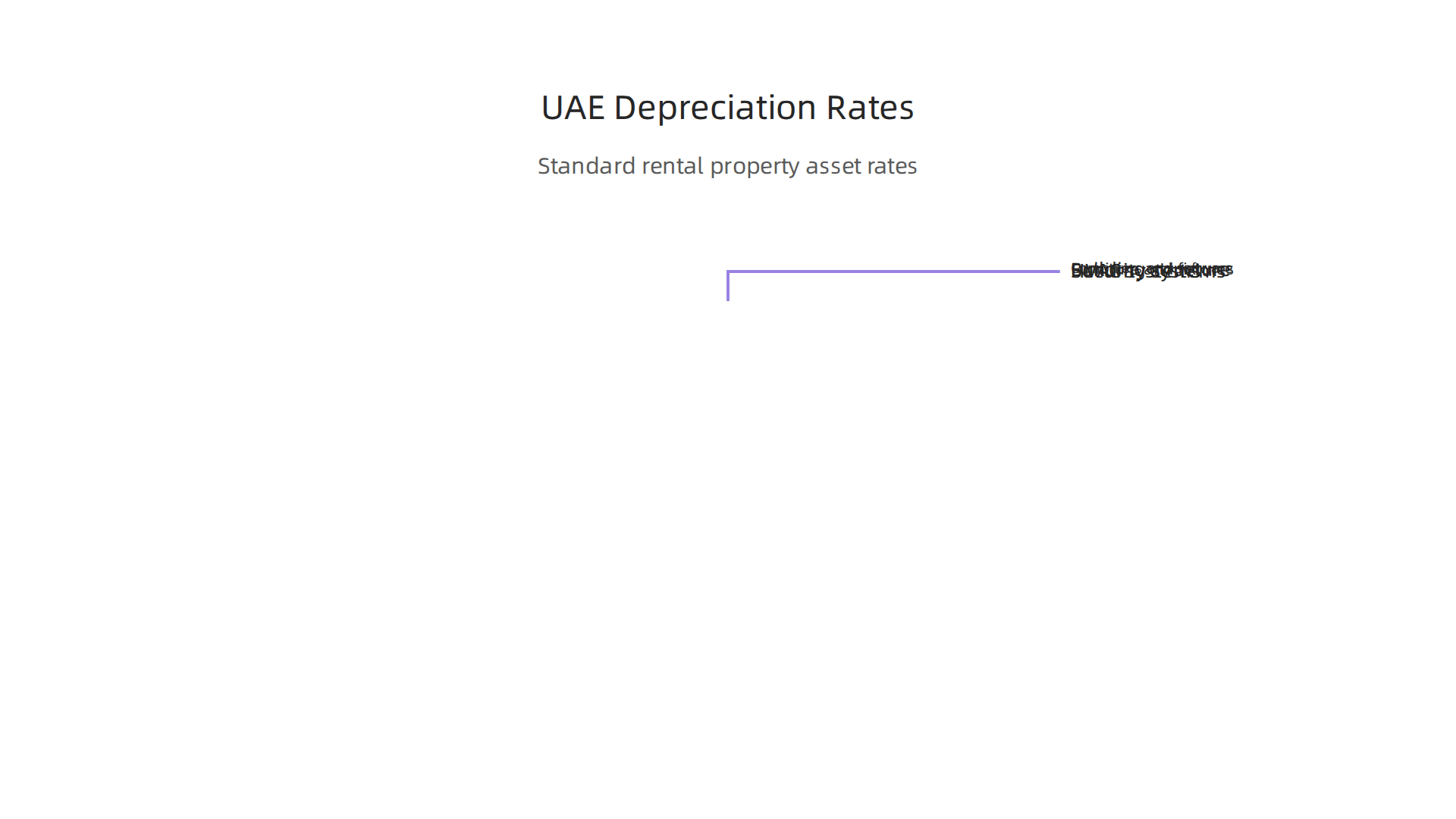
Common rates include:
| Asset Type | Depreciation Rate per Year |
|---|---|
| Building structure | 4% |
| Furniture and fixtures | 10% |
| HVAC systems and elevators | 10% to 15% |
| Security systems and cameras | 15% to 20% |
| Computers and software | 33.3% |
The Ministry of Finance issued specific guidance on these rates. To see the full official table, you can check the detailed breakdown of depreciation rates under UAE tax rules.
Capital Allowances for Big Installations
Some of the biggest deductible items are the systems that make your property livable. Things like central air conditioning, elevator upgrades, fire safety systems, and security cameras. These are called capital allowances. You claim them over the useful life of the asset, not all at once.
For example, if you install a new AED 50,000 HVAC system in your rental building, you can deduct AED 5,000 to AED 7,500 each year depending on the rate. That adds up fast across multiple properties.
FTA Rules You Need to Know
The FTA recently introduced a key rule under Ministerial Decision No. 173 of 2025 for investment properties held at fair value. If you elected the realization basis for your investment properties, you can now claim tax depreciation even if you do not record depreciation in your accounting books. The deduction each year is the lower of 4% of the original cost or the tax written down value at the start of the period. This change makes depreciation one of your most valuable taxes business tools. For a deeper look at this rule, read the full analysis of the new tax depreciation rules for investment properties.
Planning Your Depreciation Claims
You need a qualified quantity surveyor or accountant to prepare a depreciation schedule.

They will separate the building cost from the land value (land never depreciates) and list every asset with its correct useful life. Once you have that schedule, you simply apply the rate each year.
One more tip: if you are starting your property business now, track every cost from day one. The original cost of the building and all installations is your starting point for depreciation. Good records now mean bigger deductions later.
For a complete guide on structuring your property business to claim every deduction, check out how to master Dubai real estate business taxes for investment growth. That guide walks you through the full process of organizing your finances around the tax rules.
Depreciation is not complicated once you understand the rates. It is simply a matter of knowing what you own and applying the correct percentage. Use it well, and it becomes a steady annual deduction that keeps your tax bill low year after year.
Record Keeping and Compliance for Smooth Tax Filings
Now that you know how to claim business write-offs for taxes through depreciation, you need solid records to back every number. Without proper documentation, even a legitimate deduction can get rejected during an audit. The Federal Tax Authority has clear rules on what you must keep, and for how long.
FTA Record Keeping Requirements
The FTA requires you to keep all tax-related records for at least 5 years. This includes invoices, contracts, bank statements, receipts, and anything else that supports your income or deductions. If you file a tax return and later get audited, those records are your only proof.
The time frame starts from the end of the relevant tax period. So if you file for 2025, keep those documents until at least 2030. The IRS recordkeeping guidelines recommend a similar approach for US taxpayers, and the same logic applies here.

Good records protect you.
Here is what you need to hold onto:
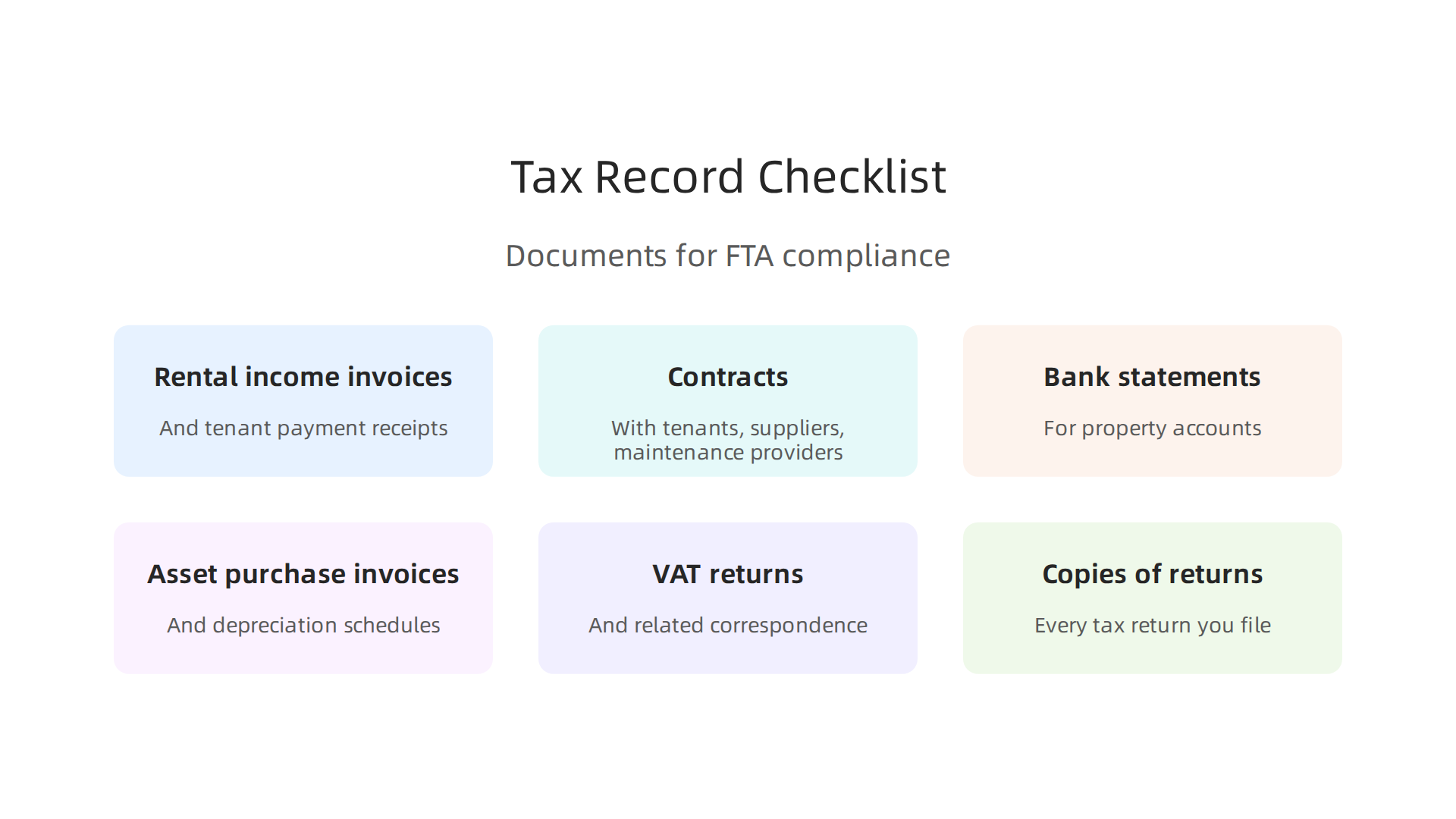
- All rental income invoices and tenant payment receipts
- Contracts with tenants, suppliers, and maintenance providers
- Bank and credit card statements for your property accounts
- Asset purchase invoices and depreciation schedules
- VAT returns and related correspondence
- Copies of every tax return you file
Keep digital copies in a secure cloud system. Paper receipts fade and get lost. Digital files are easier to back up and search.
Digital Accounting Tools Reduce Mistakes
Manual record keeping leads to errors. You forget receipts. You miss deadlines. You mix up numbers. The best way to stay compliant is to use accounting software that tracks everything automatically.
Many tools designed for property investors let you link your bank accounts, scan receipts, and generate expense reports in seconds. Some even calculate VAT and corporate tax for you. These tools turn a messy pile of paper into clean, audit-ready records.
If you manage multiple properties, a good software system saves hours each month. It also helps you spot deductions you might have missed. For a step by step guide on organizing your business finances, check out how to file business taxes for your Dubai property company. That walkthrough shows you exactly how to set up your books for compliance.
Common Compliance Pitfalls to Avoid
Even experienced landlords slip up in a few areas. Watch out for these:
Mixing personal and business expenses. This is the number one mistake. If you use your personal bank account for property income and expenses, the FTA will struggle to separate your personal life from your taxes business activities. Open a separate business account. Use a dedicated credit card for property costs. Keep everything clean.
Missing VAT filing deadlines. If your rental income exceeds AED 375,000 per year, you must register for VAT and file returns regularly. Late filings lead to penalties. Set calendar reminders or use software that alerts you.
Not keeping supporting documents for major deductions. Remember that AED 50,000 HVAC system from the depreciation section? The FTA will want to see the invoice, the installation contract, and the payment proof. Without those, the deduction disappears.
Ignoring record retention after selling. Even after you sell a property, keep the records for 5 more years. The FTA can audit older returns if they find discrepancies.
A strong record keeping system is the backbone of every tax mitigation strategies plan. Without it, your deductions are just numbers on a page. With it, you sleep well knowing every claim is backed by evidence.
Get Expert Help When You Need It
Managing Dubai property taxes can feel overwhelming, especially with changing rules and multiple properties. You do not have to figure it out alone. Getting a free Dubai real estate consultation helps you set up a system that works for your portfolio. An expert can review your records, find missing deductions, and keep you compliant with FTA rules. One conversation can save you thousands in penalties and missed write-offs.
Home Office Deductions for Property Investors
One tax write-off that many property investors miss is the home office deduction. If you use part of your home regularly and only for your property management work, you can deduct a portion of your housing costs. This is a smart way to lower your tax bill without leaving your house.
What Qualifies as a Home Office
The rule is simple. You must use the space regularly and exclusively for business. The dining table where you also eat breakfast does not count. But a spare bedroom that you turned into an office with a desk and filing cabinet probably does.
You do not need a whole room. A clearly defined corner works as long as it is used only for business. The FTA wants to see that the space has a business purpose.
What You Can Deduct
If you qualify, you can deduct a portion of these costs:
- Rent or mortgage interest
- Electricity, water, and gas
- Internet and phone service
- Property insurance
- Repairs for the office area
- Cleaning supplies for the office
The amount you deduct depends on the size of your office compared to your home. If your office takes up 10 percent of the total floor area, you deduct 10 percent of those shared expenses.
Here is a quick example. Say your annual rent is AED 120,000 and your office is 10 percent of the home. That gives you AED 12,000 in rent deductions. Add utilities and internet, and the savings grow quickly.
The Simplified Method
The FTA also allows a simpler approach. Instead of calculating percentages for every bill, you can claim a flat rate. In many cases, this rate is AED 5,000 per year. Check with the FTA or a tax advisor to confirm the current amount.
The simplified method saves you time and reduces paperwork. The tradeoff is that you may end up with a smaller deduction than if you calculated everything. For many property investors, the time saved is worth it.
Either way, you must keep records showing you use the space for business. Photos of the office, a floor plan with measurements, and copies of utility bills are enough. Following the IRS recordkeeping guidelines gives you a clear system for what to keep and for how long.
How This Fits Into Your Overall Tax Strategy
The home office deduction is one piece of a bigger picture. It works alongside other write-offs like depreciation, maintenance costs, and professional fees. Learning about all your deductible expenses helps you build a complete tax plan. You can find a full rundown of what qualifies in this guide on Dubai property tax deductions.
If you manage your properties from home, this deduction could save you thousands of dirhams each year. But you need to set up your space properly and keep good records.
Not sure whether your setup qualifies? That is a common question. The safest move is to get advice that fits your specific situation. A free Dubai real estate consultation with an expert can show you exactly which deductions apply to your portfolio. One call can help you decide between the simplified method and the actual calculation.
Understanding VAT and Service Charge Deductions
Another important area of business write-offs for taxes involves VAT and service charges. If you are a VAT-registered property investor, you can reclaim the VAT you pay on many property expenses. This is a straightforward way to lower your overall costs.
What VAT Can You Reclaim?
The Federal Tax Authority (FTA) allows you to recover the 5% VAT you pay on certain business expenses. These include maintenance work, property management fees, real estate agent commissions, and professional services. As long as you hold a valid tax invoice and the expense relates to your taxable business activities, you can claim that VAT back.
For example, say you pay AED 10,500 to a maintenance company. The breakdown is AED 10,000 for the work and AED 500 for VAT. You can reclaim that AED 500 through your VAT return.
This rule works well for commercial property investors. But the story changes for residential rentals.
Service Charges and VAT
Service charges are the fees you pay to an owners’ association for the upkeep of common areas, security, landscaping, and other shared services. The VAT treatment depends entirely on the property type.
- For residential properties, service charges are VAT-exempt. That means no VAT is added to your bill, but you also cannot reclaim any VAT on those charges.
- For commercial properties, service charges carry 5% VAT. You can reclaim that VAT as input tax if you are VAT-registered and the property supports your taxable business.
The rule is clear. A detailed breakdown of the interaction between VAT and service charges confirms that residential service charges are exempt, while commercial service charges are subject to 5% VAT, as explained in this 2026 guide on VAT and Service Charges: How They Interact 2026.
Input VAT Recovery Restrictions
Here is the most important rule. You can only recover input VAT on expenses that relate to making taxable supplies. If you make exempt supplies, you cannot recover the VAT.
Residential rental income is exempt from VAT. So if you lease a residential apartment, you cannot reclaim the VAT on your related costs like agent fees, repair bills, or service charges. That VAT becomes a real cost to your business.
On the other hand, commercial property rentals are taxable at 5%. A VAT-registered landlord can recover the VAT on nearly all expenses linked to that property, including maintenance, utilities, and professional fees.
A comprehensive overview of VAT in the UAE real estate sector explains that if you make exempt supplies like leasing a residential apartment, you cannot recover the input VAT on related costs. That VAT becomes a cost you must absorb.
Recordkeeping Matters
You need proper documentation to claim any VAT recovery. Keep valid tax invoices with the seller’s Tax Registration Number (TRN), the property details, and the VAT amount clearly listed. Also keep proof of payment and your VAT return records.
The FTA expects you to keep these records for a long time. Good recordkeeping protects you during audits and ensures you claim every dirham you are owed.
For a complete look at how to handle all your tax filings, check this guide on how to file business taxes for your Dubai property company. It covers the steps from registration to final return.
VAT recovery is a powerful tool in your tax strategy. But it only works when you understand the rules between taxable and exempt supplies. A small mistake can cost you money, so get the details right from the start.
Conclusion: Turn Knowledge into Savings – Next Steps for Investors
You now have a solid understanding of the top business write-offs for taxes available to Dubai property investors. Let us recap the key points quickly.
The biggest deductions come from mortgage interest, property management fees, maintenance costs, and agent commissions. You also have the DLD transfer fee, service charges, utilities, insurance, and professional fees. Every dirham you spend running your property business can reduce your taxable profit.
But knowing what to deduct is only half the battle. The other half is getting the timing and documentation right. A guide on how to reclaim VAT on commercial property shows that claiming input VAT in the correct tax period is critical. If you miss the window or fail to keep a valid invoice, you lose that recovery permanently.
Here is the bottom line. The rules around business and taxes in Dubai are clear, but they are also detailed. One small mistake in categorizing an expense or recording a VAT invoice can cost you real money.
That is why professional advice matters. This guide gives you a strong foundation. But every investor’s situation is different. Your property type, your VAT registration status, your financing structure, and your business setup all affect which tax mitigation strategies work best for you.
A tax advisor who knows Dubai real estate can help you build a personalized plan. They can review your records, spot missed deductions, and keep you compliant with the FTA and the corporate tax rules.
Taking action on your taxes business strategy is the smartest move you can make this year. Do not leave money on the table.
If you want to explore how these write-offs apply to your specific portfolio, connect with Ayaz Salman for a FREE Dubai Real Estate Consultation. A quick conversation can turn what you learned today into real savings for your business.
Summary
This guide explains how Dubai property investors can convert everyday property costs into legitimate tax savings under the UAE corporate tax and VAT rules for 2026. It walks you through the three-tier tax landscape (no personal income tax, 9% corporate tax above AED 375,000, and 5% VAT), which determines whether you can claim business write-offs. The article lists deductible categories—operating costs, professional fees, travel, interest, depreciation and capital allowances—and explains practical rules like the FTA’s