
Dubai Property Tax Optimization Strategies to Keep More of Your Rental Income in 2026
· 19 min read

Introduction: Why Tax Planning Matters More Than Ever for Dubai Property Investors
Dubai has a reputation that draws investors from around the world. No personal income tax. No capital gains tax. A booming property market that keeps delivering strong returns.
It sounds like a dream, right?
Here’s the thing. That zero percent headline is real, but it is not the whole story. Investors who jump into Dubai real estate without understanding the full picture often leave money on the table. Sometimes a lot of money.
The UAE now has a 9 percent corporate tax on profits above AED 375,000 for businesses that own property. VAT applies to commercial real estate transactions. Transfer fees, registration costs, and compliance requirements all eat into your returns if you are not careful.
In 2026, the rules are more complex than ever. The Federal Tax Authority has sharpened its focus on real estate structures. Free zone rules have changed. Even family offices face new scrutiny under the latest UAE corporate tax legislation updates.
This is why having smart tax optimization strategies in place is not optional anymore. It is essential.
The investors who win in Dubai are the ones who plan ahead.

They understand how to structure their ownership, track their expenses, and time their transactions. They do not wait until tax season to think about their numbers.
This guide brings together the latest regulatory updates and proven planning tax strategies that actually work for Dubai property investors. You will learn how to protect your profits, avoid costly mistakes, and keep more of what you earn.
Whether you own one apartment or a whole portfolio, the choices you make about how you hold and manage your property directly affect your bottom line.
And yes, the right approach can save you thousands of dirhams every year.
Let us start with something that trips up even experienced investors. The first step is understanding how the tax authority actually looks at your property income and what that means for the way you structure your investments.
Understanding Dubai’s Tax Framework for Property Investors in 2026
Let us break down exactly what you are dealing with as a property investor in Dubai right now.
The biggest reason people invest here is the tax advantage. And that advantage is still very real. But the picture has layers you need to understand.
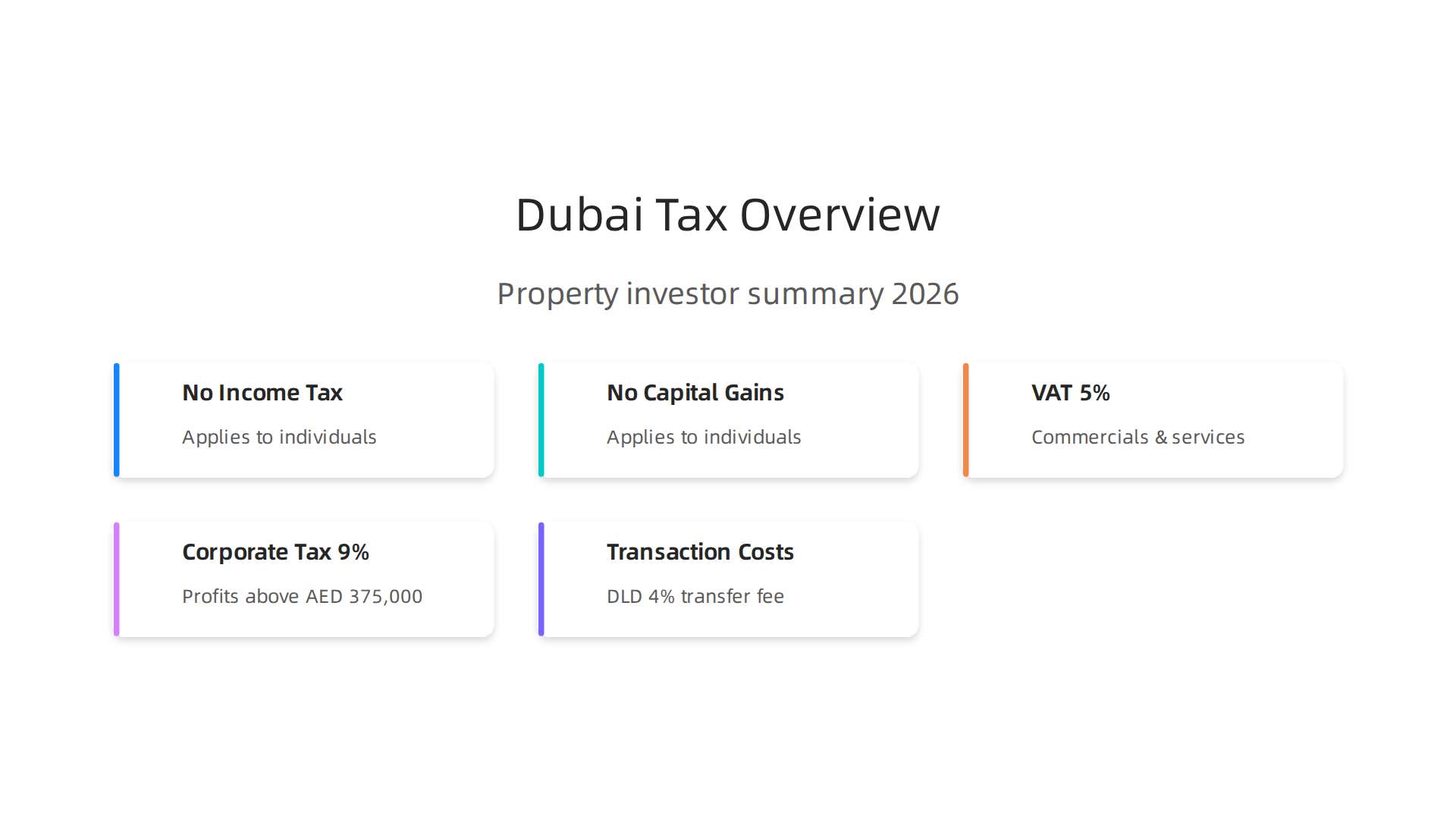
No income tax. No capital gains tax. That part is straightforward. When you earn rental income from a personally held property, the government does not take a cut. When you sell that property for a profit, same thing. Zero capital gains tax. This is the foundation of Dubai’s appeal, and it has not changed.
But here is where investors get confused.
Value Added Tax (VAT) at 5 percent applies to commercial properties and certain property-related services. If you own a commercial unit like an office or a retail space, VAT is part of the transaction. Residential property rentals are generally exempt, but the services around property management, brokerage fees, and maintenance contracts often carry VAT. You need to track these carefully because they affect your real costs.
Corporate tax at 9 percent is the big change that most investors are still trying to fully understand. According to the latest guidance on navigating UAE corporate tax for real estate, taxable profits above AED 375,000 on property held by a UAE tax resident company are subject to this rate. That means if you own your property through a company, which many investors do, the first AED 375,000 of profit is tax free. Everything above that is taxed at 9 percent.
The important thing is that this applies to the business entity, not to you personally. So an individual holding property directly still pays nothing. But a holding company, a family office, or a property management business needs to comply.
Transaction costs are the hidden tax you cannot ignore. The Dubai Land Department charges a transfer fee of 4 percent of the property value. Plus registration fees. These are one-time costs at purchase, but they are significant. For a AED 2 million property, that is AED 80,000 right off the top.
When you add these layers together, the picture becomes clearer. The zero percent headline is true for individual investors holding personally. But if you structure through a company, or if you own commercial property, or if you sell frequently, you have real tax obligations.
Understanding this framework is the first step toward building smart tax optimization strategies that actually protect your money. The next step is knowing how the tax authority views your income, which determines how you should structure everything.
For a deeper look at how corporate tax specifically affects your ownership structure, check out this guide on how UAE corporate tax affects your Dubai property investment structure.
Ready to make sense of your personal situation? Get a FREE Dubai Real Estate Consultation to review your portfolio and find the right approach for 2026.
Top Tax Optimization Strategies for Rental Income and Capital Gains
Now that you have a clear picture of Dubai’s tax framework, the real question is: how do you actually use that knowledge to keep more of your money? Good planning is everything. Without smart tax optimization strategies, you could end up paying more than you need to, especially if you hold properties through a company.
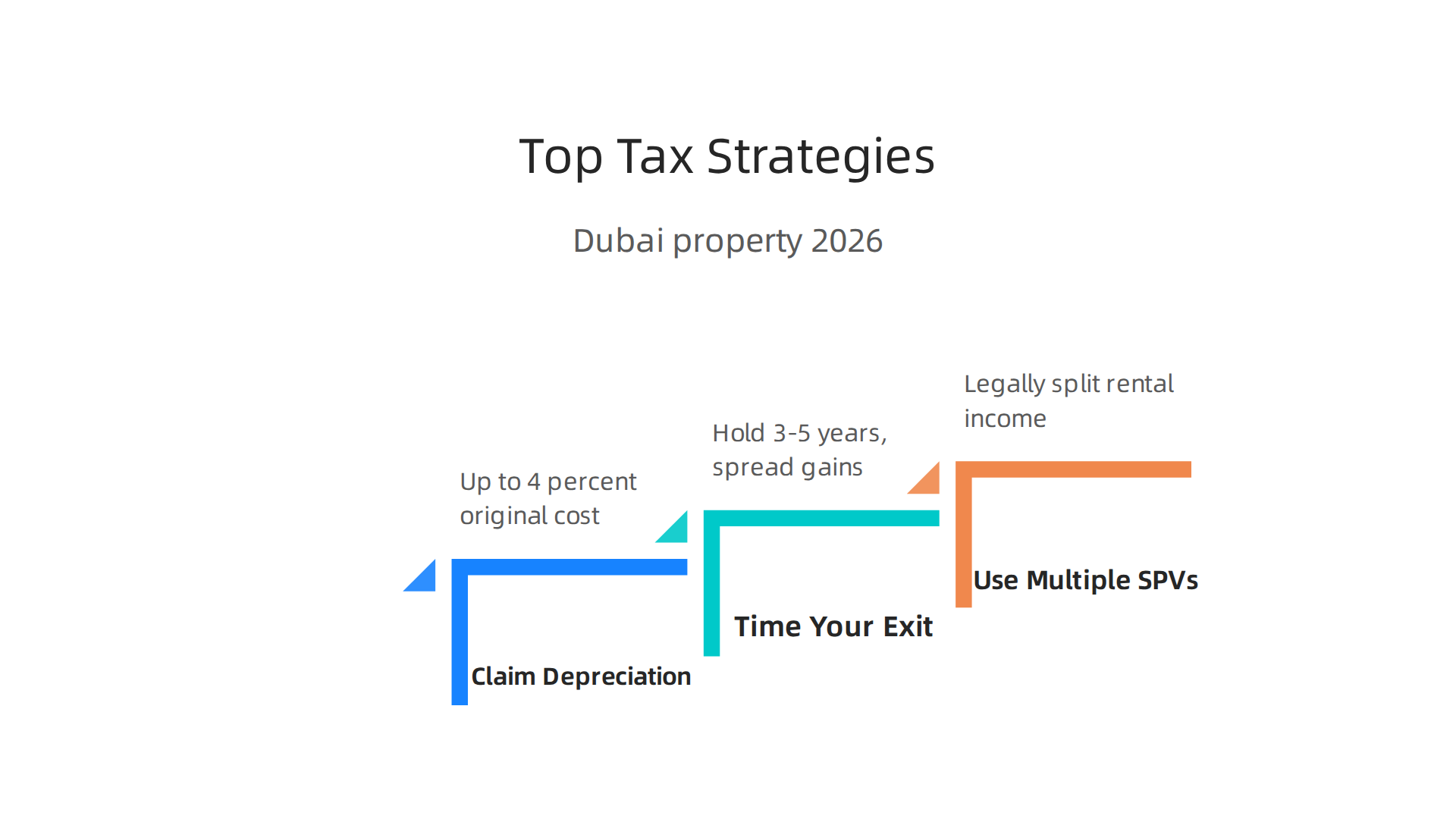
Here are three powerful strategies that work in 2026.
Claim Depreciation on Furnished Rental Properties
This is one of the most overlooked ways to lower your tax bill. If you own a rental property through a company and it is furnished, you can claim depreciation on the building structure and the furniture. Under new UAE rules, you can deduct up to 4 percent of the original cost each year. This directly reduces your taxable profit.
For example, if your property cost AED 2 million and you claim 4 percent depreciation, that is AED 80,000 off your taxable income. Over several years, the savings add up fast. The rule applies even if you hold the property at fair value under IFRS accounting. A recent update from Ministerial Decision No. 173 of 2025 made this much clearer for investors. You can check the full breakdown of how depreciation works for vacation rentals in the UAE to see how this applies to your property type.
The key is to track your asset costs carefully and work with an accountant who understands these specific rules. Do not leave money on the table.
Time Your Exit Smartly
When you sell a property, the timing and the type of property matter a lot for your total costs. Off-plan properties typically have lower upfront transfer fees because the purchase price is lower. But if you flip an off-plan unit soon after handover, you may face higher registration fees relative to your gain.
The strategy is to hold a property for at least three to five years. This spreads the 4 percent Dubai Land Department transfer fee over a longer period and reduces the sting on your net profit. Also, selling a ready property that is fully tenanted can attract a higher price, meaning you get more for your effort. If you sell within a short period, the transaction costs eat into your return.
For investors holding through a company, the holding period also affects corporate tax planning. If you sell within the same tax year, the gain hits your profit faster. Spreading gains across multiple tax years can help you stay below the AED 375,000 threshold and avoid the 9 percent corporate tax.
Use Multiple SPVs or Family Trusts to Split Income
One of the smartest planning tax strategies is to legally split your rental income across multiple entities. If your total profit from one company exceeds AED 375,000, the excess gets taxed at 9 percent. But if you own several properties through separate SPVs (special purpose vehicles), each entity can earn up to AED 375,000 tax free.
Family trusts work similarly. By distributing ownership among family members or trusts, you can keep each entity’s taxable profit below the threshold. This is completely legal under UAE law as long as the structure has real substance and is not just set up to avoid tax. The tax authority looks at the actual business activity, so each SPV needs its own license, bank account, and proper accounting.
This approach works best for investors with larger portfolios. A single small investor with one property might not need this complexity. But if you own three or four rental units worth a combined AED 5 million, splitting them across two or three companies can save you a significant amount each year.
For a full step by step guide on how to file business taxes for your Dubai property company, check out that resource to make sure you stay compliant while optimizing.
Depreciation, timing, and entity splitting are your three best tools. Start planning early, and do not wait until tax season to figure this out. The right strategy can save you thousands of dirhams every year.

Corporate Structures and Free Zones: Legal Tax Optimization Vehicles
If you own multiple properties or plan to grow your portfolio, the structure you choose matters a lot. The previous section showed how splitting income across SPVs can save you money. But the foundation of all planning tax strategies starts with picking the right corporate structure from day one.
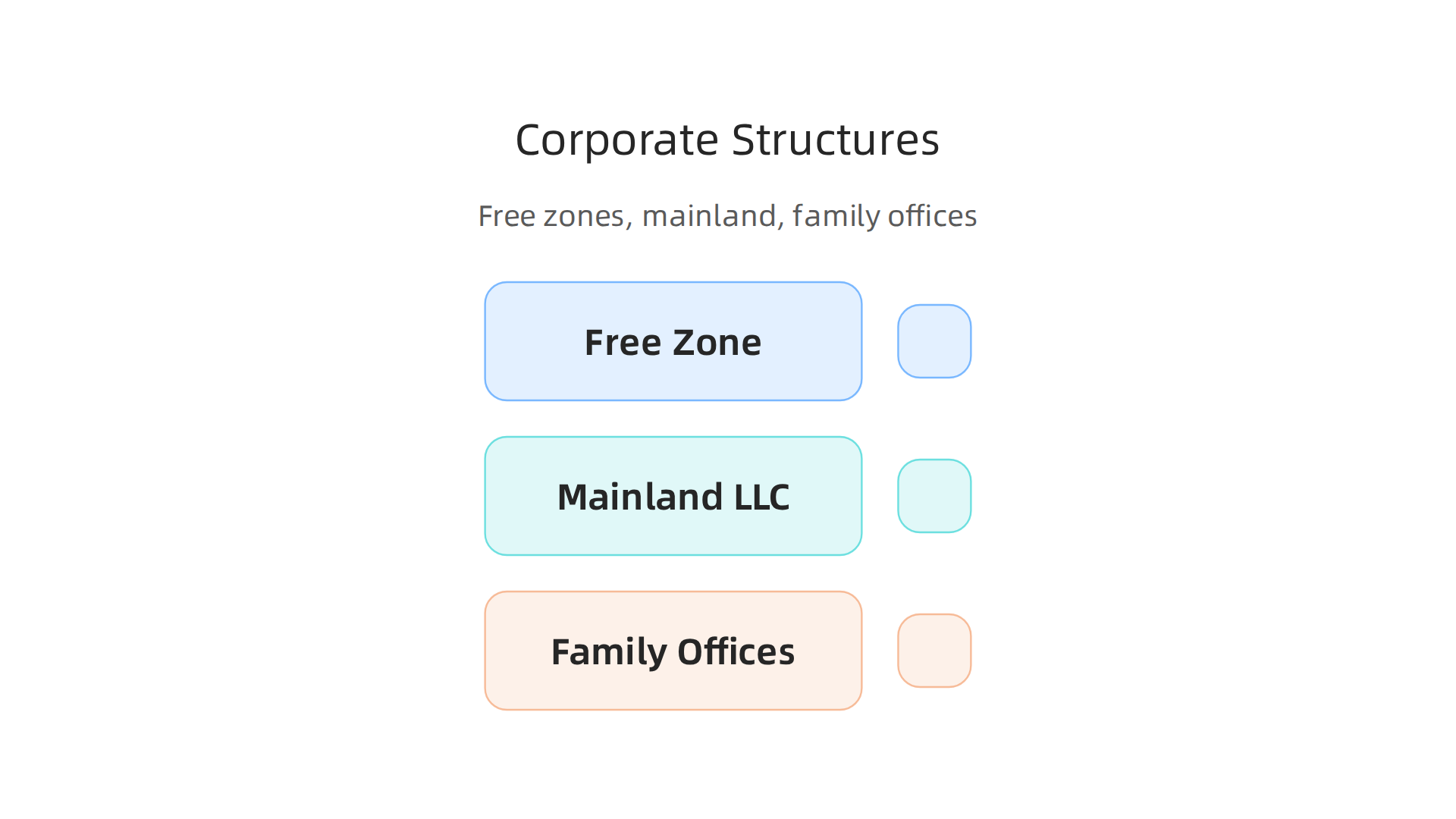
Here is what you need to know about free zones, mainland companies, and family offices in 2026.
Free Zone Companies: The 0 Percent Option with Limits
Free zones like DMCC, JAFZA, and DIFC offer a 0 percent corporate tax rate on qualifying income. That sounds perfect, right? There is a catch. Real estate activity inside the UAE mainland does not count as qualifying income. The UAE tax authority has made this clear.
A free zone company earning rental income from a property in Dubai Marina or Palm Jumeirah is earning non-qualifying income. That income gets taxed at 9 percent once it exceeds AED 375,000. The 0 percent rate in a Designated Free Zones explained guide only applies to income from outside the free zone area or from other free zone entities.
So when does a free zone work for property investors? It works well if your company earns income from outside the UAE or from other free zone companies. For example, a free zone holding company that owns shares in a foreign real estate fund can benefit. But a free zone company that directly owns a Dubai apartment and rents it out will face the 9 percent rate like anyone else.
Many investors still choose free zones for other benefits. Full foreign ownership, no customs duties, and simpler visa processes all matter. Just do not expect the 0 percent tax to cover your rental income. If you want to understand the full picture, check out this comparison of free zone vs offshore structures for real estate.
Mainland LLC: Best for Large Portfolios
For most serious property investors, a mainland LLC with a proper corporate tax registration is the better choice. Why? Because it gives you full control and flexibility.
A mainland company can own any type of property anywhere in Dubai. There are no restrictions on where you can do business. You can also claim the AED 375,000 tax-free threshold directly. If your total profit stays under that amount, you pay zero corporate tax.
The key is registering for corporate tax correctly and filing on time. Many investors set up a mainland LLC with a single purpose: holding and renting properties. This keeps the accounting simple and the tax filings straightforward. You can learn more about how to handle the process in this guide on how to file business taxes for your Dubai property company.
Family Offices and Trusts in DIFC
If you hold significant wealth in real estate, a family office or trust in the DIFC offers another layer of planning. The DIFC has its own legal system based on English common law. This makes it very attractive for estate planning and succession.
A DIFC trust can hold property shares or units indirectly. The trust itself may qualify for certain tax treatments, and the structure can help defer or reduce tax liabilities across generations. This is not something a small investor needs. But if your portfolio is worth AED 10 million or more, a DIFC family office setup is worth exploring with a professional advisor.
Getting Started with the Right Structure
Choosing between a free zone, a mainland LLC, or a DIFC trust depends on your portfolio size, your goals, and where your income comes from. There is no single right answer. But the wrong structure can cost you thousands in extra taxes every year.
If you want personalized guidance on which structure fits your situation, you can connect with an expert. Reach out for a FREE Dubai Real Estate Consultation to discuss your portfolio and find the optimal setup.
Double Taxation Agreements: Protecting International Investors
If you are investing in Dubai real estate from another country, you probably worry about paying tax in both places.

That is where double taxation agreements come into play. The UAE has signed DTAs with over 100 countries, and these treaties are one of the most powerful tax optimization strategies for international property investors.
How Double Taxation Agreements Work
A double taxation agreement is a deal between two countries that decides who gets to tax what income. Without a treaty, the same rental income or capital gain could be taxed in the UAE and again in your home country. With a treaty in place, you avoid that problem.
The UAE currently applies a 0 percent withholding tax on most payments made to non residents. That means when your Dubai property company sends profits to you as a shareholder, the UAE does not withhold any tax. But your home country might still want to tax that money. Here is where the treaty helps.
Under most UAE DTAs, the country where you live gives you a tax credit for taxes paid in the UAE. Or the treaty may say that only the UAE can tax certain types of income. For example, rental income from UAE real estate is often taxable only in the UAE under the treaty. That means you pay 9 percent corporate tax in Dubai and nothing more back home. You can check the full list of countries and their rates in this guide on the UAE’s Double Tax Treaties List.
Recent Treaty Updates That Matter
In 2025 and 2026, the UAE updated several key treaties. The new agreements with India and China include better terms for real estate income. Dividends paid from a UAE holding company to an Indian resident can now enjoy a reduced rate of 10 percent instead of India’s standard 20.8 percent. The UK treaty also now offers clearer rules for capital gains on property sales. These updates make the UAE even more attractive as a base for holding international real estate.
But pay attention. The United States has no income tax treaty with the UAE. That means US citizens and residents cannot rely on any treaty relief for taxes withheld on US source dividends or capital gains. If you are a US person investing in Dubai property, you need a different approach. This US-UAE Tax Treaty guide explains why there is no treaty and what that means for you.
Making DTAs Work for Your Portfolio
To benefit from a DTA, you must structure your investment properly. A UAE mainland holding company that owns Dubai properties and pays dividends to non resident shareholders can often reduce the taxes withheld by the shareholder’s home country. The key is proving UAE tax residency and the beneficial ownership of the income.
You also need to file the right paperwork. Most treaties require a certificate of tax residence from the UAE Federal Tax Authority. Without that document, you cannot claim the treaty rate. The tax authority has been processing these requests faster in 2026, but you should still plan ahead.
If you want to understand how your specific home country treaty works with your Dubai property structure, this guide on how UAE corporate tax affects your property investment structure gives you the full picture of how to set up for maximum treaty benefits.
Taking the time to understand your DTA can save you thousands in avoidable double taxation. It is one of the smartest planning tax strategies you can implement from day one.
Common Tax Pitfalls and Compliance Risks Every Investor Should Know
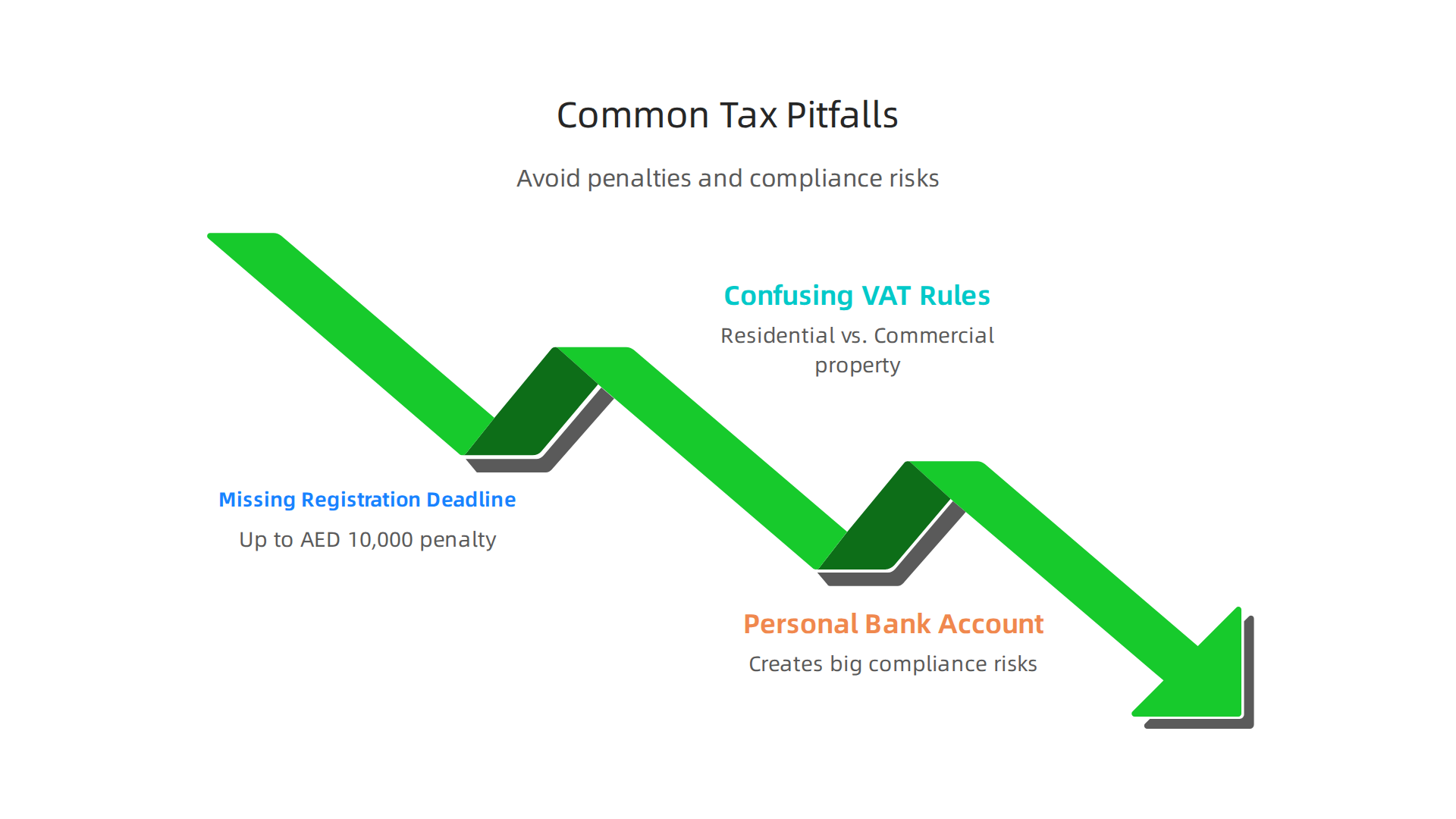
Even the best planning tax strategies can fall apart if you make simple compliance mistakes. Here are three common traps Dubai property investors hit in 2026 and how to avoid them.
Missing the Corporate Tax Registration Deadline
If you set up a single property SPV, you still need to register for corporate tax on time. The UAE Federal Tax Authority expects every taxable entity to register, even if your company only owns one apartment. Miss the deadline and you face a penalty of up to AED 10,000. That is money you could have saved with a simple calendar reminder. The complete UAE Tax & Compliance 2026 guide walks you through every deadline, threshold, and penalty so nothing slips through the cracks.
Confusing Residential and Commercial VAT Rules
Here is a mistake that costs investors thousands. If you own a commercial property in Dubai, you can recover VAT on agency fees and service charges. Residential property investors cannot. Many people assume the rules are the same and either lose out on reclaimable VAT or, worse, claim incorrectly and trigger an audit. Property misclassification is one of the most common UAE VAT errors and it leads to serious fines. Know which category your property falls into before you file. If you want a full breakdown of what counts as a deductible expense, the guide on how to file business taxes for your Dubai property company covers VAT recovery rules in detail.
Using a Personal Bank Account for Rental Income
This one seems harmless but creates big risks. When you receive rental income in a personal UAE bank account, your home country tax authority may see that as evidence of UAE tax residency. That can trigger a tax investigation back home and complicate your entire structure. Keep business income in a business account. It keeps the lines clear between your personal life and your investment portfolio.
Tax optimization strategies only work when you avoid these basic compliance traps. One wrong move with the tax authority can cost you more in penalties than you saved in planning.
FREE Dubai Real Estate Consultation
If you are unsure about any of these rules, getting expert advice early saves you from expensive fixes later. A quick chat with someone who knows Dubai property tax inside and out can give you peace of mind and a cleaner compliance record from day one.
Step-by-Step: Building Your Tax-Efficient Dubai Property Investment Plan
Knowing which compliance traps to avoid is half the battle. The other half is building a structure that keeps more money in your pocket from the start. Here is a simple three-step plan to put your tax optimization strategies into action.
Step 1: Pick the Right Ownership Structure
Your first decision shapes everything that follows. Should you buy the property in your personal name, through a company, or inside a trust? The answer depends on three things: your nationality, how many properties you plan to own, and when you expect to exit.
A single property SPV (special purpose vehicle) works well for most investors because it separates your personal assets from the business. But the wrong choice can leave you paying more corporate tax than necessary. Take a few minutes to read up on how a business setup company for Dubai property investment works before you make this call.
Step 2: Choose Your Property Type With Tax in Mind
Residential and commercial properties are treated very differently by the tax authority in 2026. If you buy residential, you pay 5% VAT on the purchase price but cannot recover VAT on ongoing costs like service charges or agency fees. Commercial properties let you recover those costs, which adds up fast.
Here is a number you should know. The 9% corporate tax rate applies to rental income earned through a licensed entity, as explained in the guide on Corporate Tax on Rental Income in Dubai 2026. So if you plan to own multiple units, commercial property may offer better tax efficiency over the long term. Match your property type to your investment goals, not just the curb appeal.
Step 3: Engage an Advisor and Register Before You Close
This step saves the most headaches. Before you sign the purchase agreement, work with a tax advisor who knows Dubai real estate inside and out.

They will help you register your entity with the Federal Tax Authority (FTA) on time and set up your accounting system correctly.
Skipping this step is a common mistake. Many investors close a deal first and try to sort out taxes later, only to find they missed registration deadlines or chose a structure that does not fit. A good advisor will also help you understand how UAE corporate tax affects your property investment structure so you can plan for the long haul.
Following these three steps does not guarantee zero taxes. But it guarantees you keep more of what your property earns and sleep better at night knowing your paperwork is clean.
Summary
This article explains why tax planning is now essential for Dubai property investors in 2026, despite the headline of no personal income or capital gains tax. It breaks down the current tax framework—5% VAT on commercial transactions, 9% corporate tax on company profits above AED 375,000, and significant transaction fees—and shows how these rules affect individuals, companies, free zones and family offices. You will learn practical optimisation tactics such as claiming up to 4% annual depreciation on furnished assets, timing disposals to spread gains, and splitting holdings across SPVs or trusts to stay below taxable thresholds. The guide also covers choosing the right corporate vehicle (free zone, mainland LLC, DIFC), using double taxation treaties for international investors, and avoiding common compliance traps like missed registrations or VAT misclassification. Follow the three-step plan and engage an advisor early to build a tax-efficient structure that protects profits and keeps you compliant.