
How to File Business Taxes for Your Dubai Property Company
· 19 min read

Introduction
If you own property in Dubai, you know the UAE has always been a place where you keep more of what you earn. But here’s the thing. That changed in June 2023 when the UAE introduced corporate tax. And if you are a property investor who runs your business through a company, this new rule now applies to you.
Many property investors in Dubai operate through LLCs or free zone entities. That was a smart move for holding assets and managing rental income. But now those companies must learn how to handle filing taxes for a business in the UAE.

It is a new task for many, and it can feel confusing at first.
The good news is the tax rate is low. According to the UAE government’s official website, the rate is 0% on taxable income up to AED 375,000 and 9% on income above that. So most small property companies will not owe much, or anything at all.
But here is where it gets tricky. New rules came into effect in 2026. The Federal Decree-Law No. 17 of 2025 gave the Federal Tax Authority more power and tightened deadlines.

This means you must know exactly when and how to file taxes business returns. Missing a deadline could mean penalties.
You also need to understand exemptions. Some free zone businesses can still enjoy a 0% rate if they follow special rules. But if your property company earns rental income through a mainland structure, the rules may look different.
This guide will walk you through the entire process. We will cover registration, deadlines, what counts as income, and how to avoid common mistakes. Whether you are new to business taxes file or just need a refresher on the latest uae tax rule changes, you will find practical steps here.
Ready to get started? Let’s look at how this tax system actually works for property investors like you. And if you want a big picture view first, check out our guide on how UAE corporate tax affects your Dubai property investment structure.
Understanding UAE Corporate Tax: What Property Investors Need to Know
Let’s start with the basics. The UAE corporate tax system is actually quite simple for most property investors. If your company makes a profit, here is how it works.
The tax rate is 0% on taxable income up to AED 375,000. Any profit above that amount gets taxed at 9%.
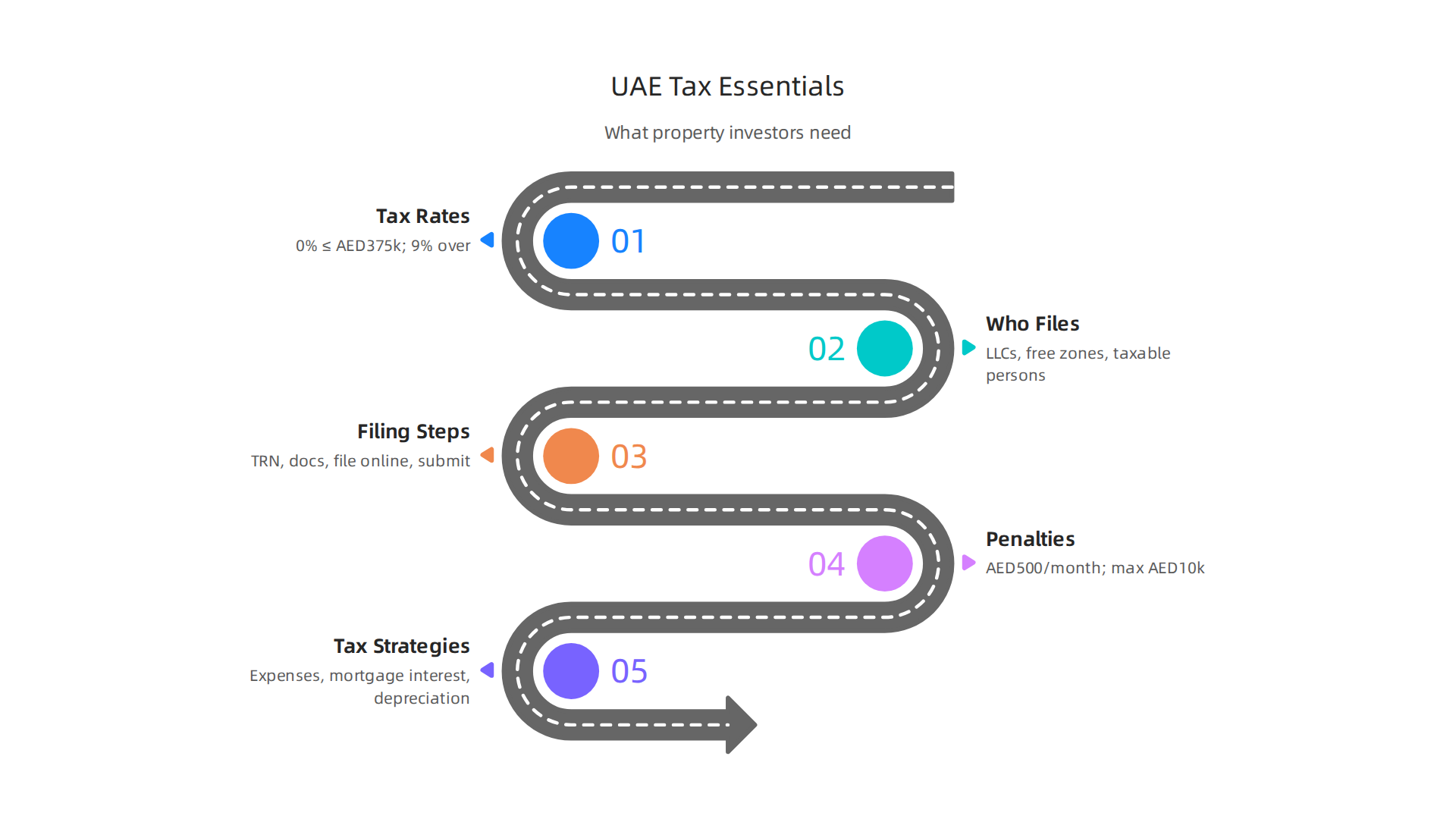
That is it. No complicated brackets or hidden layers. You can check the official UAE government page for the exact wording.
Now, who does this apply to? If you own property through a company like an LLC or a free zone entity, your business must pay corporate tax on its profits. But here is the key point. If you own property in your own name as an individual, you do not pay corporate tax on rental income or capital gains. The UAE does not have personal income tax or a separate capital gains tax for individuals. PwC confirms there is no personal income tax, so your personal property investments stay tax-free.
This distinction between personal and business investments is critical. Many investors set up companies to hold multiple properties or to limit liability. Once you do that, you enter the corporate tax world. That means you need to start filing taxes for a business properly.
For free zone companies, the rules get a little different. Some free zone businesses can still enjoy a 0% rate on qualifying income if they meet certain conditions. But if you earn income from mainland sources like renting a property in Dubai, you might lose that 0% benefit. It pays to understand the specifics of your setup.
Keep in mind that the 2026 uae tax rule changes have made things stricter. Kayrouz & Associates reports that Federal Decree-Law No. 17 of 2025 gave the Federal Tax Authority more power and tightened deadlines. So if you are running a property company, you cannot afford to miss a filing date.
One good piece of news for property investors: new depreciation rules can lower your taxable profit. A Gulf News article explains that you can claim a notional depreciation deduction of up to 4% on investment properties held at fair value. This helps reduce what you owe when you file taxes business returns.
So what does this mean for you? If you hold properties through a company, you must register for corporate tax, track your income and expenses, and submit returns on time. The good news is that most small property companies with profits under AED 375,000 will pay zero tax. But you still need to file taxes business returns to stay compliant.
Remember, filing taxes for a business in the UAE is not hard once you know the rules. The rates are low, and there are deductions to help you. The main challenge is staying organized and meeting deadlines.
Want to build a strong investment strategy that works with the tax rules? Check out our guide on Dubai real estate investment 2026: 6 core principles for smart returns to see how tax fits into your overall plan.
Who Must File: Taxable Persons and Registration Thresholds
So who exactly needs to start filing taxes for a business in the UAE? The answer is simpler than you might think. Any company or individual that runs a business must register for corporate tax. That includes you if you own property through a company structure.
The UAE government’s official portal confirms that all "taxable persons" must register. A taxable person is either a resident company or a natural person (that means an individual like you) who conducts a business activity in the UAE. And yes, owning rental properties through a company counts as a business activity.
Here is where property investors often get confused. If you hold your property in your own personal name and just collect rent, you are not a taxable person for corporate tax. The UAE does not tax personal income. But the moment you form an LLC, a free zone entity, or even a sole establishment to hold properties, you become a taxable person. That means you must file taxes business returns even if your profit is below the AED 375,000 mark.
The registration threshold is not about revenue, it is about being a taxable person. All taxable persons must register regardless of profit level. The 0% rate on the first AED 375,000 is a tax break, not a registration waiver. So even if you make zero profit, you still need to complete registration and file returns. This is a key point that many small investors miss.
To register, you use the EmaraTax portal.

UAE.](https://propertyinvestmentindubai.org/wp-content/uploads/2026/05/weblish-inline-25756.png)

The process requires you to create an account, add your business details, and submit your financial information. Your registration deadline depends on your company’s incorporation date. If you incorporated in January 2024, for instance, your deadline falls in a specific window. The Federal Tax Authority has published clear timelines. Missing these deadlines can lead to penalties, especially with the 2026 uae tax rule changes that give the FTA more power to enforce compliance.
What does this mean for you as a property investor? If you own rental properties through a business, you must register. You cannot skip this step. Even a single villa owned under a company name makes you a taxable person.
The good news is that the registration process is straightforward. You just need your trade license, passport copies, and financial records. Many investors use a tax agent to handle the details. But even if you do it yourself, the EmaraTax system guides you step by step.
For a full breakdown of how corporate tax fits with your specific property setup, read our guide on how UAE corporate tax affects your Dubai property investment structure. It covers the exact scenarios where you need to file taxes for a business and when you can stay personal.
Step-by-Step Business Tax Filing Process for 2026
Okay, so you know you have to register. Now what? The actual process of filing taxes for a business in the UAE is simpler than most investors think.
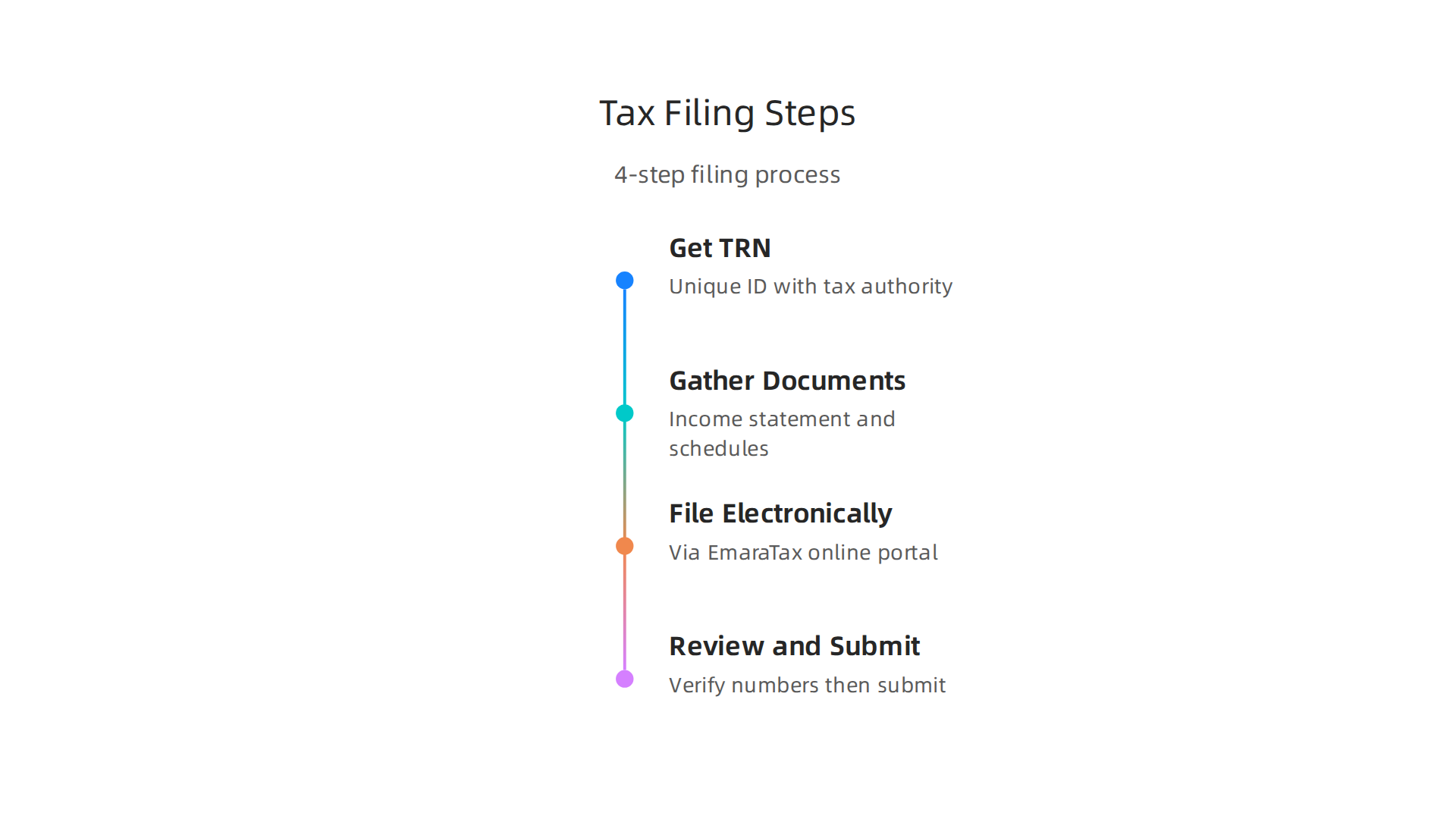
Once you have your company set up and your trade license in hand, you can get through the whole thing in a few hours. Let me walk you through it step by step.
Step 1: Get Your Tax Registration Number (TRN)
You cannot file anything without a TRN. This is your unique ID with the Federal Tax Authority. To get one, go to the EmaraTax portal and create an account. You will add your business as a "taxable person," fill in your license details, and submit. The FTA then issues your TRN within a few days. This is your first major step when you need to file taxes business returns for 2026.
Step 2: Gather Your Documents
Before you open the return, collect everything in one place. The FTA requires more than just a profit number. You will need:
- Your income statement (showing rental income and expenses)
- Your balance sheet (showing assets, liabilities, and equity)
- Supporting schedules (for depreciation, loan interest, and any exemptions)
These are the same documents you already prepare for your annual accounts. If you work with an accountant, they will have them ready. The official submission guide from Profitz Advisory confirms that missing schedules can delay your submission or trigger questions.
Step 3: File Your Return Electronically
Go back to EmaraTax, log in, and open the corporate tax return. The system will ask for your income, expenses, and tax calculation. It is all online, no paper forms. You have until 9 months after your financial year ends to submit. So if your year ends on December 31, 2025, your filing deadline is September 30, 2026. Mark that date on your calendar.
Step 4: Review and Submit
Double check your numbers. The FTA cross references your return with your registration data and any previous filings. A mistake can trigger a review letter. Once you are sure everything is correct, hit submit. You will get a confirmation and a tax assessment.
How Property Investors Should Think About This
If you hold rental properties through an LLC or free zone company, your filing will look similar to any other business. You report rental income as revenue and deduct expenses like maintenance, management fees, and mortgage interest. The 0% bracket on the first AED 375,000 profit applies automatically. So for most small portfolio owners, the tax bill is zero. But you still have to files business taxes correctly to stay compliant.
The 2026 uae tax rule changes give the FTA more power to audit and penalize late filers. Do not wait until the last week. Start the process early.
For a deeper look at how corporate tax interacts with your specific Dubai property setup, read our guide on how UAE corporate tax affects your Dubai property investment structure. It covers everything from sole establishments to multi property LLCs.
One more tip: keep a digital folder with your audited financial statements, your trade license, and your TRN certificate. You will need these every year when you business taxes file again. Once you have done it once, the next year takes half the time.
The big takeaway? Filing is not scary. It is just a process. Follow these steps, use the official portal, and you are good. No stress, just compliance.
Key Deadlines and Penalties: Avoiding Costly Mistakes
Let me tell you a quick story. A friend of mine owns a small rental company in Dubai. He thought filing taxes was a "next month" thing. Then next month came and went. By the time he remembered, the penalty had already climbed past AED 2,000. He paid more in fines than he would have in tax. Do not be that person.
The Federal Tax Authority does not mess around. If you miss the deadline for filing taxes for a business, the clock starts ticking immediately.
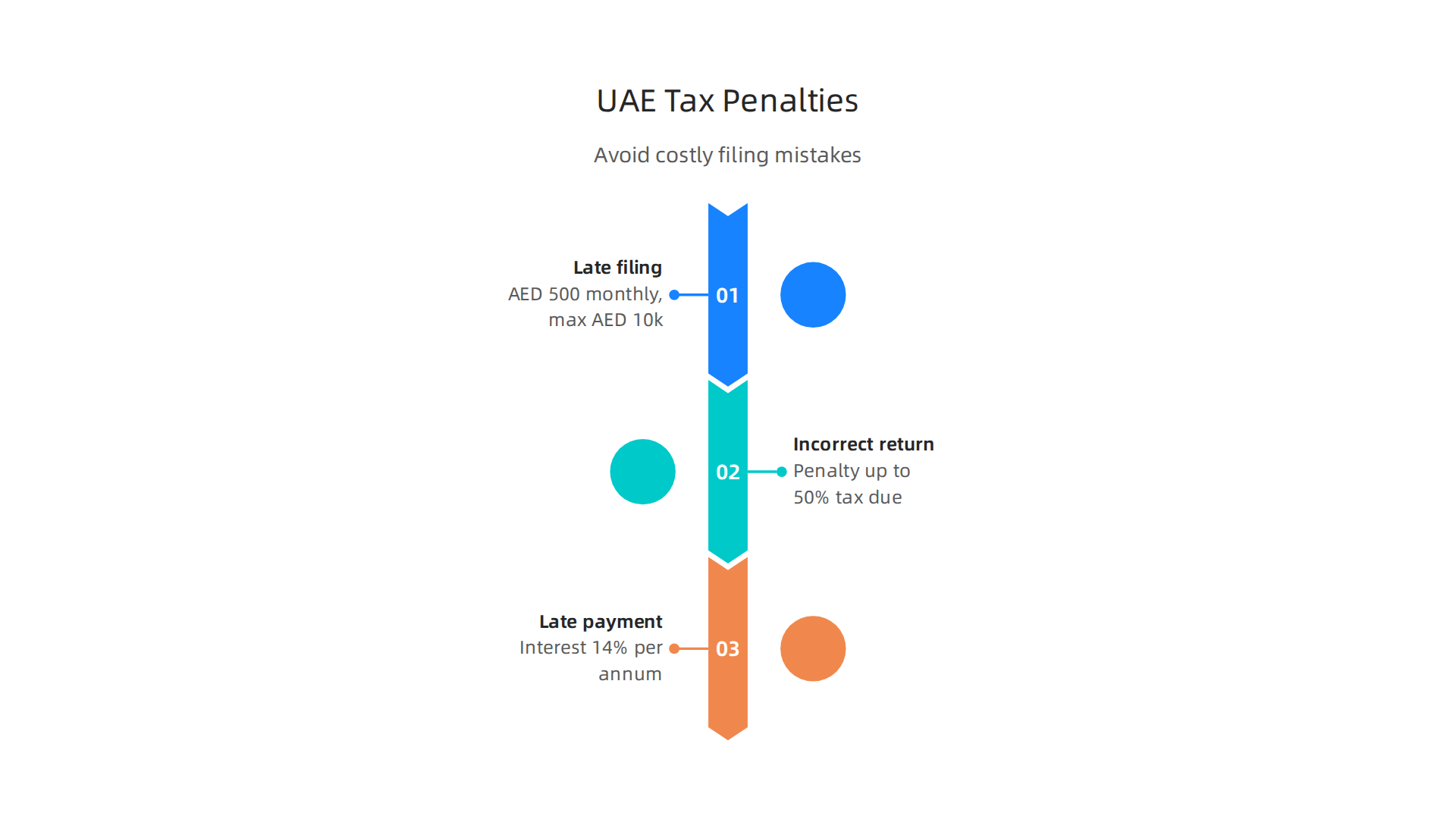
According to the official penalty guide from the FTA, a late filing penalty of AED 500 per month kicks in for the first twelve months. After that, it caps at AED 10,000. That is a hard ceiling, but it is still a lot of money you could put into your property instead.
But here is the thing. That is just the late filing penalty. The real danger comes when you submit incorrect information. If the FTA finds mistakes in your return, you can face a penalty of up to 50% of the tax due. Imagine you underreported AED 20,000 in rental income. The tax on that might be zero if you are under the AED 375,000 profit threshold. But the penalty is calculated on the tax itself, not the income. So if you owe AED 5,000 in tax and you get it wrong, you could pay AED 2,500 extra. That hurts.
The 2026 uae tax rule changes have made things stricter. The FTA has more power to audit and penalize late filers. They also offer a penalty waiver for late registration if you file your return within 7 months. But do not count on waivers. The best plan is to avoid the penalty altogether.
Here is a simple breakdown of the most important numbers:
| Penalty Type | Amount | When It Applies |
|---|---|---|
| Late filing | AED 500 per month (max AED 10,000) | After the deadline |
| Incorrect return | Up to 50% of the tax due | After FTA review |
| Late payment | 14% per annum | On unpaid tax |
You see the pattern. Small delays add up fast. And the business taxes file process is designed to catch errors because the FTA cross references your numbers with your registration data and previous filings.
So what can you do? Be proactive. Set a calendar reminder for 8 months after your financial year ends. That gives you a full month to fix any issues before the 9 month deadline.

Keep your records organized throughout the year. Work with an accountant if you have multiple properties. The cost of an accountant is way less than the cost of a penalty.
If you want to understand how these rules apply specifically to your Dubai property setup, read our guide on how UAE corporate tax affects your Dubai property investment structure. It walks through the exact scenarios for LLCs, free zone companies, and sole establishments.
At the end of the day, filing taxes for a business in 2026 is not complicated. But it requires discipline. Do the work early. Keep your numbers clean. And you will never have to worry about penalties.
Free Zone Advantages: Tax Exemptions and Compliance Requirements
That discipline we talked about. It matters even more if you run your rental business from a free zone like JLT or DIFC. The advantages of a free zone setup are real. But they come with very specific rules you must follow when you file taxes business returns.
The big draw is the 0% corporate tax rate. According to the PwC tax summaries on UAE incentives, qualifying free zone persons can enjoy a 0% rate on their qualifying income. That is a huge reason why many property investors choose this setup.
Here is the thing though. Zero percent tax does not mean zero paperwork. You still have to submit a return to the FTA. The compliance requirements are the same. If you skip the filing because you owe no tax, you will still face the AED 500 per month late filing penalty we covered earlier. So you cannot ignore the business taxes file process just because your tax bill is AED 0.
But the real trap for property investors is the non-qualifying income rule.
Here is how it works. If your free zone company rents properties only inside the free zone, that income is qualifying. It stays at 0%. But if you rent a property on the mainland too, that income becomes non-qualifying.
According to Shuraa Tax, the FTA allows a small allowance called a de minimis limit. Your non-qualifying revenue must stay under 5% of your total revenue, or AED 5 million, whichever is lower. If you go over that limit, the non-qualifying income gets taxed at 9%. And if you go way over, you could lose the 0% rate on everything.
The HKTDC research article on the new exemption rules confirms that free zone businesses earning non-qualifying income over these thresholds face the full 9% corporate tax rate. That can be a nasty surprise if you are not tracking your income sources carefully.
So how does this apply to you as a property investor in 2026?
Let us say you own a free zone company in JLT. You rent out two offices there. That is qualifying income. But you also decide to buy a villa in Palm Jumeirah through the same company and rent it out. That villa rent is non-qualifying income.
Now you must track both income streams separately and report them correctly when you file taxes business each year. The FTA will check your numbers. If you try to claim 0% on everything, the penalties from the previous section will hit you hard.
The uae tax rule changes of 2026 make this tracking more important than ever. The FTA has better systems to audit free zone companies. They will check if you really qualify for the exemption.
So what should you do?
Set up a simple system. Use separate bank accounts for qualifying and non-qualifying income if you can. Keep a spreadsheet that tracks the source of every rental payment. And work with someone who understands free zone property structures.
If you want to see how these rules apply to your specific setup, read our detailed guide on how UAE corporate tax affects your Dubai property investment structure. It walks through the exact scenarios for free zone companies holding both free zone and mainland properties.
The free zone advantage is still powerful. But in 2026, it requires real attention to detail. Keep your records clean. Know where your income comes from. And never skip filing taxes for a business just because your rate is zero.
Tax Strategies for Property Investors: Deductions, Depreciation, and More
Here is the part most people miss. Filing taxes for a business is not just about paying what you owe. The real skill is knowing what you can subtract before you calculate the final number. For property investors in 2026, the UAE tax system offers several ways to reduce your taxable profit.
You just need to know where to look.
Think of deductions as the expenses the government allows you to remove from your rental income before tax applies. The lower your taxable profit, the less you pay. Simple.
So what can you deduct?
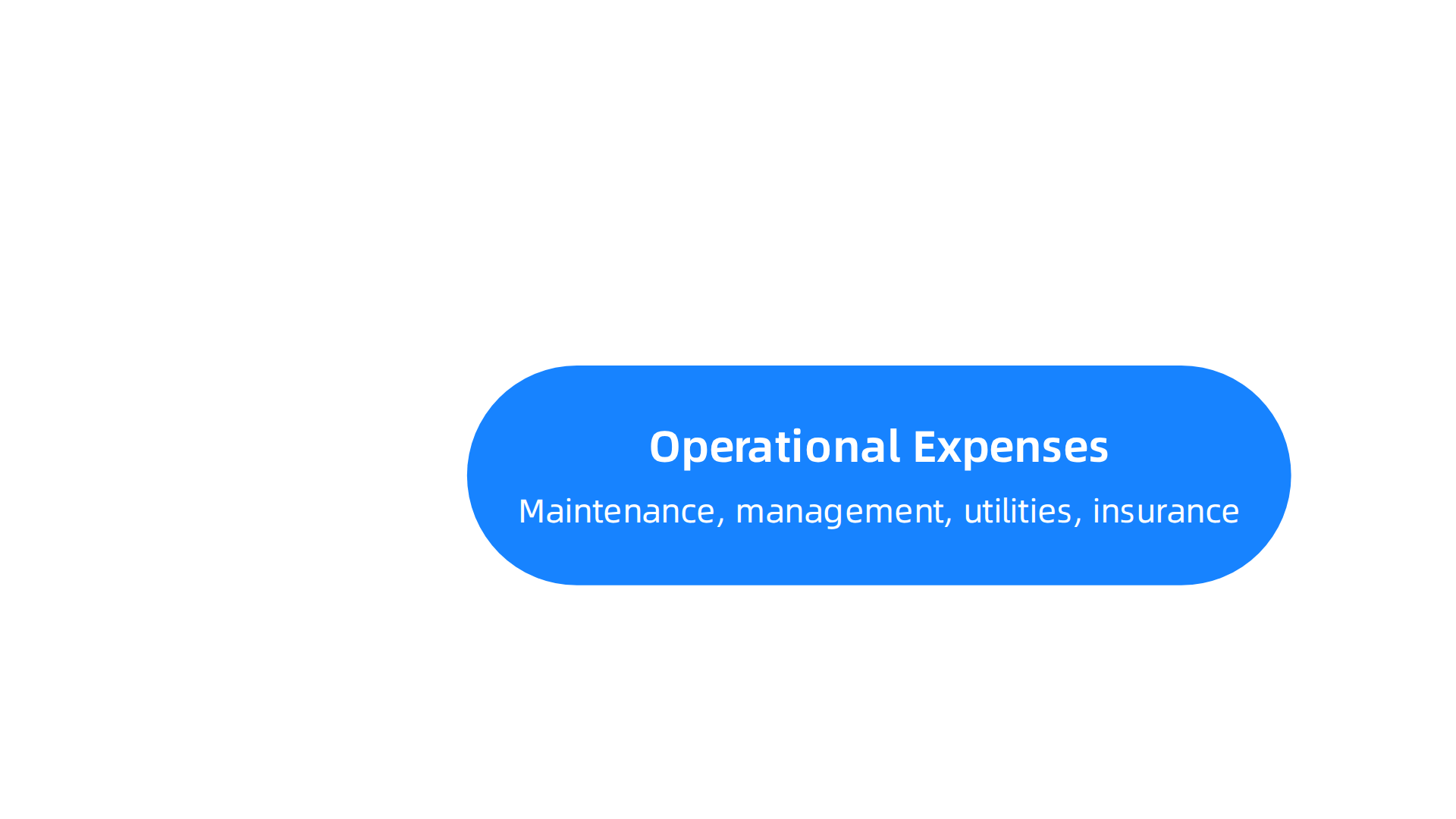
Operational expenses are your first line of defense. These are the everyday costs of running your rental property. Things like maintenance and repairs, service charges paid to the building management, property management fees, utilities you cover, insurance premiums, and even cleaning costs. Every dirham you spend to keep the property rentable can lower your business taxes file amount.
Mortgage interest matters too, but watch the cap. The UAE allows you to deduct interest paid on loans used to acquire or improve the property. There are limits though. The FTA applies a cap based on your net interest expenses. You cannot just borrow unlimited money and deduct all the interest. Your accountant needs to calculate the correct allowable amount.
Here is the big one. The uae tax rule changes introduced something powerful for property investors in 2025 and 2026. It is called the 4% notional depreciation deduction. According to a Gulf News report on the new depreciation rule, the FTA allows you to claim a tax deduction of up to 4% of the original cost of your investment property each year. The deduction is calculated as the lower of the tax written down value or 4% of the original cost. That is huge.
Why does this matter? Because even if your property value goes up on paper, you can still claim this deduction. The DLA Piper analysis of Ministry of Decision No. 173 of 2025 confirms that taxpayers holding investment property at fair value can now claim this notional depreciation. So you get a real tax deduction on a theoretical cost.
What about capital gains? This is good news. According to the PwC tax summaries for the UAE, there is currently no separate capital gains tax for individual sellers of residential property in Dubai. The Sands of Wealth guide on Dubai property taxes for 2026 also confirms this. If you hold a property personally and sell it at a profit, that gain is generally not taxable. But if you operate through a company and property trading is your business activity, the profit may be treated as business income. So your structure matters.
Do not forget the small business relief. The PwC summary also notes that the UAE provides a temporary tax relief for small businesses until 31 December 2026. If your revenue is below AED 3 million, you can elect to be treated as if you have no taxable income. That means zero tax and zero filing complexity for small investors. But you must elect this option properly.
The takeaway is simple. Filing taxes for a business does not have to hurt. Use every deduction you qualify for. Track your operational costs. Claim your mortgage interest within the limits. And absolutely use the 4% depreciation rule if you hold investment properties.
If you want to see how these strategies work with different ownership structures, read our guide on how UAE corporate tax affects your Dubai property investment structure. It explains exactly how to set things up so you keep more of your rental income.
Smart tax planning is what separates average returns from great ones. Use these tools and file taxes business returns that work for you, not against you.
Summary
This article explains how the UAE corporate tax regime introduced in 2023 — and tightened in 2026 — affects property investors who hold assets through companies. It walks you through who must register, how to get a TRN, the documents you need, and the step‑by‑step online filing process on EmaraTax, plus the nine‑month filing deadline. The guide clarifies rates (0% up to AED 375,000, 9% above), free zone qualifying income rules and the 5%/AED 5 million de minimis test, and highlights the new 4% notional depreciation allowance for investment properties. It also covers common deductible expenses like maintenance and mortgage interest (within caps), key penalties for late or incorrect returns, and simple recordkeeping and planning tips. After reading, you will know whether you must register, how to prepare and submit returns, what deductions to claim, and how to avoid costly mistakes and penalties.