
How to File Business Taxes for Your Dubai Property Company Including Corporate Tax and VAT
· 20 min read

Introduction
Think Dubai means zero taxes across the board? You are not alone. The city’s global image as a tax-free haven often hides a more complex reality for property investors. If you own rental units or run a real estate company here, the paperwork and tax obligations can pile up fast. Between the recent introduction of corporate tax and the existing rules on VAT, figuring out how to file business taxes can feel like a full-time job.

Since 2023, the UAE has enforced a 9% corporate tax on profits above AED 375,000 for businesses. This specifically impacts rental income for licensed property investors, as explained in the detailed breakdown of Corporate Tax on Rental Income in Dubai. Alongside this, VAT rules add another layer to your tax return. Residential and commercial properties are treated differently under the law, which makes it critical to understand what qualifies as a taxable supply versus an exempt supply.
This guide was created to answer the big questions. How do I file business taxes for my property company? What deductions can lower my tax payment? How do I manage tax calculations for different property types? We have put together a simple, step-by-step framework to help you comply with Federal Tax Authority requirements without the stress. For a complete walkthrough of the submission process, take a look at our detailed guide on how to file business taxes for your Dubai property company.
Need help figuring out where to start? Connect with me for a FREE Dubai Real Estate Consultation to discuss your specific situation and get personalized guidance.
1. Understanding Dubai’s Tax Landscape for Property Investors
Before you can figure out how do I file business taxes for a property company, you need to know what you are working with. The Dubai tax system for real estate splits into two main categories: corporate tax (CT) and value-added tax (VAT).
Each one treats residential and commercial properties differently.
Corporate tax is the big change in recent years.
Since June 2023, the UAE has enforced a 9% corporate tax on profits above AED 375,000 for businesses. This includes rental income earned through a licensed property company. If your taxable income falls below that AED 375,000 threshold, you pay 0% on that portion. Only the profit above that line gets the 9% rate. You can read the full details in this piece on corporate tax on rental income in Dubai.
Now here is where it gets interesting for investors. If you operate from a free zone and meet the qualifying income conditions, you may enjoy a 0% corporate tax rate. But that benefit only applies if your business has no mainland nexus. If you rent to a mainland tenant or earn income outside the free zone, you could lose that zero-rate status. The rules are strict, so knowing your business structure matters. This overview of Key UAE Real Estate Tax Investment Considerations breaks down which income qualifies for the 0% rate.
VAT adds another layer.
The standard VAT rate in the UAE is 5%. But here is the twist: residential rental income is generally exempt from VAT. That means you do not charge VAT on residential rent you collect. Commercial rentals, on the other hand, are taxable at 5%. You must charge VAT to your commercial tenants and report it on your tax return.
Services like property management fees are also taxable at 5%. So even if your rental income is exempt, your management charges are not. Get familiar with the UAE VAT on Residential Real Estate rules and exemptions to avoid mistakes.
What this means for your filing.
When you sit down to file business taxes, you need to separate your income streams. Residential rent, commercial rent, service fees, and property sales all have different tax treatments. Mixing them up on your tax return can trigger penalties from the Federal Tax Authority.
Understanding these basics is step one. If you are unsure how your specific portfolio fits into these rules, you can explore more on how corporate tax affects your Dubai property investment structure for a deeper look at the options available to you.
2. Do You Need to Register for Corporate Tax?
You now understand the rates and categories. But the next big question is simple: do you actually need to register?

Not every property investor in Dubai must register for corporate tax. The rules split into two main groups: businesses and individual investors.
The AED 375,000 threshold is the key number.
If you run a licensed property company and your taxable profit exceeds AED 375,000 in a financial year, you must register with the Federal Tax Authority. Any profit below that line pays 0%. Only the amount above 375,000 triggers the 9% rate. The UAE government’s official Invest in Dubai page on navigating UAE corporate tax confirms this structure for real estate held by tax resident companies.
What if you are an individual investor?
Here is where many people get confused. Natural persons — meaning you as an individual — may be exempt from corporate tax altogether. But only if you are not conducting a business.
So how do you know if you are "conducting a business"? The tax authority looks at factors like how many properties you own, how often you buy and sell, and whether you treat the activity like a business rather than passive investment. A detailed resource on corporate tax on real estate investment for natural persons explains that real estate investment income can be excluded if it comes from specific investment activities rather than active trading.
If you own two rental villas and collect rent without much activity, you are likely a passive investor. You probably do not need to register. But if you own 20 units, actively manage tenants, advertise vacancies, and treat it like a business, the FTA may consider you a taxable person. When in doubt, getting professional advice saves you from penalties later.
Free zone property companies have their own rules.
If you operate from a free zone and your taxable income exceeds AED 375,000, you still need to register. The good news is you can then apply for the 0% qualifying income rate if your rental activities meet the conditions. But remember from the previous section: renting to a mainland tenant can break that qualifying status.
Registration is done through the EmaraTax portal. It is an online process, but you need your trade license, passport copies, and financial records ready. For a handy overview of what you can deduct once registered, read this guide on real estate investment property loan requirements and how they affect your tax position.
A quick way to check yourself.
Ask these three questions:
- Do I have a trade license for my property activities?
- Is my annual profit above AED 375,000?
- Am I actively managing properties like a business?
If you answered yes to all three, you need to register. If you are unsure, that is okay. Many investors are in the same boat.
The rules are still new, and the FTA continues to issue clarifications. The safest move is to assume you may need to register until a professional tells you otherwise. You can get a FREE Dubai Real Estate Consultation to check your specific situation without any commitment.
3. Step-by-Step Guide to Filing Corporate Tax Returns
So you have checked your situation and you need to file. What happens next? Filing your corporate tax return in Dubai is not as scary as it sounds. The whole process happens online through the EmaraTax portal.
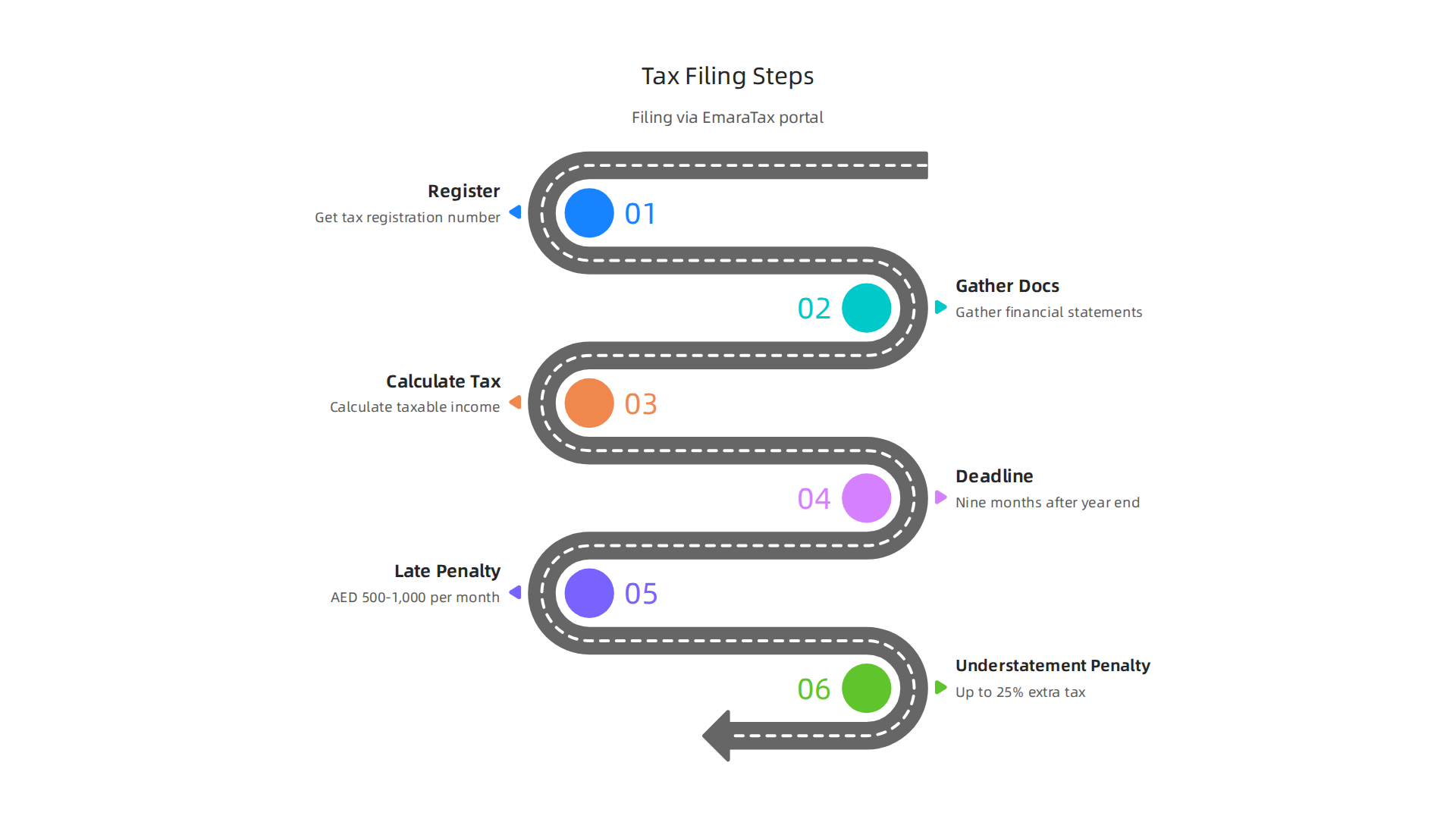
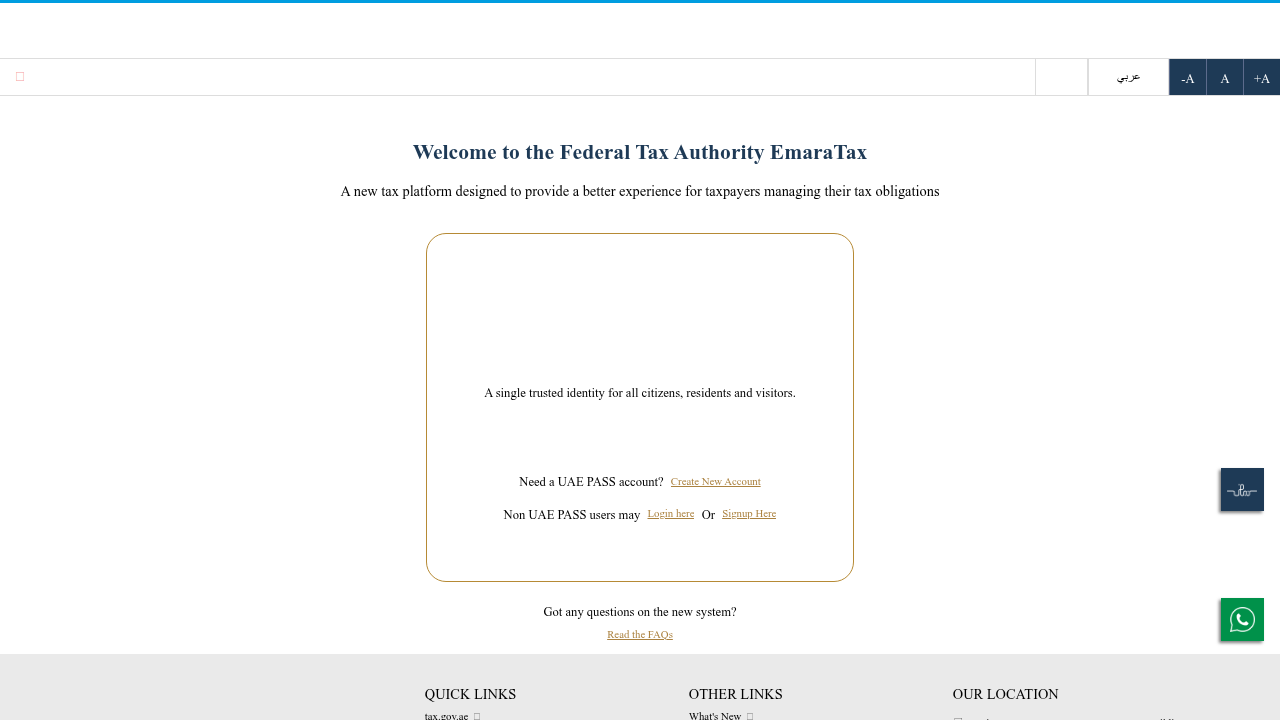
Let me walk you through each step so you know exactly what to expect.
Step 1: Get Your Tax Registration Number
Before you can file anything, you need a Tax Registration Number or TRN. You apply for this through the EmaraTax portal using your trade license and passport details. If you recently started your company in 2026, registration usually must happen within three months of incorporation. The team at The Total CFO has a solid overview of corporate tax registration in 2026 that explains the timeline clearly. Without a TRN, you cannot submit a return.
Step 2: Gather Your Financial Statements
You need proper financial records that follow FRS 102 standards. This means a profit and loss statement, a balance sheet, and notes about your income and expenses. If you own rental properties, your statements should show rental income, maintenance costs, service charges, and any loan interest you pay. Having clean books from day one makes this step much easier.
Step 3: Calculate Your Taxable Income
Log into EmaraTax and select the correct tax period. The portal will ask you to enter your revenue and deduct your allowable expenses. Remember from earlier: you subtract your costs before you check if you pass the AED 375,000 threshold. Only the profit above that amount gets taxed at 9%. Before you start your calculation, review this practical resource on what you can claim as business expenses to lower your final tax bill.
When is the deadline?
This is the part you cannot miss. Your corporate tax return and any tax payment are both due within nine months after the end of your financial year. For example, if your financial year ends on December 31, 2025, your deadline is September 30, 2026. Those dates matter because late filing triggers penalties.
What happens if you file late?
The FTA charges AED 500 for the first delay. After that, it increases to AED 1,000 per month. If you understate your income or claim deductions you should not have, you could face penalties up to 25% of the extra tax due. The September 30, 2026 deadline reminder from Middle East Briefing gives a helpful checklist for the 2026 deadline so nothing slips through the cracks.
A final tip for first-time filers
EmaraTax asks you to double-check every figure before you hit submit. Mistakes in classifications or attachments can delay your filing and trigger questions from the tax authority. Go slow. Use the UAE Corporate Tax Return Filing Checklist from FintrackUAE for a thorough guide to what you must include before you finalize your return.
Filing your first return takes more time than you expect. But once you do it once, the process becomes routine. And the peace of mind that comes with knowing you are fully compliant is worth the effort.
4. VAT Obligations on Rental Income and Services
Now that you know how to file your corporate tax return, there is another layer you need to understand. VAT or Value Added Tax applies differently depending on what kind of property you own and what services you provide. Getting this wrong can cost you money or create compliance headaches.
Residential vs. commercial: the big difference
Here is the simple rule. If you rent out a residential property to a tenant for living in, that rental income is exempt from VAT. You do not charge VAT on residential rent. This rule keeps housing affordable for tenants. The official guidelines on VAT rules for residential real estate in the UAE confirm that residential rental income is generally exempt.
Commercial property is a different story. If you rent out an office, shop, warehouse, or any commercial space, you must charge 5% VAT on the rent. Your tenant pays you the rent plus 5%, and you pass that VAT to the Federal Tax Authority.
What about short-term rentals?
This is where it gets tricky. If you rent a residential property on a short-term basis to tourists or visitors without a UAE Emirates ID, that rental income is treated as a taxable supply. Services like holiday homes and Airbnb-style rentals count as commercial activity. According to the VAT treatment of residential property in the UAE guide, short-term rentals where tenants stay less than six months and have no Emirates ID are taxable at 5%.
Services are always taxable
Here is something many property owners miss. Even if your residential rental income is exempt, the services you offer around the property are not. Property management fees, cleaning services, maintenance work, and leasing commissions are all taxable at 5%. So if you charge a tenant a monthly maintenance fee on top of their rent, that fee needs VAT added to it.
When do you need to register for VAT?
You must register for VAT if your total taxable supplies and imports exceed AED 375,000 in any 12-month period. This threshold includes your taxable rental income from commercial properties and your service fees but does not include your exempt residential rental income.
You can also register voluntarily if your taxable supplies are between AED 187,500 and AED 375,000. Some businesses choose to register voluntarily so they can claim back input VAT on their expenses. For a full breakdown of what counts and what does not, check this comprehensive UAE real estate tax guide for 2026.
A practical example
Imagine you own a small building with two commercial shops and two residential apartments. You collect AED 50,000 per year in residential rent and AED 80,000 per year in commercial rent. The residential rent is VAT exempt. The commercial rent of AED 80,000 needs 5% VAT or AED 4,000 added. Plus you charge AED 5,000 in property management fees to all tenants, which is also taxable at 5%. Your total taxable supplies are AED 85,000, which is below the mandatory registration threshold. But if you cross AED 375,000, you must register.
What happens if you do not charge VAT correctly?
The FTA can fine you for undercharging VAT or failing to register when you should have. Late VAT payments also carry penalties. This is one area where professional advice pays off quickly. If you want personalized help sorting out your specific situation, connect for a FREE Dubai Real Estate Consultation where you can get answers tailored to your portfolio.
Keep separate records
Mix up exempt and taxable income in your accounting and you will struggle at filing time. Keep separate columns for residential rent, commercial rent, and service fees. Track the VAT you charge separately from the rent itself. Good recordkeeping now saves you from a messy audit later. For more details on how VAT interacts with your overall tax picture, the real estate VAT and corporate tax guide for 2026 breaks down the latest requirements clearly.
5. Keeping Tax-Compliant Records for Your Property Business
Now that you have a handle on VAT, there is one more piece to get right. Keeping proper records is not just good practice, it is the law.

The Federal Tax Authority (FTA) requires you to maintain all your financial documents for at least five years. This includes rental contracts, invoices, bank statements, and tax invoices for any expenses you plan to deduct.
Why does this matter? When you sit down to figure out how do i file business taxes or prepare your annual tax return, good records make the whole process smooth. Without them, you are guessing. And guessing leads to mistakes.
What documents do you need to keep?
Here is a quick list of what the FTA expects:
- Rental contracts for every property you own, both residential and commercial
- Invoices for all income received and expenses paid
- Bank statements that match your rental income and outflows
- Tax invoices for every deductible expense, like maintenance, utilities, and professional fees
- VAT returns and supporting schedules if you are registered
Keep these records in a format the FTA can easily inspect. Paper is acceptable, but digital records are smarter. Using accounting software that supports VAT and corporate tax tagging saves you time and headaches. If you want to compare your options, check out the best small business tax software for Dubai 2026 to find a tool that fits your portfolio.
Three common pitfalls to avoid
Many property owners trip up in the same places. Here are the big ones:
-
Mixing personal and business expenses. If you pay a personal credit card bill from your property business account, the lines get blurry. Keep separate bank accounts and credit cards for your property business. This makes it clear when you are figuring out how to do taxes for a business.
-
Failing to retain invoices. You need a paper trail for every single expense you claim. No invoice, no deduction. Period. The FTA is strict about this. Without proper invoices, you cannot support your tax payment calculations or claim refunds.
-
Errors in VAT treatment of mixed contracts. If you have a contract that covers both exempt residential rent and taxable services like cleaning or maintenance, you must split the amounts correctly. Many landlords get this wrong and face penalties. The guide on common FTA penalties in 2026 highlights how incomplete records are a top trigger for fines.
A simple system works best
Set up a folder system, physical or digital, for each property. Store every contract, invoice, and statement in its place. Review your records quarterly, not just at year-end. This way, when tax season comes, you are ready to file your taxes without scrambling.
Good recordkeeping is the foundation of everything else in this guide. Without it, you cannot accurately calculate your tax liability, claim your deductions, or survive an FTA audit. Take the time to organize now, and you will thank yourself later.
6. Common Tax Filing Mistakes and How to Avoid Them
Even with a solid recordkeeping system, mistakes can still happen when you sit down to file your taxes.
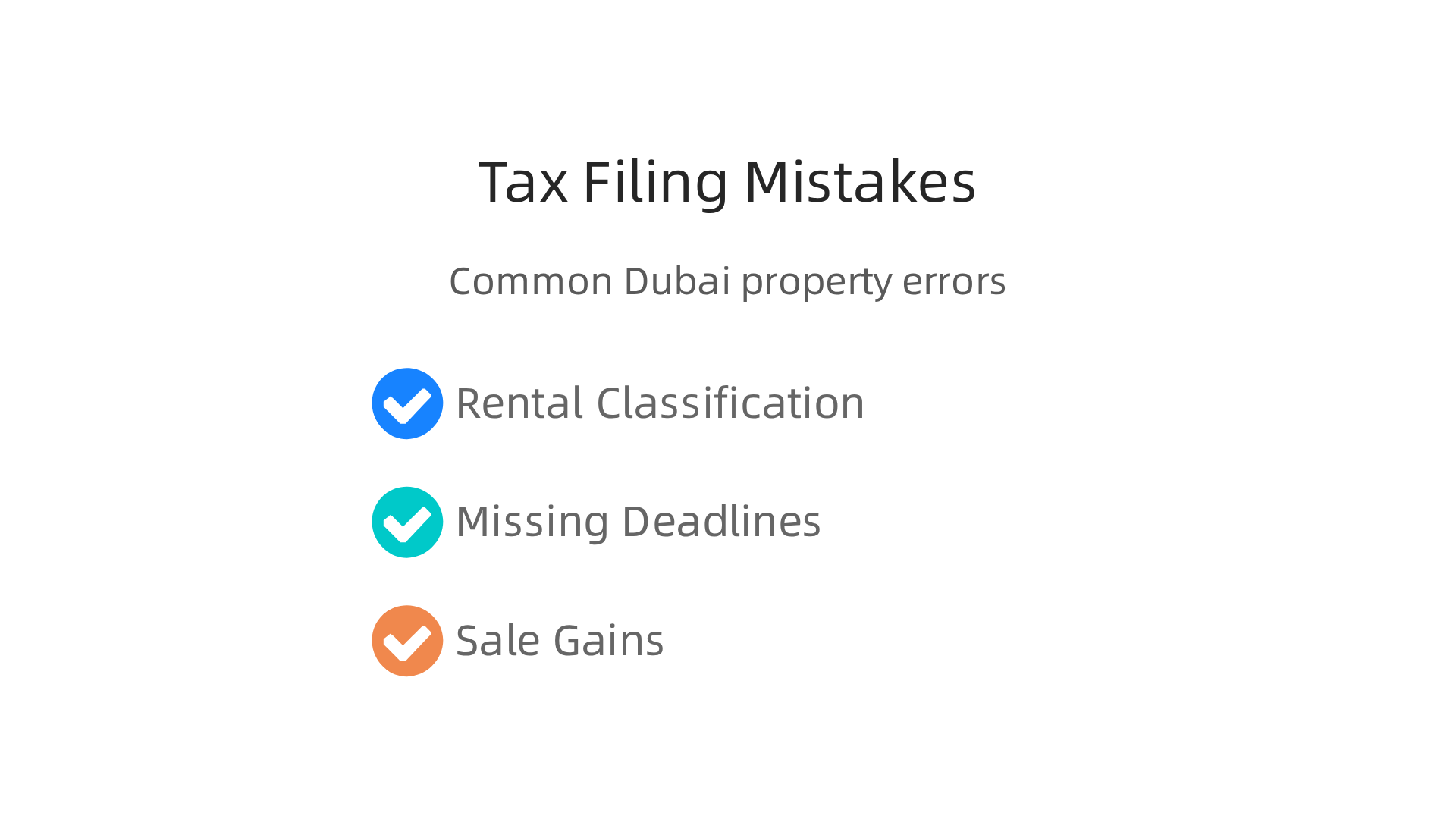
The key is knowing where other property owners slip up so you can avoid the same traps. Let us walk through the three biggest mistakes and how to steer clear of each one.
Mistake 1: Getting rental income classification wrong
Residential and commercial rental income are treated very differently under UAE tax rules. Residential rent is generally exempt from VAT, while commercial rent is taxable at 5 percent. If you mix them up or fail to split a mixed contract correctly, you end up filing an incorrect return. That mistake can lead to penalties and a messy tax payment situation later. Always check your contracts and classify each property clearly. The article on common corporate tax filing mistakes that trigger FTA penalties highlights how incorrect income classification is a frequent trigger for audits.
Mistake 2: Missing deadlines and underestimating taxable income
Many property owners do not realize they need to register for corporate tax at all. If your annual turnover exceeds the AED 375,000 threshold, you must register and file a tax return. The return is due within nine months after your financial year ends. For a calendar year business, that means September 30, 2026 is the big date. Poor recordkeeping often leads to underestimating taxable income, which then causes underpayment. You can check the September 30, 2026 corporate tax deadline checklist to make sure you do not miss it.
Mistake 3: Confusing property sale gains with rental income
This is a subtle one. When you sell a property, the gain may be subject to corporate tax, but it is calculated differently from rental income. Some investors lump everything together and end up paying the wrong amount. You need to separate your rental operations from capital gains on sales. The rules around free zone exemptions also trip people up. Many assume being in a free zone means no filing needed, but that is not always true. Understanding how UAE corporate tax affects your Dubai property investment structure will help you get the classification right from the start.
How to stay on track
The best way to avoid these mistakes is to work with a professional who knows Dubai property taxes. A good accountant can review your records, check your classifications, and make sure your tax return is accurate. They can also help you plan for your tax payment so you are not caught off guard.
If you want one-on-one guidance, you can reach out for a FREE Dubai Real Estate Consultation to get expert advice tailored to your portfolio. With the right help, filing your taxes becomes straightforward and stress-free.
7. How to Find a Trusted Tax Advisor in Dubai
So you know you need a professional. The next question is how do you actually find the right one? Not all tax advisors are created equal, especially when it comes to Dubai property.

Here is a simple guide to help you choose wisely.
Look for the right credentials first
Your advisor should be registered with the Federal Tax Authority as a tax agent. That is non-negotiable. You can find a list of approved professionals through the FTA portal or check with firms that hold a valid TAAN. The guide on FTA registered tax agents in Dubai explains what this registration means and why it matters.
Beyond FTA approval, look for qualifications like ACCA, CPA, or a degree in accounting or tax law. These credentials show the person has real training, not just a website and a business card. The professionals at firms like those offering FTA tax agent services typically hold these certifications.
Check their experience with property investors like you
A general corporate tax accountant might not understand the specific rules around rental income classification, free zone exemptions for property companies, or how to handle mixed-use buildings. You want someone who has worked with real estate portfolios similar to yours.
Ask these questions during your first conversation:
- How many property investor clients do you currently serve?
- Have you handled tax returns for companies with commercial and residential properties?
- Can you explain how you approach the tax payment process for a portfolio my size?
If they hesitate or give vague answers, move on. A good advisor will have clear examples ready.
Request references and check for red flags
Ask for contact details of two or three existing property investor clients. A confident advisor will share them. Then call those references and ask about their experience. Did the advisor file their tax return on time? Were there any surprises? Would they hire the advisor again?
Watch out for these red flags:
- Promises of overly aggressive tax avoidance schemes that sound too good to be true
- Lack of transparency about fees and billing structure
- Unfamiliarity with recent FTA updates for 2026
- Pressure to sign a long-term contract immediately
If you spot any of these, keep looking. The wrong advisor can cost you more in penalties and stress than you save in fees.
Understand how do I file business taxes with an advisor
When you work with a good tax advisor, the process of how to do taxes for a business becomes much simpler. You provide your records. They review them. They prepare your tax return and calculate the correct tax payment. Then they file the return through the EmaraTax portal and help you schedule the payment. You stay informed at every step.
The right advisor does not just file your taxes. They help you understand how to file business taxes correctly year after year. They become a long-term partner in your investment journey. Taking the time to find that person now will save you money, stress, and headaches every single filing season.
Summary
This guide explains how property investors and licensed Dubai property companies must handle corporate tax and VAT since the UAE introduced a 9% corporate tax on profits above AED 375,000. It walks you through who must register, how to get a TRN, what financial statements and records the FTA expects, and the nine‑month filing deadline using the EmaraTax portal. The article clarifies VAT treatment—residential rent is generally VAT‑exempt while commercial rent and property services are taxable at 5%—and flags short‑term holiday rentals as taxable supplies. You will learn step‑by‑step filing actions, common mistakes to avoid, what deductions you can claim, and how to find an FTA‑registered tax advisor to keep your property business compliant.