
How to File Business Taxes for Your Dubai Property Company
· 19 min read

If you own rental properties in Dubai through a company, you might be wondering how the UAE corporate tax affects your bottom line. It’s a question more investors are asking in 2026, and for good reason. Dubai’s corporate tax regime, introduced in 2023, changed the game for anyone who holds property through a business structure like an LLC or a free zone entity. And with recent updates from the Federal Tax Authority (FTA) clarifying how real estate portfolios must file, understanding your obligations has never been more important.

The thing is, the rules around filing business taxes in Dubai can feel confusing. Many investors assume that because Dubai has no personal income tax, their property company doesn’t need to worry. But that’s not true anymore. If you own properties through a company, you are likely subject to corporate tax. And the FTA now expects clear, timely filings for each tax period. Getting business filing taxes wrong or missing a deadline can lead to stiff penalties that eat into your profits. That’s a headache nobody wants.
So why should you care about accounting for taxes right now? Because 2026 brings updated guidelines that directly affect how you report rental income, claim deductions, and manage your portfolio. Whether you need corporate tax consulting or just a clearer picture of what to do, having a solid grasp of the requirements is the first step to protecting your investment. And if you are planning to start business in Dubai specifically for property investment, you need to build tax compliance into your setup from day one.
This guide is here to walk you through everything you need to know. We will cover who must file, what forms to use, and how to stay compliant without the stress.

For a closer look at how the corporate tax law applies to your property structure, read our deep dive on how UAE corporate tax affects your Dubai property investment structure.
And if you want personalized guidance for your specific situation, reach out for a FREE Dubai Real Estate Consultation with Ayaz Salman. He can help you sort out your tax filing and keep your property business on track.
Understanding Your Tax Obligations as a Property Investor in Dubai
So let’s get straight to the point. If you hold rental properties through a company in Dubai, you need to understand your tax filing obligations. The good news is that the rules are clearer in 2026 than ever before.
Corporate tax applies to your business, not to you personally as an individual investor. That is the first thing to remember. If your property is owned by an LLC, a free zone entity, or any other business structure, the company’s rental income is subject to UAE corporate tax. The same goes for income from property trading or development if you conduct those activities through a business.
According to the official UAE government portal, the corporate tax rates are straightforward.
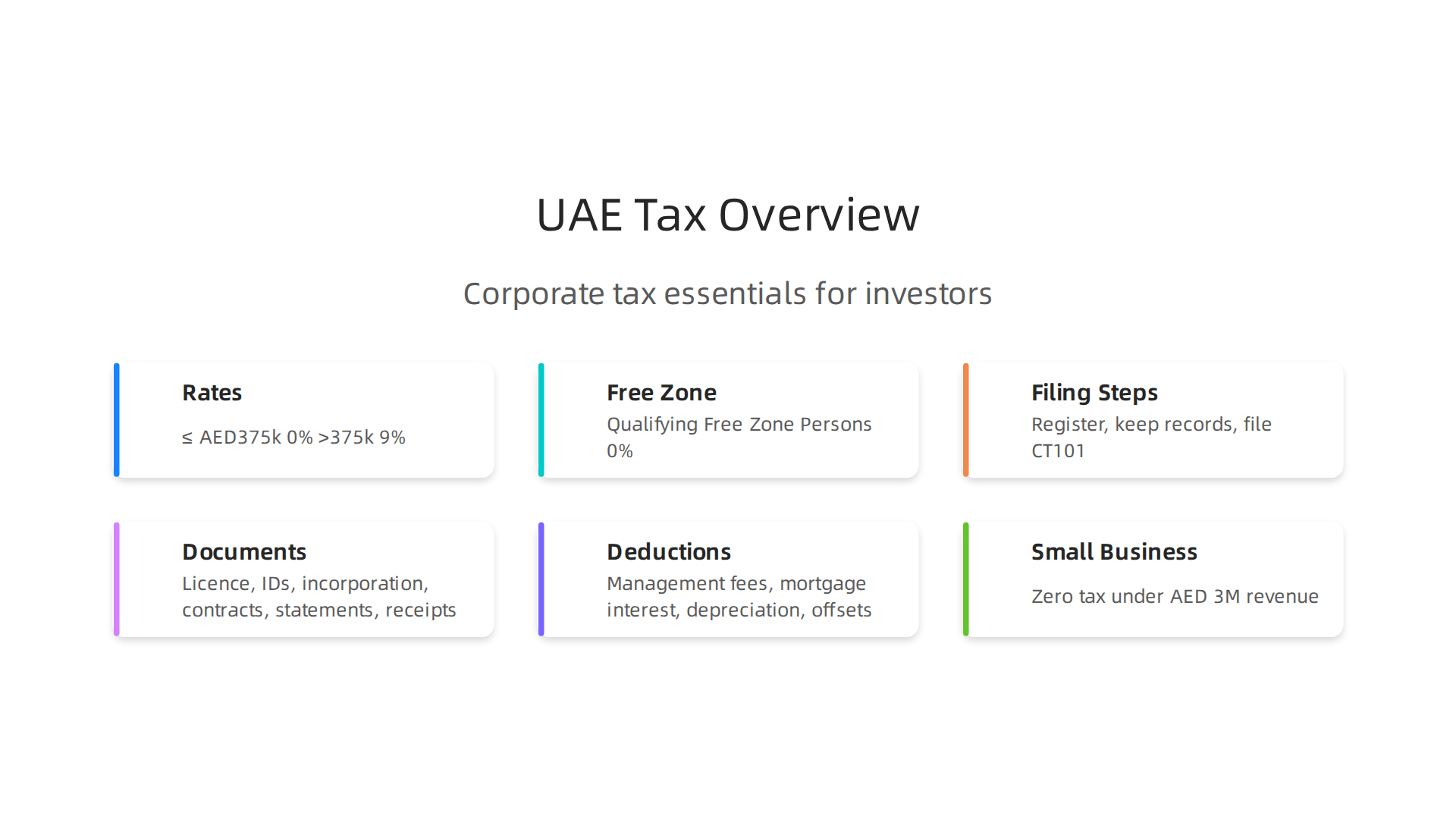
You pay 0% on taxable income up to AED 375,000 and 9% on any amount above that. So if your property company earns AED 500,000 in net profit, the first AED 375,000 is tax-free, and you pay 9% on the remaining AED 125,000. That is a very manageable rate.
Free zone property companies have a special opportunity. If your company is registered in a free zone and qualifies as a Qualifying Free Zone Person (QFZP), you may be eligible for 0% corporate tax on qualifying income. But there are conditions. You must earn qualifying income, maintain adequate substance in the UAE, comply with transfer pricing rules, and file your returns every year. Non-qualifying income is taxed at 9%, and you do not get the AED 375,000 threshold. For more details on how to meet these conditions, the guide on filing business taxes for your Dubai property company walks through the full process step by step.
What about individual investors? Here is where many people get confused. If you hold properties in your own name, not through a company, you are generally not subject to corporate tax on your rental income. The same applies to capital gains from selling a personal property. As noted in the UAE Corporate Tax Exemptions 2026 guide, a foreign investor who owns UAE real estate and earns rental income without conducting an active business does not need to register with the Federal Tax Authority and has no corporate tax obligation. That is a huge relief for small landlords.
But if you plan to start business in Dubai specifically for property investment, you need to set up your entity carefully from day one. A mainland company or a free zone company both have different tax implications. Getting the structure right early saves you headaches later.
If you are unsure whether your free zone company qualifies for the 0% rate, or if you simply want to double-check your numbers, do not guess. Professional corporate tax consulting can save you from costly mistakes. And for your accounting for taxes needs, keeping clean records of all rental income, expenses, and deductions is the foundation of a smooth filing process.
The bottom line is this: understand your structure, know the thresholds, and file on time. That is really all it takes to stay compliant and keep your property investment thriving.
Corporate Tax vs. Personal Income Tax on Property Investments
Now let’s clear up one of the biggest points of confusion. Many investors think corporate tax and personal income tax are the same thing.

They are not. And in Dubai, this difference matters a lot.
Dubai has zero personal income tax. That is a huge advantage for individual investors. If you own a rental property in your own name and you are not running a licensed business, you pay no tax on that rental income. Period. The same goes for profits when you sell a personal property. This is one reason why foreign investors love Dubai real estate. As the 2026 guide on property taxes explains, most individual landlords pay no income tax on rental earnings because the UAE simply does not have a personal income tax.
Now, if you own that same property through a company, the story changes. The company must pay corporate tax at 9% on net profit above AED 375,000. That is the key difference. Individual ownership equals no tax. Company ownership equals corporate tax on profits above the threshold.
What about non-resident investors? If you live abroad and own UAE property through a company, you may trigger a taxable presence in the UAE. That means your company needs to register with the Federal Tax Authority and file returns. There is also the question of withholding tax. Under current UAE law, payments like dividends, interest, and royalties face a 0% withholding tax rate. That is good news. But non-residents should still stay informed because rules can change.
Here is the bottom line. Your business filing taxes obligations depend entirely on your ownership structure. If you are an individual with a few rental units in your name, you have little to worry about. But if you plan to start business in Dubai specifically for property investment, you need to set up the right entity from day one. A mainland company and a free zone company have very different tax outcomes.
Good accounting for taxes is essential for company owners. You need to track every expense, every rent payment, and every deduction. Missing a detail can lead to penalties. That is why many investors turn to professional corporate tax consulting to make sure they get it right.
If you are unsure whether your current structure is costing you money, do not guess. The difference between individual ownership and company ownership could save or cost you thousands every year.
Are you ready to make the smart move? Get a FREE Dubai Real Estate Consultation to review your property investment structure and tax obligations today.
If you own rental properties through a company in Dubai, filing business taxes is not optional. It is the law. And the process is straightforward once you understand the steps. Let me walk you through exactly what you need to do.
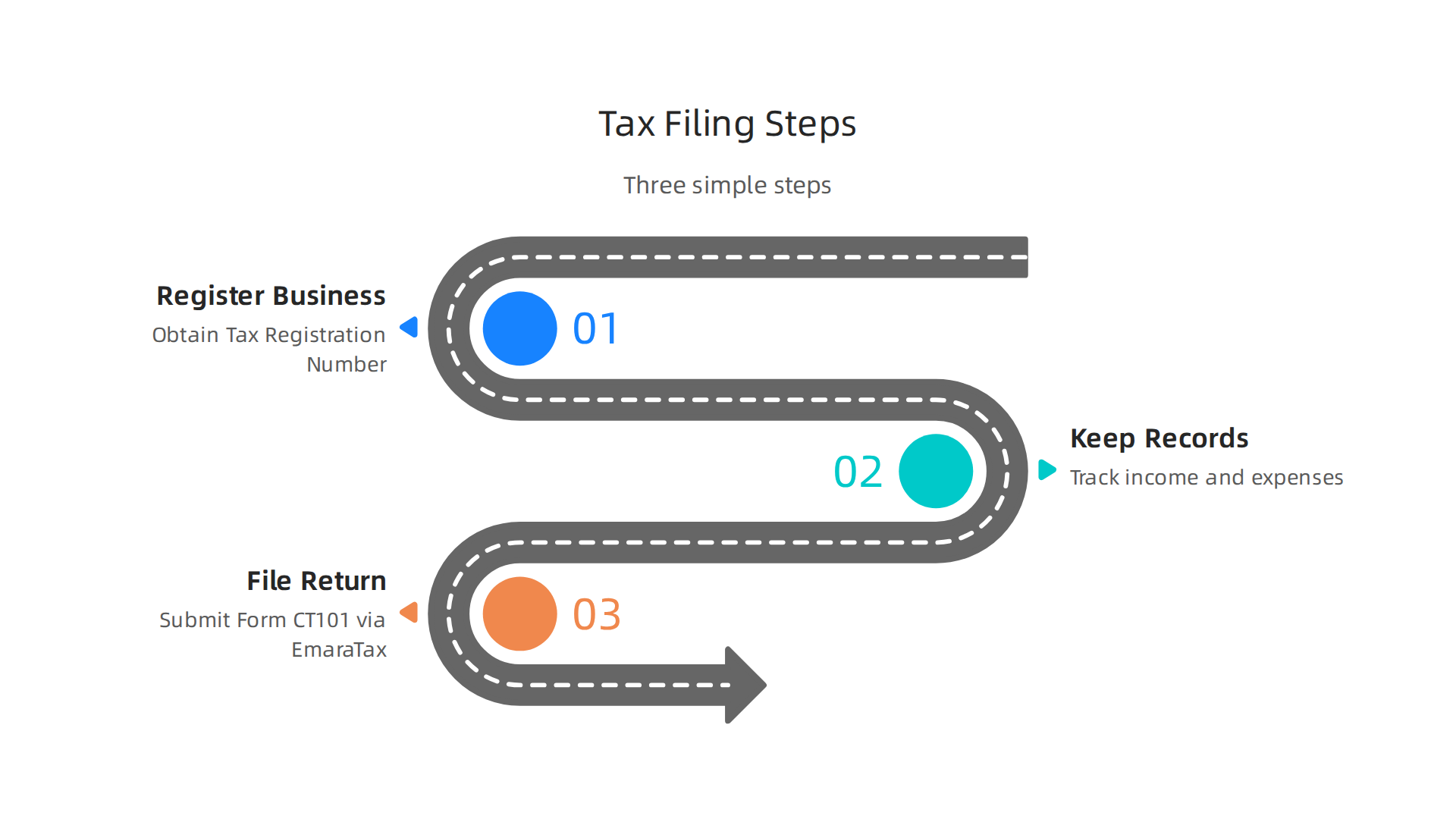
Step 1: Register Your Property Business with the FTA
Before you file anything, you need a Tax Registration Number (TRN). This is your company’s unique ID with the Federal Tax Authority. Without it, you cannot submit a tax return.
You register online through the FTA’s EmaraTax portal. You will need your trade licence, Emirates IDs, and passport copies of the owners. The application takes about 20 business days to process. Once approved, you receive your TRN by email. A helpful guide on corporate tax registration in 2026 explains exactly which documents to prepare and how to avoid common mistakes that cause delays.
Step 2: Keep Accurate Financial Records
This is where good accounting for taxes becomes critical. You must track every single thing:
- Rental income from each property
- Maintenance and repair costs
- Property management fees
- Mortgage interest (if applicable)
- Service charges and utilities
- Capital gains from property sales
Your tax return draws directly from your financial statements. If your books are messy, your return will be wrong. And wrong returns mean penalties. For companies with revenue over AED 50 million, audited financial statements are mandatory.
Step 3: File the Corporate Tax Return (Form CT101) Every Year
This is the main event. The return is filed exclusively through the EmaraTax portal. You have exactly nine months from the end of your financial year to submit it and pay any tax due. For example, if your year ends on 31 December 2025, your deadline is 30 September 2026. The UAE corporate tax filing deadline 2026 is strict. There are no extensions. Late filing triggers a penalty of AED 10,000 per return for repeated failures, plus monthly interest on unpaid tax.
The return itself is a self-assessment. You declare your income, claim allowable deductions, and calculate the tax at 0% on income up to AED 375,000 and 9% on anything above that. You must also complete up to 20 schedules covering things like related-party transactions and transfer pricing. Make your elections carefully because some are irreversible.
After you file, keep all records for at least seven years. The FTA can ask for supporting documents at any time.
Getting Professional Help
This process can feel overwhelming, especially if you have multiple properties or complex ownership structures. That is why many property investors turn to corporate tax consulting to handle the filings. A tax agent can submit the return on your behalf, make sure you claim every deduction you qualify for, and keep you compliant with the latest rules.
If you want to dig deeper into the entire filing process from start to finish, check out this complete guide on how to file business taxes for your Dubai property company.
Your Next Step
Filing business taxes for your property portfolio does not have to be stressful. The key is to start early, keep clean records, and meet that nine-month deadline. Get it right from day one and you will save yourself a lot of headaches and money.
Are you ready to make sure your property company is fully compliant? Connect with Ayaz Salman for a FREE Dubai Real Estate Consultation and get expert advice on your tax obligations.
H2: Navigating the UAE Federal Tax Authority (FTA) and Required Documentation
So you understand the steps. Now let’s talk about the central tool you will use: the EmaraTax portal. This is the only official platform for everything related to filing business taxes in the UAE. You register there, you file your return there, and you make payments there.
Getting started with the portal is simple, but you need the right documents ready. Without these, your application will sit waiting for weeks. Here is what the FTA typically asks for:
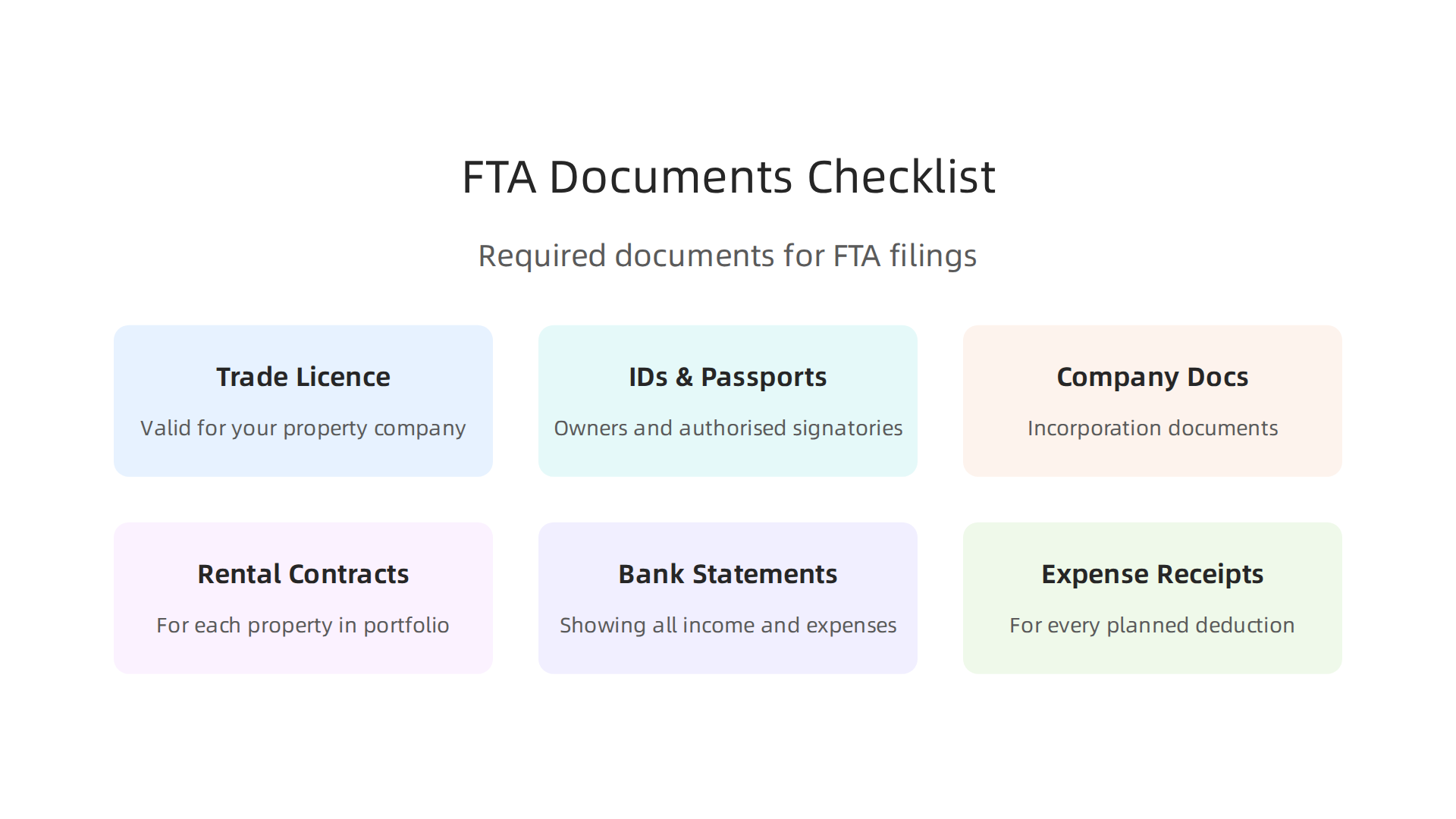
- A valid trade licence for your property company
- Emirates IDs and passport copies of all owners and authorised signatories
- Company incorporation documents
- Rental contracts for each property in your portfolio
- Bank statements showing all income and expenses
- Receipts for every expense you plan to deduct
If your company’s revenue is AED 50 million or more, you also need audited financial statements. Those are mandatory, not optional. Even if your revenue is below that threshold, having clean, reliable financial records is smart. They make your return accurate and protect you if the FTA ever asks for proof.
The FTA portal itself is designed to be user-friendly. You log in using your UAE Pass credentials. From the dashboard, you navigate to the Corporate Tax tile and start your application. You fill in details about your entity type, business activities, shareholders, and fiscal year. Then you upload your documents in PDF format.
Here is a tip: check everything before you submit. Even a small typo can delay your application by weeks. Once the FTA receives your application, they take about 20 business days to process it. After approval, you get your Tax Registration Number (TRN) by email.
This TRN is your key to the rest of the process. Every time you file a return, you will use it.
For property investors with complex portfolios, digital filing through EmaraTax can get tricky. You might have multiple properties, different ownership structures, or related-party transactions. That is where professional help becomes valuable. A qualified tax agent can submit the return on your behalf and make sure every document is in order. This is especially helpful if you want to learn more about how UAE corporate tax affects your Dubai property investment structure.
Do not wait until the last minute to gather your paperwork. Start collecting your rental contracts, expense receipts, and bank statements early. The smoother your documentation, the smoother your business filing taxes experience will be.
H2: Top Deductions and Exemptions for Real Estate Businesses
Now you have your TRN and you are registered. The next step in filing business taxes is knowing what you can deduct. Real estate companies have many allowable expenses that lower your taxable profit.
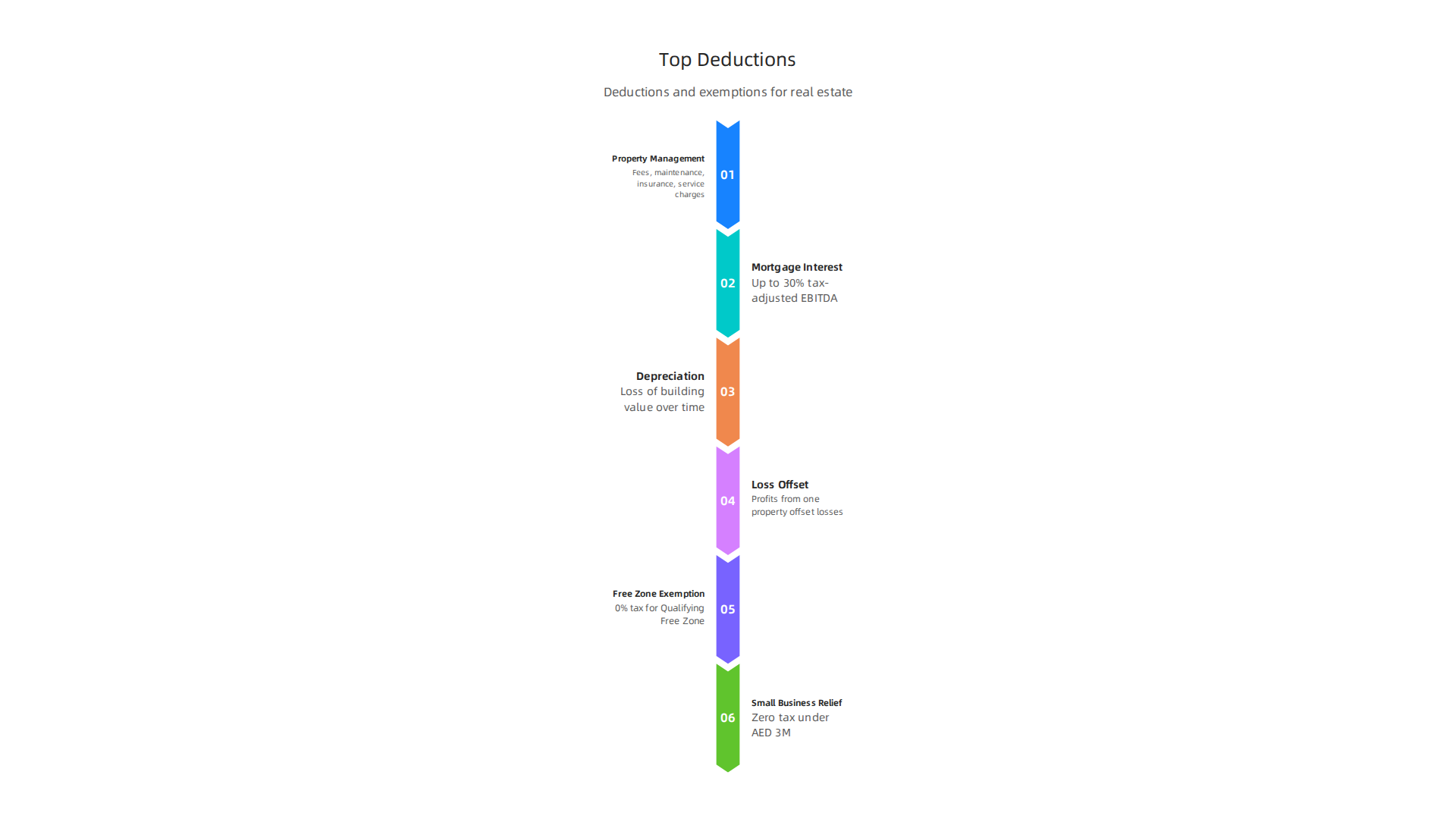

Start with the basics. The FTA allows you to deduct costs that are wholly and exclusively for your business. This includes property management fees, routine maintenance and repair costs, insurance premiums, and service charges. You can also deduct agent commissions and Ejari registration fees. According to this UAE corporate tax real estate deductions guide, these items are clearly deductible for corporate landlords.
One big deduction is mortgage interest. If you have a loan on your property, the interest you pay is deductible. But there is a limit. The net interest expense deduction cannot exceed 30% of your tax-adjusted EBITDA, or AED 12 million, whichever is higher. This is the General Interest Deduction Limitation Rule (GIDLR). The UAE corporate tax loss offset rules explain this restriction in detail.

Depreciation is another powerful tool. Buildings lose value over time. You can deduct that loss each year against your income. The deduction applies to the building structure, not the land. Capital improvements like new roofs or HVAC systems may be depreciated over several years instead of deducted all at once.
Here is a major benefit for property investors with multiple assets. If your company owns more than one property, losses from one property can offset profits from another. This applies within the same taxable entity. It reduces your overall tax bill.
Now for exemptions. If your real estate company is located in a free zone, you may qualify for a 0% corporate tax rate. But there are conditions. You must be a Qualifying Free Zone Person (QFZP). You must not do business with mainland UAE. Your income must be qualifying income. If you sell properties to mainland customers, that income is taxed at 9%. The free zone exemption guide covers the rules in plain language.
For smaller businesses, the Small Business Relief (SBR) may apply. If your revenue is AED 3 million or less in a tax period, you can elect to have zero taxable income. That means you pay no corporate tax at all for that period.
As you can see, there are many ways to reduce your tax through careful planning and documentation. Good accounting for taxes makes a real difference.
If you want a step-by-step walkthrough of the entire process, check out our guide on how to file business taxes for your dubai property company.
And if you are thinking about investing in Dubai real estate and need professional advice tailored to your situation, you can get a FREE Dubai Real Estate Consultation with Ayaz Salman. He can help you understand the tax implications for your specific portfolio.
H2: Expert Tips for Compliant Tax Filing and Avoiding Penalties
Knowing your deductions is half the battle. The other half is making sure you stay on the right side of the Federal Tax Authority. Even small mistakes in filing business taxes can trigger fines that eat into your profits. The good news? A few simple habits can keep you penalty-free.
Here are three expert tips to help you stay compliant and stress-free.
Tip 1: Set up deadline reminders and file early
Missing a tax return deadline is one of the most common mistakes. The FTA charges a late filing penalty of AED 500 per month for the first twelve months, and AED 1,000 per month after that. Plus, if you owe tax and pay late, you will be charged 14% interest per year on the unpaid amount. The UAE Corporate Tax Penalties & Fines 2026 guide breaks down exactly how these penalties add up.
To avoid this, mark your calendar. Your corporate tax return is due nine months after your financial year ends. For example, if your year ends on December 31, your deadline is September 30. Set a reminder at least one month early so you have time to gather documents and double-check numbers. Filing early also gives you a buffer if something goes wrong.
Tip 2: Work with a tax professional who knows real estate
UAE corporate tax has specific rules for property businesses. Interest deduction limits, depreciation calculations, and free zone exemptions all have real estate angles. A general accountant might miss these details. You need someone who understands both corporate tax law and property valuation.
Good corporate tax consulting can save you more than it costs. An expert will help you claim every legal deduction, structure your business filing taxes correctly, and spot potential issues before they become problems.

If you are planning to start business in dubai as a property investor, getting the right advisor early is a smart move.
Tip 3: Reconcile your financial records with FTA submissions regularly
Do not wait until the last minute to check your numbers. Every quarter, compare your internal profit and loss statements with the records you plan to submit. Make sure all deductions are backed by invoices, receipts, or contracts. The FTA can audit your returns years later. If your records do not match, you could face fines for incorrect returns (AED 500 per incorrect return) and additional penalties during an audit.
Good accounting for taxes means keeping clean books all year. Use accounting software or a dedicated bookkeeper to track income and expenses by property. This makes filing business taxes much smoother when tax season comes.
Staying compliant does not have to be hard. A little planning and the right help go a long way. For a deeper look at how corporate tax rules apply to different property investment structures, check out our guide on mastering real estate business taxes.
H2: Frequently Asked Questions – Business Tax Filing for Investors
We know tax rules can feel confusing. Here are answers to the three questions we hear most from property investors.
Q1: Do I need to pay tax on rental income if I own a property personally?
No, not in most cases. If you own a property in your own name and rent it out without a business license, that income is not subject to corporate tax. The FTA considers this a personal investment activity. According to the latest guidance on corporate tax on rental income for individuals, natural persons who lease property without a license remain outside the corporate tax system. This means you keep 100% of your rental income with no tax bill.
The rules change if you set up a company to hold the property. In that case, your rental income becomes part of your business filing taxes obligations and the 9% rate applies on profit above AED 375,000.
Q2: Can I deduct my own salary if my property company has no other employees?
Yes, you can. The FTA allows owner-employees to deduct a reasonable salary as a business expense, even if you are the only person working in the company. The key is consistency. Your salary must be documented in official records, paid regularly, and aligned with market rates for your role. You cannot give yourself a huge salary one year and nothing the next just to reduce taxable profit. For a full walkthrough of what counts as a deductible expense, read our Dubai property investor tax filing guide.
Q3: What happens if I miss the filing deadline?
Penalties add up fast. The FTA charges AED 500 per month for the first twelve months of late filing, then AED 1,000 per month after that. If you owe tax and pay late, you also face 14% interest per year on the unpaid amount. The complete UAE Corporate Tax Guide 2026 lists every penalty so you know exactly what to expect.

If you miss a deadline, file right away. Do not wait. The FTA may show leniency if you have a legitimate reason and file voluntarily before they contact you.
Need help making sense of your specific situation? Get a FREE Dubai Real Estate Consultation and talk through your tax questions with someone who knows the Dubai market.
Summary
This article explains how UAE corporate tax affects rental properties owned through a company in Dubai and gives a practical roadmap for staying compliant in 2026. It covers who is liable (companies, not most personal landlords), the corporate tax rates (0% up to AED 375,000 and 9% above that), special free zone rules, and the importance of correct entity setup. You will learn the registration steps with the FTA (get a TRN via EmaraTax), what records to keep, how to file the annual CT101 return within nine months of your fiscal year-end, and which deductions and limits (like the 30% interest cap) commonly apply. The guide also lays out penalties for late or incorrect filings and gives practical tips—set reminders, reconcile quarterly, and hire a specialist when needed. By following these steps you can reduce tax risk, claim the right deductions, and keep your Dubai property business compliant and efficient.