
How an Income Tax Calculator Can Help You Master Dubai Property Taxes in 2026
· 20 min read

Introduction
Dubai is famous for its tax-friendly environment. There is no annual property tax, no tax on rental income, and no capital gains tax when you sell.

But here is the thing: "tax-free" does not mean "no tax planning required." Many investors jump into Dubai property thinking they can ignore taxes completely. That mistake can cost you thousands.
In 2026, global tax rules are getting stricter. The new UAE corporate tax also affects some property investors. Plus, your home country may still require you to report income and pay taxes on your Dubai earnings. Common obligations like home-country tax filing, VAT on property transactions, and FBAR reporting for US citizens are often overlooked.
This guide is here to help you navigate these challenges. We will break down what taxes you actually face, what you can ignore, and how to plan smartly. You will also learn how to use practical tools like an income tax calculator to estimate your real obligations and avoid surprises.
We cover real-world examples, common investor traps, and actionable strategies. Whether you are a UK investor, a US expat, or a high-net-worth individual from another country, this guide is built for you.
Let us start by understanding the basics of Dubai Property Taxes Explained and the hidden rules that catch most people off guard. For a deeper look at how the new tax affects ownership structures, check out how UAE corporate tax affects your Dubai property investment structure.
If you prefer personalized advice, get a FREE Dubai Real Estate Consultation to discuss your specific situation.
The UAE Tax Landscape for Property Investors in 2026
The UAE is often called tax-free, but that label needs a closer look.
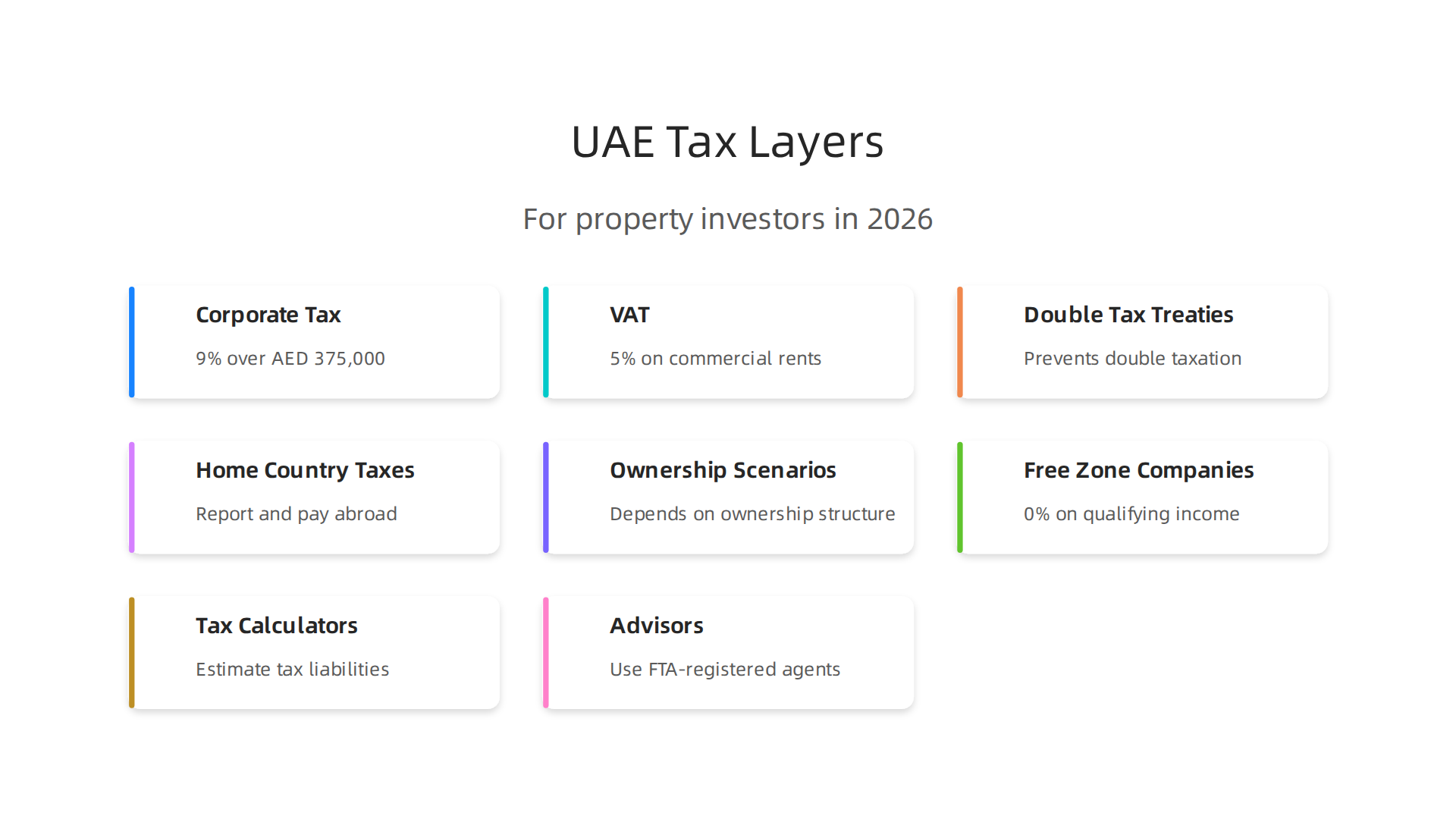
Yes, you pay zero personal income tax on your salary or rental income as an individual. But in 2026, other taxes matter just as much.
First, the big change. In June 2023, the UAE introduced a 9% corporate tax. This tax applies to business profits above AED 375,000. For property investors, this means your rental income from commercial properties may be subject to corporate tax if you hold them through a company. Even residential property held through a company can be affected. Individual investors who lease property in their own name without a business license are not subject to corporate tax. That distinction between individual and corporate holding is crucial.
Second, there is VAT. Rental income from residential property is exempt from VAT. But commercial property rents are subject to 5% VAT. If your total taxable supplies exceed AED 375,000 per year, you must register for VAT and file returns. This goods services tax adds to your compliance work.
Third, your home country still matters. The UAE does not tax your personal income, but your home country may. US citizens, for example, must file and report foreign assets. UK investors may need to report overseas income. Using an income tax calculator can help you estimate your total tax bill across both countries.
Understanding these layers helps you choose the right structure. Some investors keep properties in their personal name to stay outside corporate tax. Others use a free zone company for a 0% rate on qualifying income. The right choice depends on your situation.
For more on how to set up your investment for tax efficiency, check out this guide on mastering Dubai real estate business taxes for investment growth. If you hold property through a company, you need to understand the full rules. The official UAE government portal provides a corporate tax overview that explains who must register and what rates apply.
Corporate Tax on Rental Income
The 9% corporate tax does not apply to every property investor the same way. It depends on what you own and how you hold it.
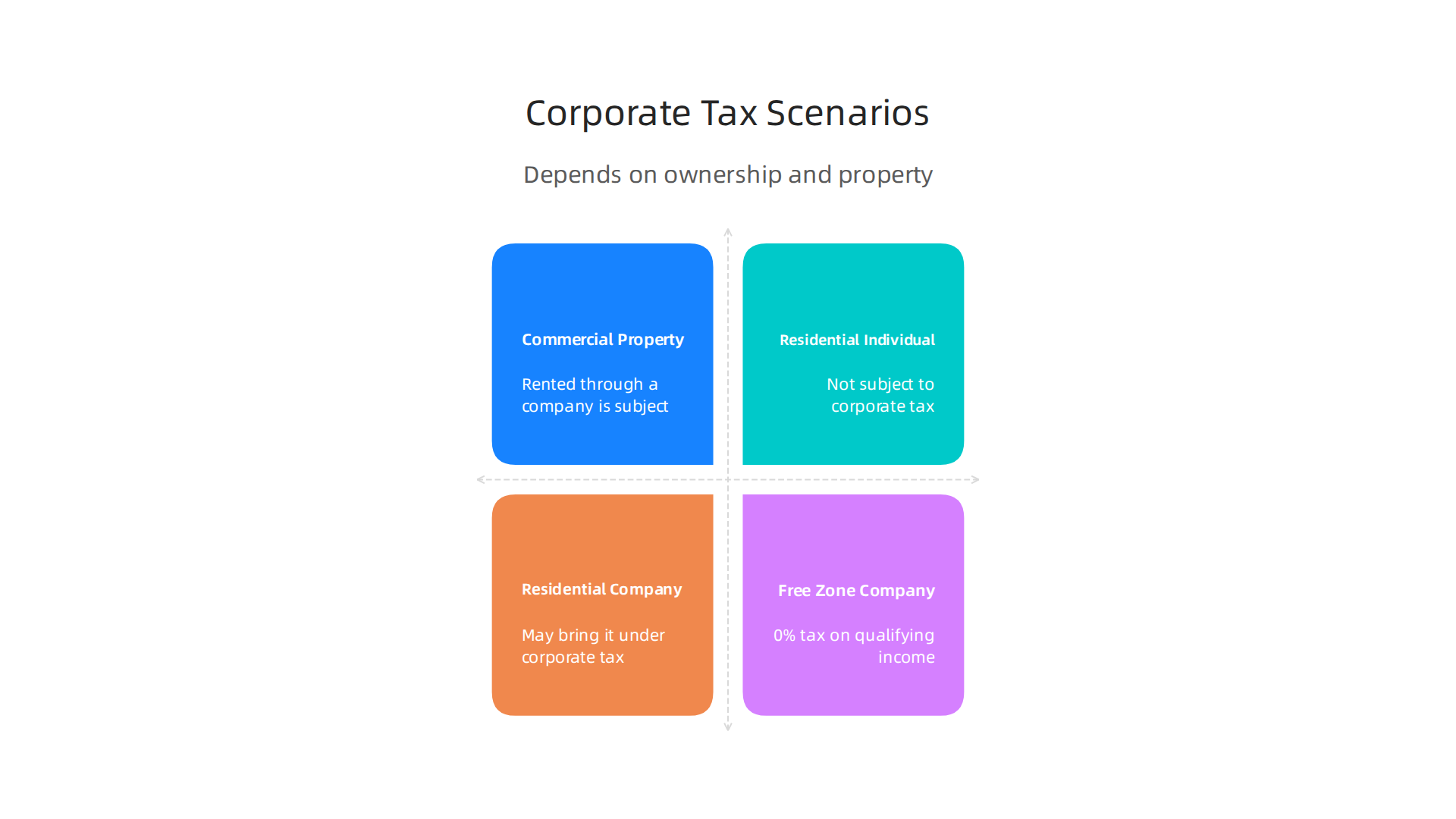
Commercial property rented through a company is clearly subject to corporate tax. Taxable income up to AED 375,000 per tax period is taxed at 0%. Any amount above that is taxed at 9%. The EGSH guide on corporate tax on rental income in Dubai 2026 breaks this down clearly.
Residential property is different. If you own a villa or apartment in your personal name and rent it without a business license, the rental income is not subject to corporate tax. But holding that same property through a company may bring it under corporate tax. Tax authorities often test this line.
Free zone property companies have an advantage. A Qualifying Free Zone Person (QFZP) can earn 0% corporate tax on qualifying income. But non-qualifying income is taxed at 9% with no AED 375,000 threshold. Meeting compliance requirements is essential.
To compare different structures, use an income tax calculator that accounts for both UAE corporate tax and your home country taxes. This is a key part of tax strategies for high income earners who own property across borders. Working with an advisor who handles accountant taxes in the UAE helps you choose the right setup from the start.
For a detailed breakdown of different ownership setups, read this guide on how UAE corporate tax affects your Dubai property investment structure.
If you need personalized advice on structuring your investment, get a FREE Dubai Real Estate Consultation with someone who understands the full picture.
VAT on Property Transactions
Now let’s talk about Value Added Tax (VAT). This is a 5% tax that applies to many goods and services in the UAE. You can think of it like a goods services tax (GST) used in other countries.
So what does VAT mean for property investors?
Residential property sales are generally exempt from VAT. If you sell a villa or apartment in your personal name, you do not charge VAT to the buyer. But commercial property sales are subject to 5% VAT. That means if you sell a shop or office, you must add 5% VAT on top of the sale price.
VAT also applies to other costs. Service charges, agency fees, and property management services all attract 5% VAT. You need to budget for these when you buy or manage a property.
There is an important registration rule. If your total annual supplies (including rental income from commercial property) exceed AED 375,000, you must register for VAT with the Federal Tax Authority. This is separate from corporate tax registration. The 2026 UAE tax guide for expats explains that VAT applies across all emirates.
You might wonder how VAT affects your overall tax picture. When you add VAT to the mix, using an income tax calculator that covers both corporate tax and VAT can help you see the full financial picture. This is part of smart tax strategies for high income earners who invest in property. An accountant taxes expert in UAE regulations can help you register correctly and avoid penalties.
For a deeper look at managing taxes for your property business, check out this guide on mastering Dubai real estate business taxes.
Cross-Border Tax Implications & Double Taxation Treaties
If you invest in Dubai property but live in another country, you might worry about paying tax twice. Your home country could tax your Dubai rental income or capital gains on top of what you pay in the UAE. That’s where double taxation treaties (DTAs) come in.
The UAE has signed 193 double taxation agreements with countries around the world.

These Double Taxation Agreements help you avoid paying tax twice on the same income. How? They decide which country gets to tax what.
For example, under the 2016 UK-UAE treaty, if you pay corporate tax in the UAE, the UK allows you to deduct that amount from your UK tax bill. The UK-UAE Double Taxation Convention explains these rules in detail. But here’s the key: you must prove you are a tax resident of the UAE. Tie-breaker rules help determine your residency based on where you live, work, and have your permanent home.
Many expat investors miss a big opportunity. They forget to claim foreign tax credits for UAE corporate tax they already paid. This leads to double taxation that could have been avoided.
That’s where an income tax calculator becomes your best friend. A good calculator that includes treaty benefits can show your real tax bill after credits. But you need the right numbers. An accountant taxes expert who knows UAE and home-country rules can make sure you claim every credit you deserve. This is one of the top tax strategies for high income earners who invest across borders.
To understand how your property investment structure affects your taxes, check out this guide on how UAE corporate tax affects your Dubai property investment structure.
If you’re investing in Dubai property and want to navigate these rules confidently, FREE Dubai Real Estate Consultation can connect you with an expert who understands international tax treaties.
Top Income Tax Calculators for Property Investors
Once you understand how double taxation treaties work, the next step is to estimate your actual tax bill.

That’s where an income tax calculator becomes essential. These tools help you figure out what you might owe your home country on rental income and capital gains from your Dubai property.
Some calculators are built specifically for UAE expats. They include the details of double taxation agreements and the UAE’s 9% corporate tax. This makes your estimate much more accurate.
But picking the right calculator depends on a few things. Your residency status, the type of property you own, and whether a tax treaty covers you all matter. A tool for a UK resident investing in Dubai won’t work for a US citizen. Here are some examples:
-
For UK residents: The UK offers a Personal Allowance of £12,570. If your total income stays below that, you may not owe UK income tax. If it’s higher, you pay 20% to 45%. A good calculator can factor in these brackets. The non-resident UK tax calculators from Experts for Expats are a helpful starting point.
-
For US citizens: The US taxes worldwide income, even if you live in Dubai. You can use the Foreign Earned Income Exclusion (FEIE) to shield up to $132,900 in 2026. A US expat tax calculator that includes the FEIE and Foreign Tax Credit can show your true tax burden.
-
For German investors: Germany taxes non-residents at progressive rates from 14% to 45%, plus a 5.5% solidarity surcharge. You need a calculator that handles those rules.
After you get a calculator estimate, you should review it with an accountant taxes specialist. They can confirm your foreign tax credits and make sure you don’t miss any deductions. This is one of the smartest tax strategies for high income earners who own property abroad.
Working with a professional also helps you plan ahead. If you need a complete guide on filing taxes for your Dubai property company, check out this Dubai property investor tax filing guide. It walks you through the steps to stay compliant and avoid penalties.
Calculators for Rental Income in Your Home Country
Even with a good income tax calculator, you need to be careful when using tools from your home country. Many online calculators were built for local rental income and don’t automatically handle the UAE’s 0% personal income tax or your double taxation treaty.
Take the UK as an example. The official UK tax guidance on tax on foreign income says you must report worldwide rental earnings. So you could use the UK HMRC rental income calculator to estimate what you owe. But that calculator assumes your Dubai rental is fully taxable in the UK. It won’t automatically subtract the foreign tax credit you’re entitled to under the UAE-UK treaty.
The same issue happens with Canada’s online estimator or Australia’s myTax tool. These calculators don’t know that the UAE doesn’t tax rental income at the individual level. So they may overstate your bill by a lot.
Here’s what you need to do:
- Run the calculator with your Dubai rental income.
- Take the tax it shows.
- Then manually apply your foreign tax credit. In most cases, the credit equals the tax you would have paid in the UAE (which is zero for individuals). That reduces your home country tax to near zero.
Always double-check. A standard calculator works for basic planning, but it’s not the final word. Understanding how UAE corporate tax affects your Dubai property investment structure will help you see the full picture, especially if you own through a company.
If this sounds complex, you don’t have to figure it out alone. A specialist can walk you through the numbers. Connect with Ayaz Salman for a FREE Dubai Real Estate Consultation and get clear on your exact tax situation.
Calculators for UAE Corporate Tax on Rental Income
Now let’s look at calculators made for the UAE itself. The Federal Tax Authority (FTA) offers a basic corporate tax calculator for small businesses. But it is very general. It does not dig into the details of real estate income. For example, it may not separate rental income from other business income. That can lead to wrong numbers.
Third-party tools fill this gap. Law firms like Baker McKenzie and Al Tamimi provide calculators that include special sections for rental income and real estate expenses. These tools are built with property investors in mind. They help you account for things like service charges, maintenance costs, and management fees.
A good UAE corporate tax calculator should do three specific things:
- Include the AED 375,000 tax-free threshold.
- Let you add all deductible expenses.
- Handle the timing of when you receive rental payments.
Many online tools miss these. The PwC tax summary for the UAE points out that real estate investment income is not counted when deciding if your business exceeds the AED 1 million turnover threshold for corporate tax. So a calculator that does not know this rule could overestimate your tax bill.
For a complete picture, look for a Property Tax Calculator for UAE Properties that covers both personal and corporate scenarios. Then double-check your numbers with a tax professional. Understanding the full tax landscape helps you avoid surprises. Read more about mastering Dubai real estate business taxes for investment growth to build a smarter tax strategy.
Capital Gains Tax Considerations and Calculators
When you sell a property in Dubai, the good news is that the UAE charges no capital gains tax. This is a huge advantage. But here is the catch: your home country may still want a piece of that profit. If you sell while you are still a tax resident in your home country, or if you move back after selling, you could face a tax bill there.
That is where a good capital gains tax calculator becomes important. But not just any calculator will do. It needs to include the rules from the UAE’s Double Taxation Agreements (DTAs). The UAE has signed many of these agreements with countries like the UK, India, and Canada. Some DTA articles give the UAE the exclusive right to tax capital gains from property there. That means your home country cannot tax that gain. This is a huge benefit that many investors miss.
A proper calculator should ask about how long you owned the property. It should also check if your home country has a DTA with the UAE and what the treaty says about capital gains.
For example, the UAE Ministry of Finance double taxation agreements page shows the growing network of treaties. And resources like how UAE corporate tax affects property investment structure help you understand how these rules apply to your situation.
Getting this right can save you thousands. If you are buying, selling, or investing in Dubai, getting professional advice is a smart move. You can connect with Ayaz Salman for a free consultation to discuss your specific situation.
Essential Tax Planning Resources for Dubai Property Investors
To build a solid investment plan, you need the right tools. Beyond capital gains, other taxes and fees will affect your returns. Luckily, several excellent resources are available in 2026.
The first stop is the UAE Federal Tax Authority (FTA) website. It offers clear guides on corporate tax and VAT. For example, the FTA’s October 2024 guidance on real estate investment income clarifies when rental income is taxed. You can review the detailed rules around Corporate Tax on Rental Income in Dubai 2026 to see how they apply to your properties. The FTA also provides e-services for registration and filing returns on the EmaraTax portal.
Next, professional bodies offer excellent support. Organizations like ACCA and ICAEW provide country-specific tax planning sheets for expats. These sheets help with tax strategies for high income earners moving to or investing in the UAE. They work alongside a good income tax calculator from your home country to show you the full picture of your global tax bill.
Finally, do not overlook the Dubai Land Department’s fee calculators. These tools help you estimate transaction costs like the 4% transfer fee, registration fees, and title deed issuance fees. Knowing these costs upfront is key to calculating your net profit. The guide on Property Taxes, Fees and Costs in the UAE (2026) breaks down exactly what you will pay at each stage of a purchase.
Using these resources together gives you a complete view of your finances. You will know your tax obligations, your filing deadlines, and your true net returns. This turns a good investment into a great one.
Government Portals and Publications
The most reliable source for tax rules is always the official government portal. For property investors in the UAE, three main bodies publish the regulations you need to know.
The Federal Tax Authority (FTA) website is your first stop for corporate tax and VAT legislation. Its 2026 guides break down exactly how the 9% corporate tax applies to rental income earned through a company. The FTA also provides e-services and tax calculators on its EmaraTax portal. These tools function like a basic income tax calculator for your UAE obligations. Reviewing the Key UAE Real Estate Tax Investment Considerations from a trusted advisor can further clarify how FTA rules apply to your situation.
Next, the Dubai Land Department (DLD) and the Real Estate Regulatory Authority (RERA) publish fee schedules and circulars. These are essential for calculating your transaction costs. For a complete guide to the 4% transfer fee and other municipal charges, you can read about Understanding Property Tax in the UAE on a specialized business briefing site.
Finally, the Ministry of Finance issues important circulars on international tax matters. This includes updates on Double Taxation Agreements (DTAs) with other countries. These agreements are vital for building effective tax strategies for high income earners who own property abroad. For a deeper dive into structuring your investments around these rules, check out this guide on how UAE corporate tax affects your property investment structure.
Of course, reading official documents can feel overwhelming. If you prefer a clear, personalized walkthrough for your situation, it helps to speak with an expert.
FREE Dubai Real Estate Consultation
Professional Advisory Services and Credentialed Experts
That is where professional advisory services come in. A UAE-licensed tax agent registered with the Federal Tax Authority (FTA) can turn your confusion into clarity.

The rules around corporate tax on rental income are nuanced, especially for complex structures like free zone companies or SPVs. A qualified agent understands the latest guidance, such as the FTA’s Corporate Tax Guide for Real Estate Investment. They ensure you file correctly and avoid penalties. For a deeper look at how these rules apply to different property setups, you can read more about corporate tax on rental income in Dubai 2026.
International firms like PwC, EY, KPMG, and Deloitte have dedicated expat tax services for real estate. They are ideal if your portfolio includes properties in multiple countries or if you need cross-border tax strategies. However, their fees can be high for smaller investors.
For more personalized help, local boutique firms are a strong alternative. They often charge lower fees and provide direct access to a partner. An experienced accountant taxes expert in a boutique firm can go beyond what a simple income tax calculator offers. They will evaluate your goods services tax (VAT) obligations on both residential and commercial leases. They can also design custom tax strategies for high income earners that minimize your total liability.
To get started with filing, check out this tax filing guide for Dubai property investors.
How to Choose the Right Income Tax Calculator: A Comparison
Before you file your returns, you need accurate numbers. An income tax calculator can help you estimate what you owe or what you might save. But here is the catch: not all calculators work the same way for Dubai property investors.
Your situation is unique. You may earn rental income in the UAE (where there is no personal income tax) but still owe tax in your home country. A basic calculator that only handles one country will give you a misleading result. To get a clear picture, you need a tool that handles both UAE corporate tax rules and home-country foreign tax credits.
So what should you look for? Here are the key criteria:
- Supports multiple jurisdictions. The calculator should handle your home country’s tax system alongside UAE rules.
- Updated for 2026 law changes. Tax brackets, allowances, and exemptions change every year. A good calculator reflects the latest rates.
- Includes deductions and credits. Things like maintenance costs, property management fees, and foreign tax credits can lower your bill.
- Produces clear reports. You need a simple summary you can share with your accountant taxes expert.
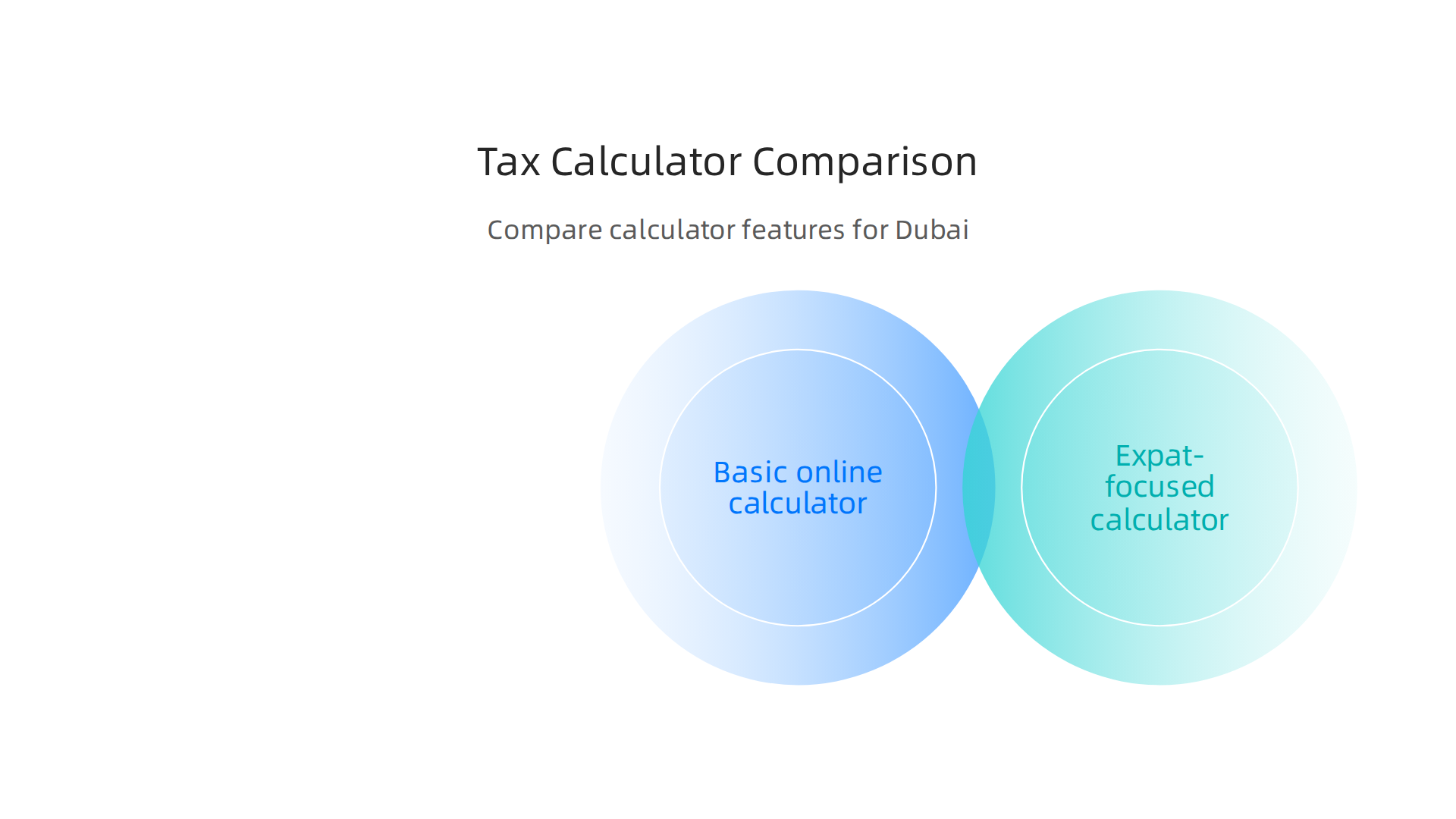
To help you compare, here is a quick table of what different types of calculators can offer:
| Tool Type | Multiple Jurisdictions | 2026 Updates | Deductions & Credits | Clear Reports |
|---|---|---|---|---|
| Basic online calculator | No | Sometimes | Limited | No |
| Expat-focused calculator | Yes | Yes | Yes (including Foreign Tax Credit) | Partial |
| Specialized UAE property calculator | Yes | Yes | Yes (including goods services tax and rental expenses) | Yes |
For example, if you are a US citizen living in Dubai, a general income tax calculator will miss the Foreign Earned Income Exclusion. A dedicated US expat calculator, like the one explained in this U.S. Expat Tax Calculator guide, automatically applies the FEIE and FTC so you get a true estimate.
If you are a UK expat, you need a calculator that accounts for the UK personal allowance and the special rules for non-resident landlords. The Non-Resident UK Tax Calculators from Experts for Expats can handle that.
The best tool depends on your specific portfolio. If you own property only in Dubai, a UAE-focused calculator may be enough. If you own properties in multiple countries, an expat calculator is better. And if you are a high income earner, you may need custom tax strategies beyond what any calculator can offer.
After you estimate your numbers, you need to take action. Use your calculations to plan your filing or start a conversation with a professional. If you are buying, selling, renting, or investing in Dubai and want personalized guidance, you can get a FREE Dubai Real Estate Consultation with an expert who understands the full picture.
For a deeper look at how UAE corporate tax interacts with your property structure, read this guide on Dubai real estate investment strategies for 2026.
Summary
This article explains what Dubai’s