
Co Investment Real Estate in Dubai Lets You Own Premium Property for Less
· 21 min read

Introduction
Dreaming of investing in Dubai’s world-famous property market but feel priced out? You are not alone. Luxury towers, beachfront villas, and off-plan developments in prime areas often come with price tags that feel out of reach for many individual investors. High entry costs can make property investment feel like a closed club.
But there is another way. Co investment real estate lets you pool your money with others to buy premium Dubai properties.

Instead of needing millions upfront, you can own a share of a high-value asset for a fraction of the cost. You also share the risk with other investors. This approach opens doors that used to stay locked for most people.
Here is the thing. Dubai regulates these arrangements carefully. The Dubai Land Department and RERA oversee property transactions to protect your rights. Recent rules like Decree No. 22 of 2022 create a clear legal framework for real estate investment funds. And if you are looking at jointly owned property, each investor must hold a minimum share valued at AED 400,000 to qualify for certain residency benefits.
This guide gives you research-backed, unbiased insights into how co investment works in Dubai. You will learn how to find a trustworthy real estate investment company, what legal protections exist, and how to run proper due diligence before you commit.
Whether you are a first-time buyer or an experienced investor looking to diversify, this article helps you make smarter choices. Let us get started.
If you want personalized help choosing the right partner, <CTA>
What Is Co-Investment in Real Estate?
Let us start with a simple definition. Co investment real estate happens when a group of investors pools their money together to buy a property or a portfolio of properties. Each person owns a share. Each person shares in the rental income and any profit from selling the asset later.
Think of it like buying a pizza with friends. You each chip in, you each get a slice, and you each enjoy the meal. The same idea applies to property. Instead of needing millions of dirhams to buy a luxury apartment in Downtown Dubai or a villa on Palm Jumeirah, you can own a fraction of that asset for a much smaller amount.
As Hamilton Lane explains, this approach allows multiple parties to combine their financial resources, expertise, and networks to make a joint investment and share in the potential profits.
Common Co-Investment Structures
There is more than one way to structure a co-investment deal. Here are the most common ones you will encounter in Dubai:
-
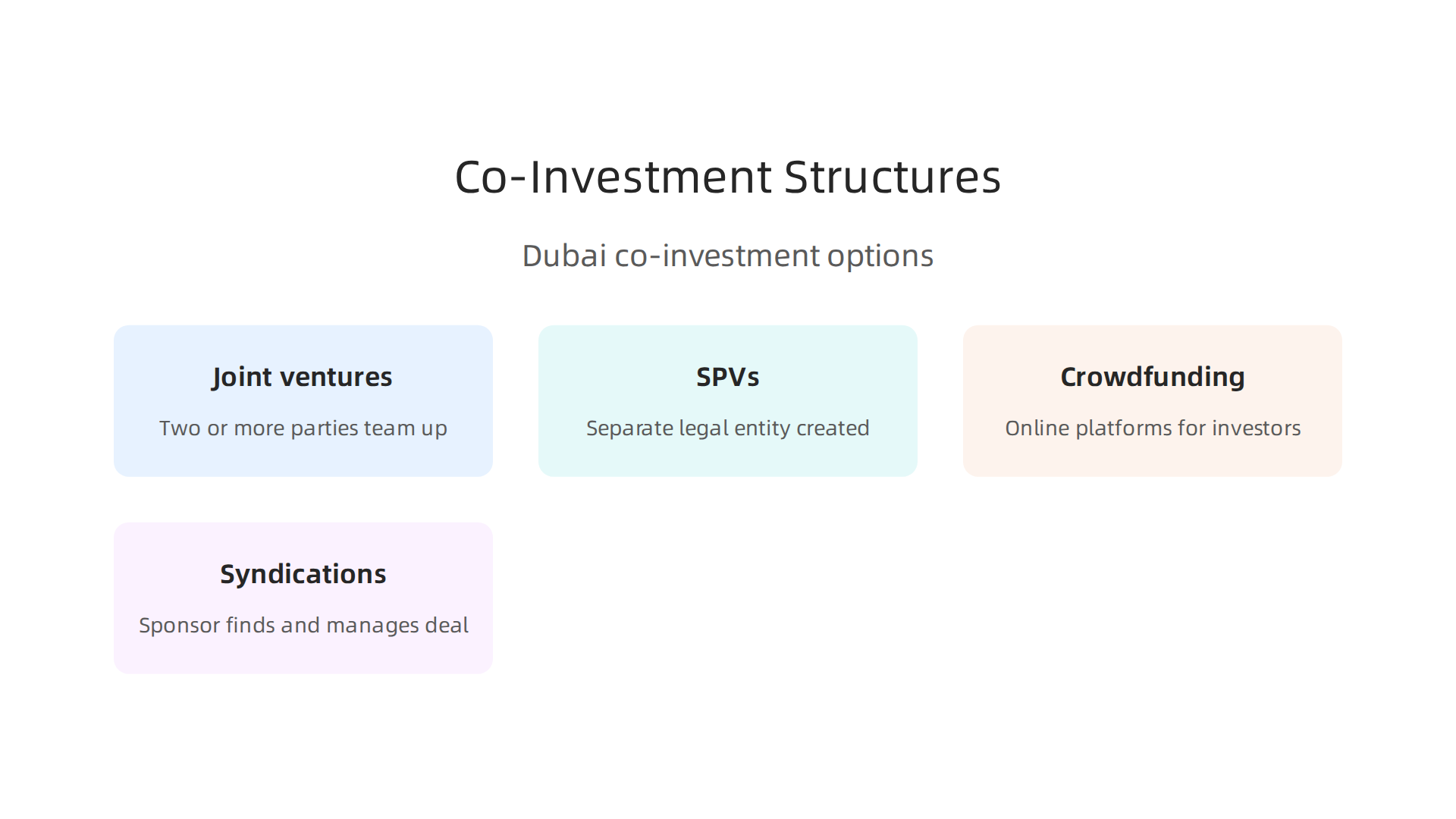
Joint ventures (JVs): Two or more parties team up to buy and manage a property together. Each party brings something to the table, whether it is capital, expertise, or both. NAIOP notes that joint ventures are becoming a popular route for investors looking to enter new markets.
-
Special purpose vehicles (SPVs): A separate legal entity is created just for one investment. This structure protects each investor by keeping the asset separate from your personal finances. It also makes it easier to sell your share later.
-
Real estate crowdfunding platforms: Online platforms let you browse properties and invest with just a few clicks. These platforms handle the legal paperwork and property management for you.
-
Syndications: A sponsor or a real estate investment company finds the deal, puts together the financing, and manages the property. Passive investors provide most of the capital and receive regular income distributions.
According to Altus Group, real estate funds are typically created when a sponsor or general partner sets up a fund and invites limited partners to invest alongside them. The Carta guide on co-investments adds that these are minority investments made directly into a portfolio company or asset.
Why Co-Investment Makes Sense in Dubai
Dubai’s property market is famous for high-value assets and exclusive off-plan developments. A prime apartment in the Dubai Marina or a villa in Emirates Hills can cost millions. Most individual investors simply cannot afford that alone.
That is where co investment real estate becomes a game changer. By pooling resources, you can access prime locations that were previously out of reach. You also spread your risk across multiple investors, which can make each deal safer than going in alone.
A real estate investment company in Dubai typically structures these deals so that passive investors earn regular income without having to manage the property themselves. The sponsor finds the deal, handles the due diligence, and oversees the day-to-day operations.
If you are evaluating a potential partner, you need to run proper checks. Our guide on how to choose a real estate investment company in Dubai walks you through the exact steps to verify their track record and legal compliance.
Also keep in mind that the way you structure your co-investment can affect your tax situation. The UAE corporate tax rules may apply differently depending on whether you invest directly or through a fund. It is wise to understand these implications before you commit.
Ready to explore your first co-investment opportunity? Connect with Ayaz Salman on WhatsApp for a free consultation. He can help you find the right structure and partner for your goals.
The Benefits of Co-Investment for Dubai Investors
Now that you understand what co-investment looks like and how the different structures work, let us talk about why so many people in Dubai are choosing this path. The benefits go beyond simply splitting the cost with others.
Lower Capital Requirement
The most obvious advantage is that you need much less money to start. In Dubai, a single apartment in a prime area can easily cost AED 2 million or more. A villa in Palm Jumeirah can run into the tens of millions. For most people, that is simply out of reach.
With co investment real estate, you can own a slice of that same asset for AED 100,000 or even less. This opens the door to premium locations that would otherwise stay on your wish list forever.
Dubai’s market continues to grow in 2026. According to the Dubai Property Market Forecast, the city is expected to add around 42,000 new units this year alone. More supply means more co-investment opportunities, especially in high-demand areas.
Diversification
Putting all your money into one property is risky. If that market dips, your entire investment takes a hit. Co-investment lets you spread your capital across multiple deals.
You can invest in a luxury apartment in Dubai Marina, a commercial unit in Business Bay, and a hospitality project on Palm Jumeirah all at the same time. If one sector slows down, the others may keep performing well. The Emerging Trends in Real Estate 2026 report from PwC highlights how institutional investors are increasingly looking at real estate to balance their portfolios. You can do the same thing, but with much smaller amounts.
This kind of diversification helps you sleep better at night. You are not betting everything on a single outcome.

Access to Institutional-Grade Deals
This is perhaps the biggest game changer for individual investors. Some of the best real estate deals in Dubai are only offered to large funds, family offices, and institutional investors. These deals often come with better pricing, stronger locations, and professional management.
Through a trusted real estate investment firm, you can now access these same opportunities. You get the same terms that big players receive, without needing millions of dollars.
As McKinsey notes in their Global Private Markets Report, real estate is moving from stabilization to selective acceleration in 2026. The timing is right to get into institutional-quality assets through co-investment.
Of course, finding the right partner is critical. You want a real estate investment company that has a proven track record, transparent deal terms, and a clear exit strategy. That is why doing your homework matters so much.
If you are serious about exploring co-investment in Dubai, the next step is simple. Connect with Ayaz Salman on WhatsApp for a free consultation. He can help you find the right opportunities that match your goals and budget.
Navigating the Risks: Dubai’s Regulatory Environment
Every investment has some risk, and co-investment is no different. But here is the good news: Dubai has one of the most transparent real estate regulatory systems in the world. If you understand the rules, you can protect yourself.
The Main Risks You Need to Know
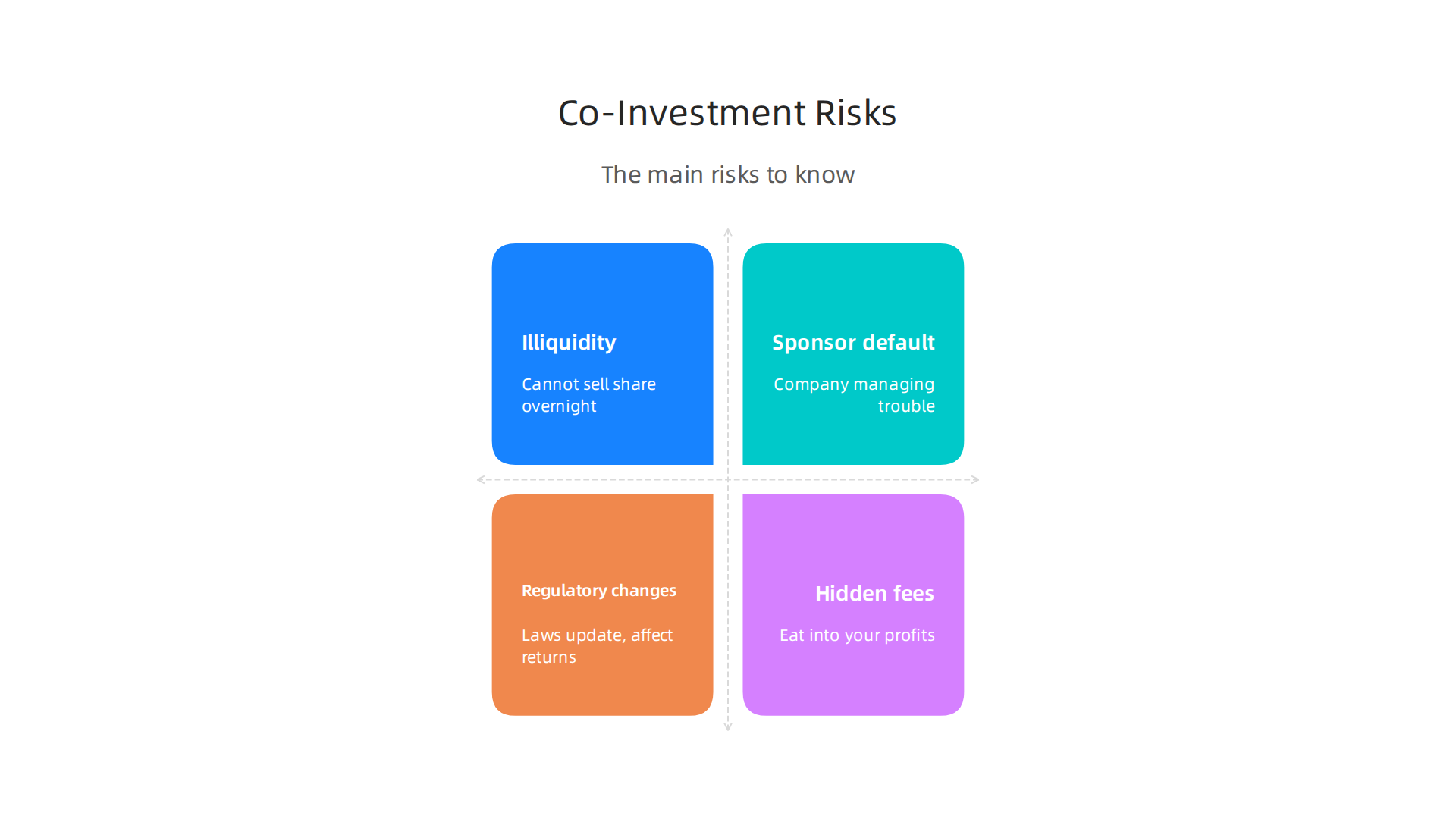
Illiquidity is the biggest concern. Unlike stocks, you cannot sell your share of a property overnight. If you need cash fast, you might have to wait months to find a buyer for your stake. That is why you should only co-invest money you will not need in the short term.
Sponsor default is another real risk. The company or person managing the co-investment could run into trouble. They might mismanage the property or even go bankrupt. That is why choosing a trustworthy real estate investment company matters so much. You want a partner with a solid track record and clear transparency.
Regulatory changes can also affect your returns. Dubai’s government regularly updates real estate laws to protect investors and keep the market healthy. For example, in May 2026 the city revised its investor visa rules. According to KPMG’s analysis of the new rules, investors in jointly owned properties must now hold a minimum share valued at AED 400,000. That change directly affects how you structure your co-investment.
Hidden fees can eat into your profits. Some platforms charge management fees, exit fees, or transaction costs that you may not see upfront. Always ask for a full fee schedule before you commit.
How Dubai’s Regulations Protect You
Dubai’s real estate market is regulated by two main bodies: the Dubai Land Department (DLD) and the Real Estate Regulatory Authority (RERA).

RERA was established by Sheikh Mohammed bin Rashid Al Maktoum to oversee the sector and ensure fair practices. As explained in the RERA guide by Manage My Property, it sets rules for developers, brokers, and property transactions.
For co-investment, three key documents matter:
- Ejari registration – This system records your tenancy contract with the government. If your co-investment involves a rental property, make sure your share is registered properly.
- Oqood – If you are investing in off-plan property, Oqood registers your sale with the DLD. It proves you have a legitimate claim to the unit.
- Title deed – Once the property is completed, the title deed shows who owns it. In a co-investment, your name and share percentage should be clearly listed.
Always verify that the real estate investment firm you work with complies with RERA regulations regarding co-ownership and sales. The Engel & Völkers overview of Dubai real estate laws reminds us that these laws exist to ensure transparency and investor protection.
Your Mitigation Checklist
Before you invest in any co investment real estate opportunity, do these three things:
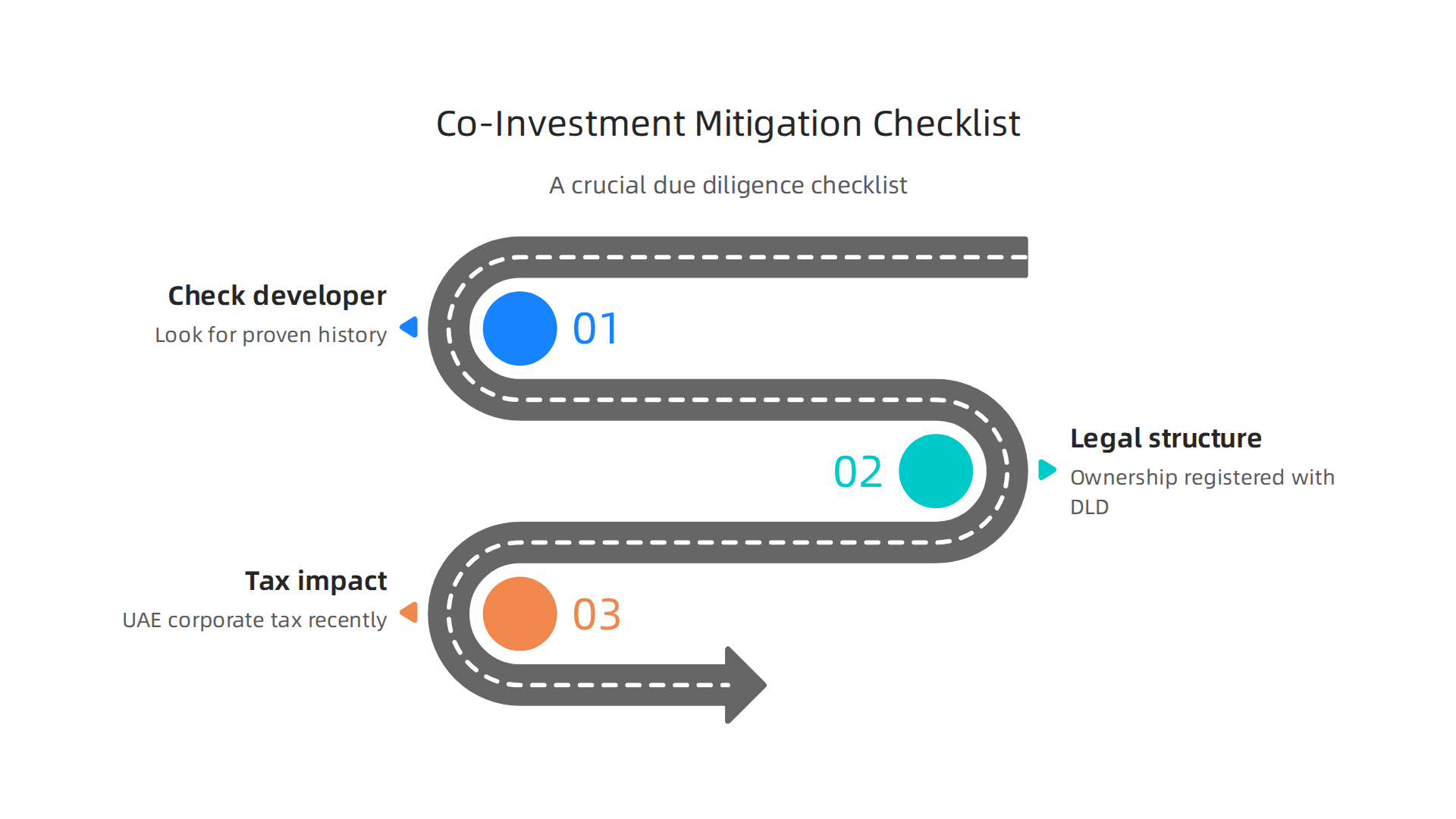
- Check the developer or sponsor. Look for a proven history of successful projects. Read our due diligence guide to choosing a real estate investment company for a step-by-step process.
- Understand the legal structure. Ask if your ownership is registered with DLD, if Ejari applies, and if Oqood is in place for off-plan projects.
- Know how taxes affect your returns. The UAE introduced corporate tax recently, and it can impact your investment structure. Learn more in our article on how UAE corporate tax affects your Dubai property investment structure.
Dubai’s regulatory environment is built to help you invest with confidence. But you still need to do your homework. If you want personalized guidance on navigating these rules, our team is ready to help. Contact us for tailored advice on your next co-investment step.
Legal Structures and Compliance for Co-Investment
Now that you know the risks, let’s talk about the actual legal structure that holds your investment. This is where most people get confused. But honestly, it does not need to be that complicated. You just need to know the main options and what each one means for you.
Common Legal Vehicles for Co-Investment
When you pool money with others, the investment needs a legal home. Here are the three most common structures used for co investment real estate in Dubai.
- Limited Liability Company (LLC) – This is a separate legal entity. You and your co-investors become shareholders. The LLC owns the property. If something goes wrong, your personal assets are protected. But LLCs come with setup costs and ongoing compliance.
- Special Purpose Vehicle (SPV) – Think of this as a shell company created just for one property. Many real estate investment firms use SPVs to keep each project separate. This makes it easy to add or remove investors. The Dubai Land Department recognizes SPVs as valid ownership structures.
- Property Holding Company – This is similar to an LLC but focused only on holding real estate. It is a cleaner setup if you plan to buy multiple properties with different groups of people.
According to a Driven Properties guide, Dubai’s property laws in 2026 require all co-ownership arrangements to be clearly recorded with the DLD. Your name and share must appear on the official records.
DLD Requirements You Cannot Ignore
The Dubai Land Department has specific rules for co-ownership. Here is what you need to know.
- Registration of co-ownership – Your stake must be registered with the DLD. This is not optional. It protects your claim.
- Trustee services – Some co-investments use a trustee who holds the property on behalf of all investors. The trustee must be licensed by RERA.
- Transfer fees – When you buy into a co-investment, you pay a transfer fee to the DLD. This is usually 4% of the property value. Make sure your agreement states who pays this.
The Dubai Land Department official rules page confirms that all these requirements exist to protect investors. Always verify that your real estate investment company follows them.
Tax Considerations
Here is the good news. The UAE has no personal income tax. So your rental income from a co-investment is tax-free at the individual level.
But there is a catch. If your co-investment uses a company structure like an LLC or SPV, corporate tax may apply. The UAE introduced corporate tax in 2023. For most small co-investment entities, the rate is 9% on profits above AED 375,000.
This is important. You need to structure your investment wisely to avoid unexpected tax bills. Read our detailed guide on how UAE corporate tax affects your Dubai property investment structure to understand the full picture.
Also, the new real estate funds law introduced in 2022 creates additional options for pooled investments. If you are working with a larger group, this law might apply to you.
Your Next Step
Co-investment can be a smart way to enter the Dubai property market. But the legal side matters. A small mistake in the structure can cost you later.
If you want to set up a property investment with a clear legal framework, talk to someone who knows the rules. Connect with Ayaz Salman on WhatsApp for a free consultation. He can help you choose the right structure and avoid the common traps. You can also contact us for tailored guidance on your next co-investment step.
How to Evaluate and Conduct Due Diligence on Co-Investment Opportunities
You have the legal structure in place. Now comes the harder part. How do you know if the co-investment opportunity itself is any good? This is where most people lose money. They get excited about the numbers and skip the checks.
Due diligence is your safety net. It is the process of verifying everything before you hand over your cash.

Let us break it into three simple areas.
Sponsor Due Diligence
The sponsor is the person or company leading the co investment real estate deal. They find the property, manage the process, and often handle operations. You need to trust them completely.
- Track record – How many deals have they done before? Ask for references. Check if they have completed projects on time and on budget.
- Financial stability – Are they in good financial shape? A sponsor with debt problems might make bad decisions. Run a basic check through the Dubai Land Department or ask for audited accounts.
- Skin in the game – The best sponsors invest their own money too. If they have nothing to lose, you should walk away.
According to the Engel & Völkers risk guide, one of the main risks in Dubai property is legal complexity, which includes working with sponsors who do not follow proper procedures. Do not skip this step.
Property Due Diligence
Once you trust the sponsor, check the property itself.
- Title deed verification – Get a copy of the title deed from the DLD. Make sure the seller actually owns the property. The UAE real estate sale rights update confirms that buyers should always obtain title searches from the DLD.
- Encumbrances – Check if there are any mortgages, liens, or legal disputes on the property. A clean title is a must.
- Valuation – Is the price fair? Get an independent valuation from a certified appraiser. Do not rely only on the sponsor’s numbers.
- Rental yield analysis – If the property will generate income, calculate the expected return. Look at comparable properties nearby. The Oliva due diligence checklist has a full list of 25 items to verify.
For a deeper look at choosing a trustworthy partner, read our full guide on how to choose a real estate investment company in Dubai.
Fee Transparency
Hidden fees can ruin your returns. Before you commit, ask for a complete breakdown of all costs.
- Management fees – What percentage goes to the sponsor each year? Typical fees range from 1% to 3% of the property value.
- Performance fees – Does the sponsor take a cut of profits above a certain return? This is common but should be clearly defined.
- Exit fees – If you want to sell your share early, what are the penalties? Some deals lock you in for years.
The general UAE due diligence guide emphasizes that understanding all financial terms upfront prevents nasty surprises later. Always get everything in writing.
Your Next Step
A good real estate investment firm will welcome your questions. If they get defensive or rush you, that is a red flag. Take your time. Due diligence is not optional. It is what separates smart investors from those who lose money.
If you want help evaluating a co-investment deal, connect with Ayaz Salman on WhatsApp for a free consultation. Or contact our team for personalized advice on your next property investment move.
Co-Investment vs. Direct Ownership: A Comparative Analysis
So you have done your checks on the sponsor and the property. Now you face a bigger question. Should you buy a property yourself or invest through a co investment real estate deal?
Both paths can work. But they are very different. Understanding the trade offs helps you pick the right one for your situation.
Let us compare the three biggest differences.
| Factor | Co-Investment | Direct Ownership |
|---|---|---|
| Capital Outlay | Low entry. Start with AED 50,000 or less. | High entry. You need 20% to 30% down payment plus closing costs. |
| Control | Low. The sponsor or manager makes most decisions. | Full. You choose the property, tenant, and exit strategy. |
| Liquidity | Low. Most deals have a fixed lock up period of 3 to 7 years. | Medium. You can sell on the secondary market, but it can take months. |
Capital Outlay
This is the biggest reason people choose co investment real estate. You do not need hundreds of thousands of dollars. With a co-investment, a group of investors pools their money to buy a larger property. According to the Hamilton Lane introduction, this approach allows multiple parties to combine their financial resources and share in the potential profits. That means you can access premium properties that would be out of reach on your own.
Direct ownership requires a serious chunk of cash. In Dubai, you need a 20% down payment plus a 4% transfer fee paid to the land department, as confirmed in the UAE property taxes guide for 2026. That is a lot of money sitting in one asset.
Control
Here is the trade off. With direct ownership, you call all the shots. You decide when to sell, who to rent to, and how much to renovate. With a co-investment, you hand over control to a sponsor or manager. You are a passive partner. The Gateway PE breakdown explains how sponsors operate and what investors gain, but it also shows that investors hand over decision making.
If you like being hands on and want to pick every detail, direct ownership may fit you better. If you want to let someone else handle the work while you earn, a real estate investment company may be a better fit. For help finding a good partner, read our guide on how to choose a real estate investment company in Dubai.
Liquidity
This catches many people off guard. Co-investments usually have a fixed lock up period. You cannot pull your money out early without paying penalties. The Altus Group guide confirms that real estate funds often have defined holding periods. Direct ownership gives you more flexibility. You can list your property on the market anytime. But selling can take months, especially in a slow market.
Your Next Step
Both options have pros and cons. Co-investment gives you low entry and passive income. Direct ownership gives you control and flexibility. The right choice depends on your goals, your budget, and how much time you want to spend.
If you are still unsure which path fits your situation, connect with Ayaz Salman on WhatsApp for a free consultation. Or contact our team for personalized advice on your next property investment move.
The Future of Co-Investment in Dubai’s Real Estate Market
You have seen how co investment real estate stacks up against direct ownership today. But what about tomorrow? The landscape is shifting fast. Here is what you need to know about the trends shaping co-investment in Dubai right now.
Digital Platforms Are Opening Doors
New technology is making it easier than ever to join a real estate investment company or fund. Fintech platforms now let you browse deals, complete due diligence, and commit capital all from your phone. The Dubai market is expected to add more than 42,000 new units in 2026 alone, according to the GuestReady guide. That flood of supply means more opportunities for co-investors who want to own a slice of premium projects without buying the whole thing.
Regulatory sandboxes from the Dubai government are also helping. They let startups test new investment models under supervision. This reduces risk for everyone involved. The result? A faster, safer way for you to put your money to work.
Big Money Is Moving In
Institutional investors like pension funds, family offices, and insurance companies are using co-investment structures more than ever. According to the King & Spalding playbook, direct investments in the GCC are shifting toward platform-style models that resemble co-investment. These big players bring professional management and deep pockets.
This is good news for you. When institutions get involved, the deals tend to be better vetted and more stable. You ride alongside capital that has its own rigorous checks. Before jumping into any deal, make sure you know how to pick a trustworthy partner. Our guide on how to choose a real estate investment company in Dubai walks you through the red flags and green lights.
Rising Demand for Affordable Housing and Hospitality
Co-investment is not just for luxury towers anymore. Two sectors are attracting serious attention:
- Affordable housing. With Dubai’s population growing fast, demand for mid-market rentals is climbing. Co-investors can buy into developments that target this steady tenant base.
- Hospitality. Short-term rental and hotel projects are another hot area. The Dubai property market forecast highlights strong yields in hospitality zones. Co-investment lets you share in those profits with a smaller check.
What This Means for You
The future of co investment real estate in Dubai looks bright. Digital tools lower the barrier to entry.

Institutional money adds stability. And new sectors give you more ways to diversify your property investment portfolio.
If you are ready to take the next step, do not go it alone. Connect with Ayaz Salman on WhatsApp for a free consultation. Or contact our team to get personalized advice on a real estate investment firm that fits your goals.
Summary
This article explains how co‑investment real estate lets multiple investors pool capital to buy high‑value Dubai properties, opening access to premium locations with much lower entry costs. It outlines common structures—joint ventures, SPVs, syndications and crowdfunding—then reviews the benefits such as lower capital requirement, diversification and access to institutional‑grade deals. The guide explains Dubai’s regulatory framework (DLD and RERA), key documents (title deed, Oqood, Ejari) and the AED 400,000 minimum share rule relevant to residency. You’ll also get practical legal and tax guidance on LLCs, SPVs and corporate tax implications, plus a clear due‑diligence checklist to vet sponsors, property titles and fees. The article compares co‑investment with direct ownership, highlights liquidity and control tradeoffs, and previews future trends like digital platforms and institutional involvement. After reading, you’ll know how to evaluate opportunities, spot red flags, and take the next steps toward a safe co‑investment in Dubai.