
Dubai Property Tax 2026 How to File Corporate Tax and Claim Key Deductions
· 17 min read

Introduction
You bought a Dubai property expecting big returns and a simple tax setup. But in 2026, the rules are different. Corporate tax now applies to many property investors. And without the right help with business taxes, you could overpay or even miss deductions.
Here is the truth. Dubai is still tax-friendly. But it is not tax-free for everyone. If you own property through a company or earn rental income from a licensed activity, you likely owe 9% corporate tax on profits above AED 375,000. The official government guidance on taxation of UAE real estate structures confirms that this rate applies to mainland and free zone entities alike.
Many investors struggle with preparing taxes for small business property holdings. They miss out on legitimate business write off taxes like interest expenses, maintenance costs, and property management fees. Others fail to file on time and risk penalties. The result is lower net returns and unnecessary stress.
This guide will walk you through everything you need to know. You will learn how to file business taxes for your Dubai property company, which deductions you can claim, and how to structure your investments to keep more of your profits. We also cover the 2026 VAT updates and how they affect your rental income.
Whether you are an individual landlord or a company owner, understanding these rules is essential. The goal is simple: pay what you owe, nothing more.

For a deeper look at how holding structures change your tax bill, check out this guide on how UAE corporate tax affects your Dubai property investment structure.
And if you are just getting started or want personalised help, you can connect with an expert. Get your FREE Dubai Real Estate Consultation today to discuss your specific situation and make sure you are on the right track.
Understanding Dubai’s Tax Landscape for Property Investors in 2026
So here is the big picture. Dubai still offers a massive advantage. If you rent out a property in your own name without a business license, your rental income is not subject to corporate tax. That is a huge win for individual investors.
But the moment you hold property through a company or get a trade license for short term rentals like Airbnb, you step into the corporate tax world. From June 2023, companies earning net rental profits above AED 375,000 pay 9% corporate tax. The detailed guidance on corporate tax on rental income in Dubai 2026 confirms this applies to mainland and free zone entities alike.

This is where many investors get confused. They think "Dubai is tax free" and skip the compliance steps. Then they face penalties. Getting professional help with business taxes early can save you thousands in missed deductions and late fines.
VAT rules are different for residential and commercial property. Here is a simple breakdown:
| Property Type | First Sale (new build) | Subsequent Sales & Leases |
|---|---|---|
| Residential | 0% VAT (developer reclaims input tax) | Exempt from VAT |
| Commercial | 5% VAT | 5% VAT |
If you own a commercial property and charge rent, you must add 5% VAT to each invoice. Your tenant pays it. But you also need to register for VAT with the Federal Tax Authority if your taxable supplies exceed AED 375,000 per year. That means preparing taxes for small business real estate holdings now involves VAT filings too.
2026 brought tighter enforcement. The Federal Tax Authority is paying closer attention to property companies that mix residential and commercial income. If you get this classification wrong, you could owe back taxes plus penalties.
Many investors also overlook the interest limitation rule. You can deduct interest expenses on loans for your property, but only up to 30% of your tax-adjusted EBITDA or AED 12 million, whichever is higher. Understanding these limits is a key part of getting the business write off taxes you deserve.
If you want a clearer view of how all these numbers affect your bottom line, this practical guide on how an income tax calculator can help you master Dubai property taxes breaks it down simply.
The landscape is still investor friendly. You just need to know the map.
Key Business Tax Filing Requirements for Property Investors
Knowing the tax rules is one thing. Actually doing the filing is another. In 2026, the Federal Tax Authority in Dubai has clear expectations for property investors who run their business through a company or hold a trade license. Let us break down exactly what you need to file and when.
Register Your Business and File Corporate Tax Returns
The first step is registration. Every revenue-generating property entity must register for corporate tax.

The official guidance on Taxation of UAE real estate structures confirms this applies to all mainland and free zone companies. After registration, you must file a corporate tax return every year.
Your filing deadline is always 9 months after your financial year ends. For companies that follow a January to December financial year, the UAE Corporate Tax Filing Deadline 2026 falls on September 30, 2026. Late filing triggers a fixed penalty, and unpaid tax builds monthly interest. Do not wait until the last week to start preparing your numbers.
Do Not Forget About VAT
If you own commercial property or offer short-term rentals through a licensed business, you likely need to register for VAT. The threshold is the same as corporate tax: AED 375,000 in annual taxable supplies.
The rules around Corporate Tax on Rental Income in Dubai 2026 explain how VAT and corporate tax work together. If you charge rent on a commercial unit, add 5% VAT to your invoices and submit VAT returns to the FTA on time. Mixing residential and commercial income without proper VAT classification is a common mistake that leads to audits.
Prepare the Right Documents
You cannot file business taxes without solid records. The FTA expects organized paperwork. A good September 30, 2026 Corporate Tax Deadline: A Checklist shows you exactly what to gather before you log into the EmaraTax portal.
Key documents to keep ready:
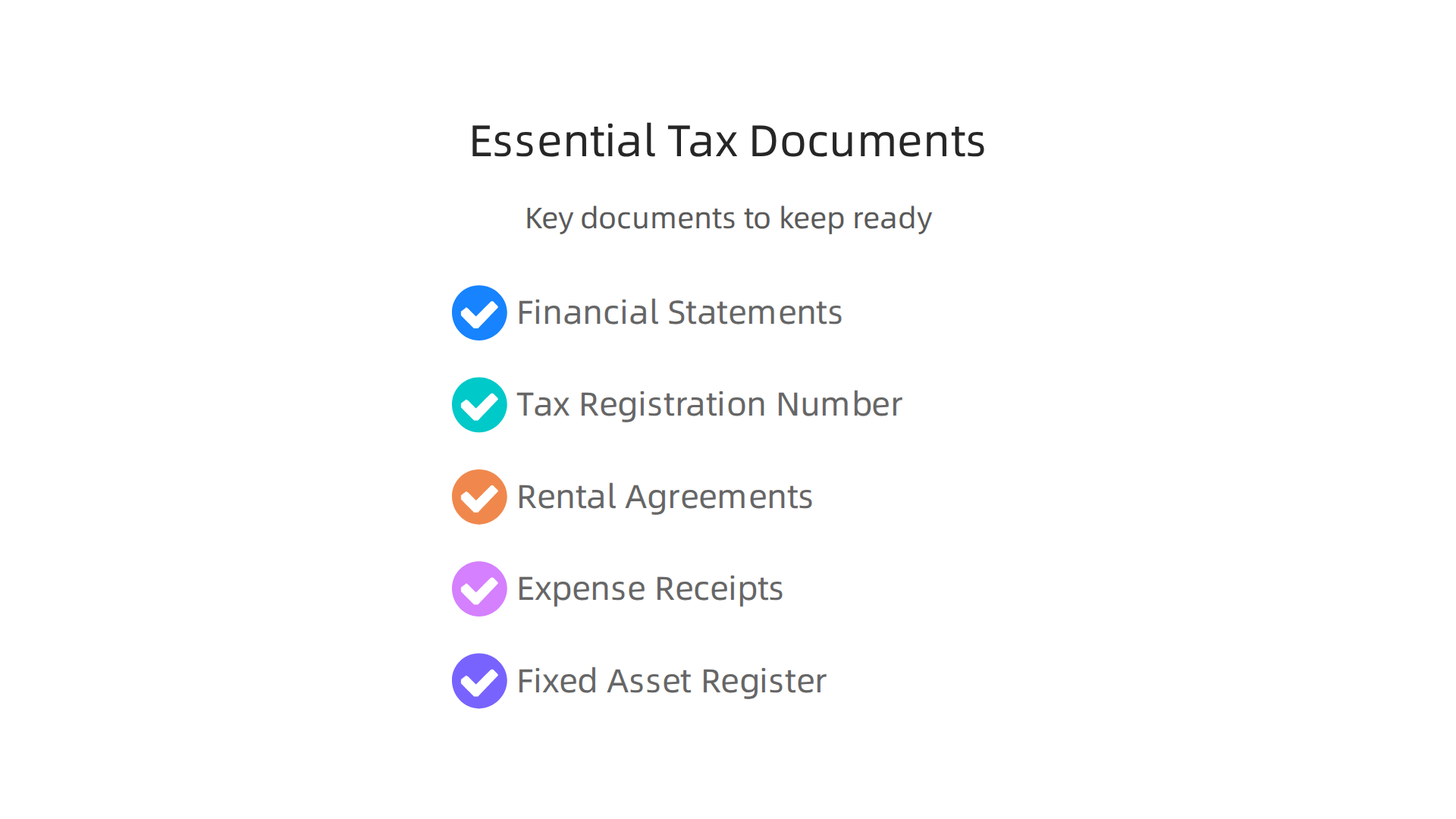
- Audited or reviewed financial statements
- Your Tax Registration Number (TRN)
- Rental agreements and Ejari contracts
- Receipts for maintenance, management, and loan interest
- Fixed asset register with depreciation details
Every receipt counts when you are preparing taxes for small businesses in the property sector. Maintenance fees, service charges, and loan interest are all deductible. Understanding these deductions is the key to getting the right business write off taxes for your situation.
Get Professional Help with Business Taxes
Here is the honest truth. Tax rules for Dubai property investors in 2026 have layers. If you hold multiple properties or mix short-term and long-term rentals, getting it wrong is easy.
This is exactly why smart investors look for help with business taxes. A step-by-step guide on how to file taxes for your Dubai property company can save you hours of confusion.
But if you want personalized advice for your specific investment portfolio, talking to an expert is the best move. Whether you are buying your next property, selling an existing one, or managing a rental portfolio, expert guidance keeps you compliant and profitable. Click here to get a FREE Dubai Real Estate Consultation with Ayaz Salman.
Maximising Tax Write-Offs for Your Property Portfolio
Once you know how to file your returns, the next smart move is lowering your taxable profit. Getting the right business write off taxes makes a real difference to your bottom line each year. The good news is that the UAE tax system allows plenty of legitimate deductions for property investors. You just need to know what counts and how to track it.
Mortgage Interest Is a Big One
If you have a mortgage on your rental property, the interest you pay is deductible. This is one of the largest expenses you will have, and it can significantly reduce your taxable profit. The rules around deductible expenses for corporate entities include mortgage financing interest, but there is a limit to watch out for.
Under the UAE Corporate Tax Law, net interest expenditure is capped at the higher of 30% of EBITDA or AED 12 million per year for the group. This is called the interest limitation rule, and it often catches property investors off guard. The detailed breakdown of UAE Corporate Tax and the Real Estate Sector explains exactly how this rule applies to your portfolio. If your interest costs push past that limit, the excess cannot be deducted in the current year.
Property Management Fees and Maintenance Costs
These are straightforward deductions. Any fee you pay to a property management company is fully deductible. The same goes for maintenance and repair costs on your rental units. You can also claim insurance premiums, service charges paid to the building owner association, and agent commissions for finding tenants.
Every receipt counts when you are preparing taxes for small business operations in the property sector. Keep a dedicated folder for maintenance invoices, management fee statements, and insurance renewal documents. The FTA expects you to back up every deduction with a receipt.
Depreciation of Your Building Assets
Here is one that many new investors miss. You can claim depreciation on the building structure itself. Under UAE accounting standards, commercial and residential rental properties depreciate at 4% per annum on a straight-line basis. The land value cannot be depreciated, only the building.
This deduction happens every year automatically once you set up your fixed asset register. It does not cost you any cash outlay, but it lowers your taxable profit. Understanding this single deduction can transform how you think about help with business taxes for your portfolio.
Home Office Expenses for Property Businesses
If you run your property business from home, you may be able to claim a portion of your household expenses. This includes a percentage of your rent or mortgage interest, utilities, internet, and phone bills. The key is that you must use the space exclusively and regularly for your business activities.
The claim needs to be reasonable. A common approach is to calculate the floor area of your home office as a percentage of your total home floor area, then apply that percentage to your eligible household bills. Keep a log of your business use to support the claim if the FTA ever asks.
Get the Full Picture Before You File
Maximising deductions without crossing the line into incorrect claims requires a good system. The rules are clear, but they are also detailed. Learning how UAE corporate tax affects property investment structure will help you make smarter decisions about which deductions to claim and how to structure your property holdings for maximum tax efficiency.
Small mistakes in your deduction claims can lead to audits and penalties. But when you get it right, you keep more of your rental income working for you instead of paying it to the tax authority.
Navigating VAT for Property Transactions
Now that you understand how to claim deductions, there is another layer to get right. Value Added Tax, or VAT, affects almost every property deal in the UAE. Get it wrong, and you could lose money or face penalties. Get it right, and you handle your cash flow much better.
The rules depend entirely on what type of property you are buying or selling. Here is a simple breakdown.
Residential Property: The Three Year Rule
If you buy a brand new residential property directly from the developer, the first sale is zero-rated for VAT. That means the developer charges you 0% VAT. This rule applies only within the first three years after construction is complete. The developer can still reclaim the VAT they paid on construction costs, which keeps prices more affordable for you.
After that first sale, things change completely. Any subsequent sale or long term lease of that same residential property is exempt from VAT. You do not charge VAT when you sell it or rent it out. But here is the catch. Because the supply is exempt, you cannot reclaim the VAT on your own costs related to that property. This matters a lot when you are preparing taxes for small business property operations. The detailed breakdown of UAE real estate VAT rates and exemptions explains exactly when each rate applies.
Commercial Property: 5% Across the Board
Commercial properties are different. Every sale and lease of a commercial space attracts 5% VAT. Whether you are buying an office, a retail shop, or a warehouse, you pay VAT on the purchase price. When you rent out a commercial unit, you must charge 5% VAT to your tenant and pass that amount to the Federal Tax Authority.
The good news is that if you are VAT registered, you can reclaim the VAT you paid on your own commercial property expenses. This makes the system fair. You charge VAT on your income, but you also get back the VAT on your costs. Understanding this balance is a key part of getting help with business taxes for your property portfolio.
What This Means for Your Invoices and Returns
You must account for VAT correctly on every transaction. If you buy an off-plan commercial unit, the developer will issue a VAT invoice at 5%. You need to record that invoice in your VAT return. If you are a landlord leasing commercial space, your lease agreement should clearly state that 5% VAT is added to the rent.
For residential rentals, no VAT applies. But you still need to keep proper records to show the FTA that your income is exempt. Mixing up residential and commercial treatment is a common mistake that leads to audits.
Registration Thresholds to Know
If your taxable supplies exceed AED 375,000 in a year, you must register for VAT. If your supplies are between AED 187,500 and AED 375,000, you can register voluntarily. Voluntary registration is often a smart move for property investors because it lets you reclaim VAT on your business costs like agent commissions and maintenance services.
Navigating VAT properly means you keep more of your money and avoid costly errors. If you want personalised advice on how VAT affects your specific property deals, connect with an expert who understands the Dubai market. Get your FREE Dubai Real Estate Consultation to discuss your portfolio and tax strategy.
Common Tax Filing Mistakes and How to Avoid Them
Even smart property investors trip up on taxes. The good news? Most mistakes are easy to avoid once you know what to watch for. Here are the three biggest errors and how to steer clear of them.
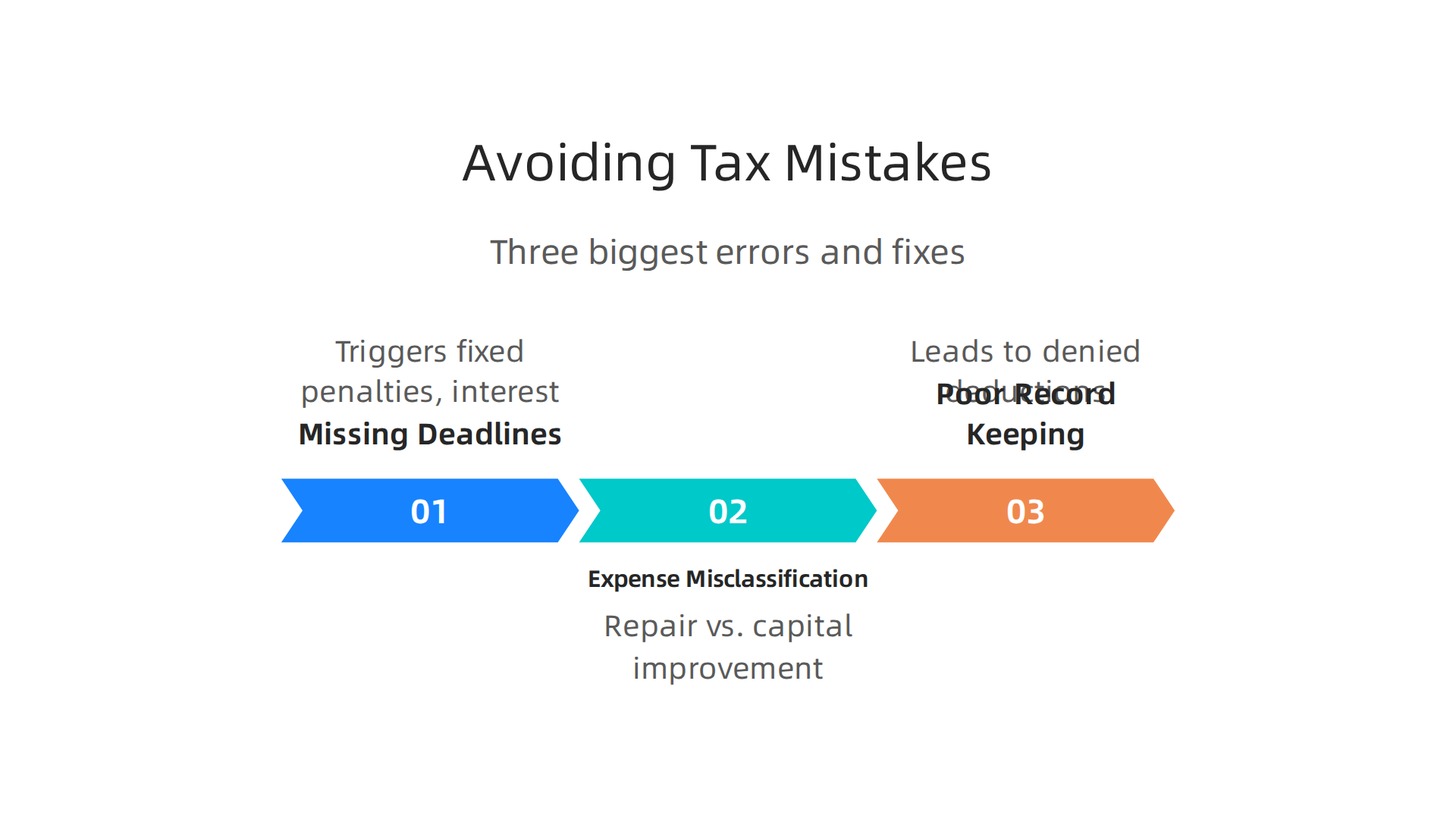
Mistake 1: Missing Deadlines
Late filing is the most expensive mistake you can make. For VAT, the penalty starts at AED 500 per month. For corporate tax, the fines climb higher. If you miss the corporate tax deadline, you face AED 500 per month for the first 12 months, then AED 1,000 per month after that. Late payment of tax also triggers 14 percent annual interest on the unpaid amount. Check the September 30, 2026 Corporate Tax Deadline checklist to see exactly when your return is due and avoid these automatic penalties.
Here is a simple rule. Know your financial year end date. Mark the nine month deadline on your calendar. Then file before that date, not on it. If your year ends on December 31, 2025, your corporate tax return and payment must be in by September 30, 2026. No exceptions. No extensions.
Mistake 2: Calling Everything an Expense
This one catches a lot of investors. You buy new tiles for the kitchen floor of your rental unit. You call it a repair and deduct the full cost in one year. But the tax authority may see it differently. If the work adds value or extends the life of the property, it counts as a capital improvement. That means you must depreciate it over several years instead of deducting it all at once.
Getting this wrong leads to denied deductions and back taxes. The guide on common real estate investor tax mistakes shows exactly how to tell the difference between repairs and improvements. A simple rule of thumb helps. If you are fixing something broken, it is likely a repair. If you are upgrading or replacing something that still worked, it is likely a capital expense.
Mistake 3: Poor Record Keeping
This is the number one reason tax audits happen. The Federal Tax Authority expects to see clear, organized records for every transaction. If you cannot show receipts, invoices, and contracts, the FTA may deny your deductions entirely.
Keep digital copies of everything. That includes purchase contracts, renovation invoices, maintenance receipts, agent commission statements, and service charge bills. Store them in one place where you can find them quickly. The 10 Property Investment Tax Mistakes To Avoid guide emphasizes that missing paperwork is the most common reason investors lose deductions during an audit.
Get your record keeping right from day one. It saves you stress, money, and time later. And if you want a clear system to follow, check out how to file business taxes for your Dubai property company. It walks you through the exact documents you need and how to organize them.
Getting Expert Help with Business Taxes: When and How
You can handle your own tax filing. Many investors do. But at some point, the complexity grows. Maybe you own three or four properties. Maybe you use different ownership structures. Maybe you are not sure if a renovation counts as a repair or an improvement. That is when you should bring in a pro.
The right accountant saves you money. They find deductions you miss. They keep you from making the mistakes we covered earlier. And they handle the paperwork so you can focus on growing your portfolio.
Here is a simple rule. Hire a UAE-licensed accountant who knows real estate. Not a general bookkeeper. Not an unregistered consultant. Real estate tax rules are different from other businesses. Service charges, registration fees, depreciation, and capital gains all work in specific ways. A general accountant might get them wrong.
You can check credentials with the Federal Tax Authority (FTA) or the Real Estate Regulatory Authority (RERA). Both maintain lists of registered professionals. Never work with someone who cannot prove their license. The guide on common real estate investor tax mistakes reminds you to consult with a tax professional whenever you are unsure about classifying an expense. That is solid advice.
Most accountants offer a free initial consultation. Use it. Bring your current numbers. Ask them how they handle the tax rules we discussed. See if they understand property investment in Dubai. If they do not, move on.
Once you find the right expert, your whole process gets smoother. They help you with preparing taxes for small business structures. They show you what qualifies as a business write off taxes. And they make sure you file business taxes on time, every time.
If you are building a portfolio and want a clear system to follow, check out the guide on how to file business taxes for your Dubai property company. It walks you through the exact steps with the right professional by your side.
And if you are ready to get personalized advice, connect with a trusted expert who knows the Dubai market inside and out. Get a FREE Dubai Real Estate Consultation to discuss your specific portfolio and find out exactly what help you need for your tax filing this year.
Summary
This article explains how Dubai property investors must handle business taxes in 2026, outlining when corporate tax and VAT apply and how to stay compliant while protecting returns. It covers who pays the 9% corporate tax (companies and licensed rental businesses with profits above AED 375,000), VAT treatments for residential and commercial property, and important limits such as the interest deductibility cap. The guide walks through registration, filing deadlines, required documents, common deduction types (mortgage interest, management fees, maintenance, depreciation), and typical mistakes that trigger audits or penalties. It also explains practical steps to organise records, choose the right ownership structure, and when to get a UAE-licensed accountant to reduce risk and save tax. After reading, investors will know how to prepare tax returns, claim legitimate write-offs, and avoid costly compliance errors.