
How a Business Setup Company for Dubai Property Investment Works in 2026
· 21 min read

Introduction
Picture this: You have found the perfect apartment in Dubai Marina. The views are stunning. The price makes sense. Your heart says yes. But then a question stops you cold. How do you actually buy this property?

Not as a tourist. Not through a friend. But legally, safely, and with full ownership rights.
This is where most global investors get stuck. Dubai’s property market is one of the most exciting in the world right now. There is no annual property tax, no rental income tax, and no capital gains tax. The numbers are genuinely attractive. But the legal side of things can feel confusing fast.
That confusion often leads to costly mistakes. Many property investors jump in without setting up the right business structure first. They buy under personal names or use arrangements that create compliance risks later. Worse, they miss out on serious growth opportunities because they never had the right entity in place.
Here is what you need to know. Dubai does not let foreign investors own property the same way locals do. At least not everywhere. You need to understand the ownership rules for free zones, mainland areas, and designated investment zones. And that is exactly where working with experienced business setup companies in Dubai changes everything.
The right setup company does more than file paperwork. They help you choose the best ownership structure for your situation. Whether you need an LLC, a free zone company, or a holding entity, they guide you through every step. They make sure you meet all Dubai Land Department requirements and stay fully compliant from day one.
This guide walks you through the entire process. You will learn what business structure fits your goals, how to handle taxes and filings, and why professional support is worth every dirham. By the end, you will know exactly how to move forward with confidence.
If you are ready to skip the guesswork and get expert advice tailored to your situation, you can get a FREE Dubai Real Estate Consultation with someone who knows the market inside out. The first step is simple. The rest is what we cover next.
Let us start with the foundation. First, you need to understand why your business structure matters more than the property itself.
Why Property Investors Need a Business Setup Company in Dubai
So you have found the perfect apartment and you are ready to sign. But ask yourself this: are you buying it as an individual or through a company? If you plan to own more than one property, build a rental portfolio, or eventually sell for profit, buying under your personal name may not be the smartest move.
Many global investors do not realize that a business entity is often required to hold property under corporate ownership in Dubai. This is especially true if you want multiple assets or a professional rental operation. Without the right structure, you could face unnecessary legal headaches and missed tax advantages.
The Role of a Business Setup Company
This is where professional business setup companies in Dubai become your best ally. They handle the entire process of getting your company registered.

That means obtaining the right commercial license, securing trade permits, and processing residency visas for you and your team.
But they do more than just paperwork. Experienced setup companies help you choose the best legal structure for your real estate goals. Should you go with a mainland LLC or a free zone company? The answer depends on where you plan to buy and how you plan to use the property. Each option comes with different ownership rules and tax implications.
For example, free zone companies like those in DMCC or JAFZA can own property within the zone and in designated areas. LLCs on the mainland have broader access. The guide on to own property in Dubai breaks down these options clearly.
Compliance Keeps You Safe
Dubai regulators take property ownership seriously. The Dubai Land Department (DLD) and the Real Estate Regulatory Agency (RERA) have strict rules. If you cut corners, you risk fines or losing your investment. A business setup company ensures every document is correct and every requirement is met. They also help you stay on top of for your business and keep your tax filings clean from day one.
Working with experts also saves you time. Instead of bouncing between government offices and trying to understand Arabic forms, you get one team that handles everything end to end. That frees you up to focus on finding the right properties and growing your portfolio.
If you want to avoid costly mistakes and move faster, a business setup company is not optional. It is the foundation of smart property investment. Next, we will look at the specific business structures available and which one fits your situation best.
Understanding the Main Business Structures for Property Investment: LLC, Free Zone, and Offshore
Now that you know why a business setup company in Dubai is so valuable, let’s look at the three main structures you can choose from. Each one works differently for property investors.
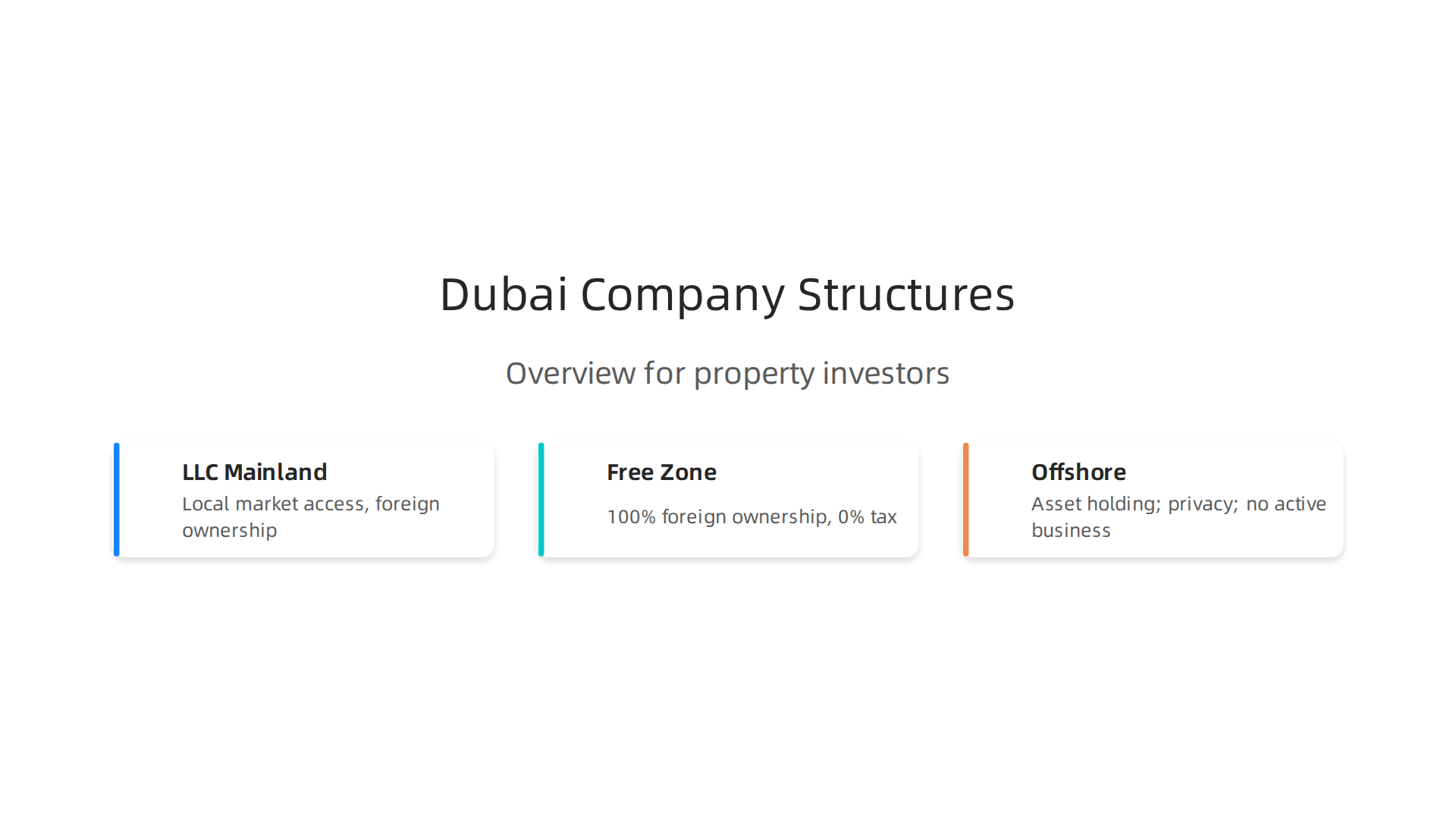
Your choice will affect where you can buy, how much tax you pay, and how much freedom you have.
LLC (Limited Liability Company)
An LLC is a mainland company registered with Dubai’s Department of Economic Development. It gives you full access to the local market. That means you can buy property anywhere in Dubai and across the UAE. You can also sell directly to local buyers and rent to anyone without restrictions.
In 2026, most business activities allow 100% foreign ownership, so you do not need a local partner anymore. However, you still need a physical office space. And if your business involves a strategic sector like media or utilities, local equity rules may still apply.
For property investors, an LLC is the best choice if you want to own multiple properties in different areas and do active business like leasing or flipping. You will pay 9% corporate tax on profits above AED 375,000. But there is no property tax, no capital gains tax, and no rental income tax in Dubai. The guide on how to invest in Dubai real estate explains these tax benefits in more detail.
An LLC also requires you to maintain proper records and file taxes on time. Business setup companies in Dubai can help you with that. They make sure you understand LLC meaning in Dubai and handle your compliance from the start.
Free Zone Company
Free zones like DMCC, JAFZA, and DIFC are special areas designed for foreign investors. You get 100% foreign ownership automatically.

You also get 0% corporate tax on qualifying income if you meet the conditions. Setup is faster and cheaper than mainland.
But free zone companies have limits on property ownership. You can only buy property in designated freehold areas. For example, a DMCC company can own property inside the DMCC zone and in areas labeled as designated investment areas by the Dubai Land Department. You cannot buy commercial property outside those zones without special approval.
Free zones are ideal if you plan to hold a few properties in specific freehold areas and do not need to trade actively in the mainland market. Many international investors use a free zone company as a holding vehicle to shield assets and keep tax low.
For a full comparison of free zone versus mainland options, check out this breakdown of UAE free zone vs mainland company differences.
Offshore Company
Offshore companies in Dubai, such as those registered in JAFZA Offshore or RAK ICC, are used mainly for asset holding and privacy. They cannot conduct active business inside the UAE. They also cannot own property directly in most areas. To buy a Dubai property with an offshore company, you usually need to set up a special structure or use a nominee arrangement.
Offshore is best for wealthy investors who want to keep their ownership private and are not looking to rent out or sell properties frequently. It is a passive structure. You will still need a local service agent to handle registration.
Which One Fits You?
Your choice depends on your goals. If you want to buy and sell actively across Dubai, go with an LLC. If you want tax breaks and are okay with limited locations, pick a free zone company. If privacy and pure asset holding are your priority, consider offshore.
Every structure has ongoing rules. You must file taxes for a business correctly, pay any business taxes due, and follow the right tax invoice format UAE requires. A good business setup company can walk you through all of this.
If you are ready to take the next step and need expert advice on which structure works for your portfolio, get a FREE Dubai Real Estate Consultation with Ayaz Salman. He can help you match your investment plans with the right legal setup.
Tax Compliance for Property Investors: VAT, Corporate Tax, and Exemptions
Once you pick your business structure, the next big thing is tax compliance. Understanding how VAT and corporate tax work for property investments will save you money and keep you legal.

Let’s break it down simply.
VAT on Property: Residential vs Commercial
Dubai’s VAT system treats residential and commercial property very differently. This is one of the most important rules to know.
Residential property buying and long-term renting are VAT-free. If you buy an apartment in Dubai Marina or rent out a villa, you pay zero VAT on those transactions. The first sale of a new residential property within three years of completion is zero-rated, meaning you pay 0% VAT and can reclaim input VAT on costs. After that, all subsequent sales and rentals are exempt. You can check the full VAT on Dubai property guide for a deeper look.
Commercial property is a different story. Sales and leases of offices, retail spaces, and warehouses all carry a 5% VAT charge. That VAT is added to the rent or sale price, and the tenant or buyer pays it. If you own commercial property and your annual rental income exceeds AED 375,000, you must register for VAT with the Federal Tax Authority and file quarterly returns.
Also remember that services like agency commissions, property management fees, and maintenance carry 5% VAT, whether the property is residential or commercial.
Corporate Tax for Property Investors
The UAE introduced a 9% corporate tax in 2023. For property investors using a company structure, here is what you need to know.
Corporate tax applies to taxable profits above AED 375,000. The first AED 375,000 of profit is taxed at 0%. So if your property company makes AED 400,000 in profit, you only pay 9% on the AED 25,000 above the threshold.
If you use a free zone company and meet the conditions for Qualifying Free Zone Person status, you may get a 0% corporate tax rate on qualifying income. But this is complex. For example, income from commercial properties inside the free zone may qualify, while residential rental income typically does not.
Importantly, individuals who earn rental income from personal property investments (without a business license) are exempt from corporate tax. But if you operate through a company, you must pay corporate tax and file annual returns. Learn more in this guide on how to file business taxes for your Dubai property company.
How Business Setup Companies Help with Compliance
Staying compliant with VAT and corporate tax rules is not something you want to handle alone. Business setup companies in Dubai offer services that make tax management simple.
They can help you register for VAT when your taxable supplies cross AED 375,000. They also prepare and file your quarterly VAT returns, so you never miss a deadline. They advise on which expenses you can claim input VAT on, like maintenance, agency fees, and service charges tied to commercial properties. And they make sure you issue the right tax invoice format UAE requires, with all the necessary details.
When corporate tax comes due, a good business setup company will structure your transactions to minimize tax liabilities. They can help you file taxes for a business correctly and keep track of all business taxes due. This is especially valuable if you own a mix of residential and commercial properties, because VAT treatment and input VAT recovery differ between the two.
Rather than stressing over compliance, let the experts handle it. Many business setup companies include tax advisory in their packages, so you can focus on growing your portfolio.
Step-by-Step Process to Register a Business Setup Company in Dubai (2026)
So you want to start your own business setup company in Dubai for property investing. Great choice. The process is clear and well established. Here is the step-by-step path to getting your trade license and starting operations.
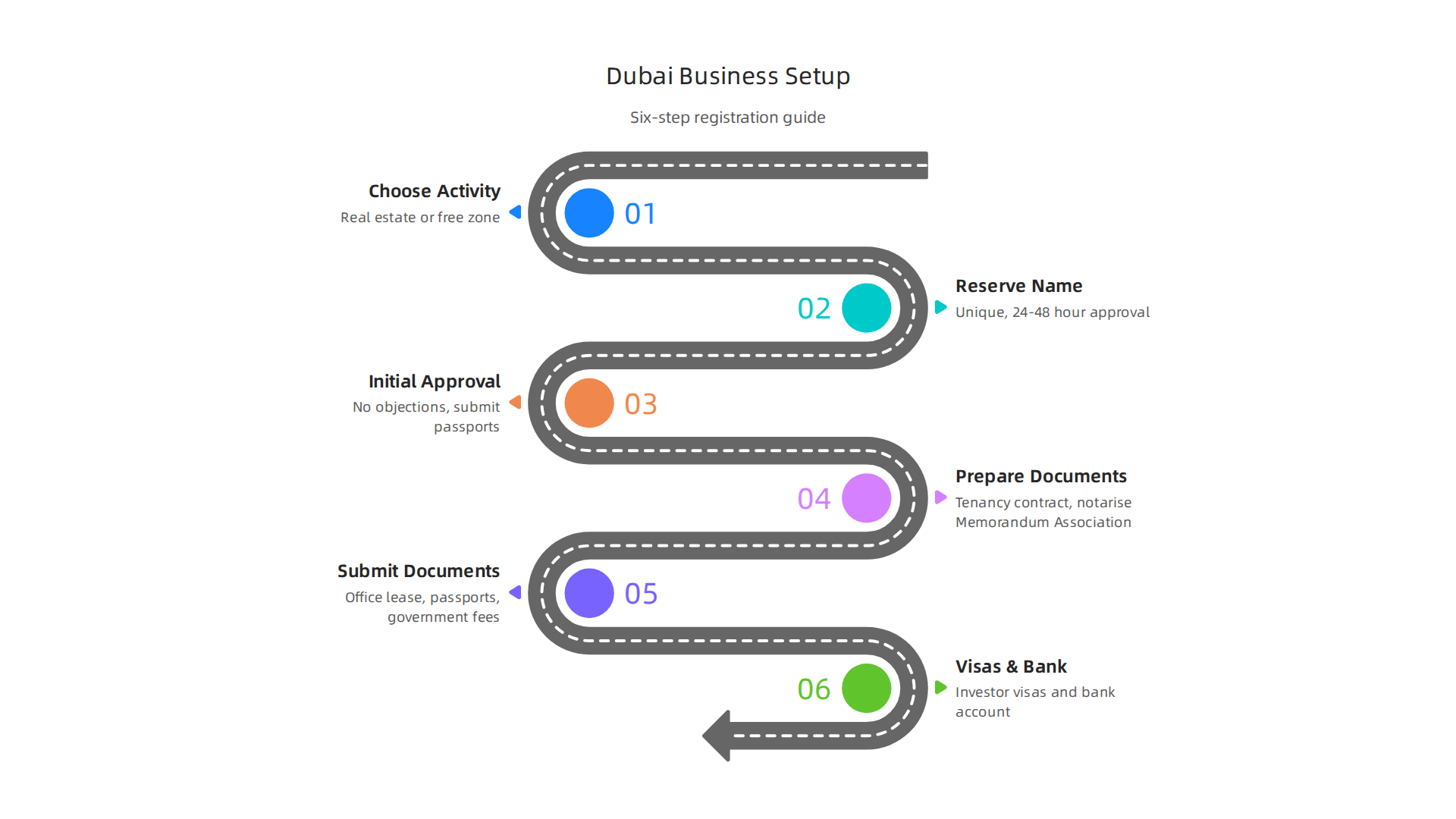
Many investors use business setup companies in Dubai to handle this process, but understanding each step yourself helps you make better decisions.
Step 1: Choose Your Business Activity and Jurisdiction
Your first decision is picking what you want to do. For property investing, your activity could be real estate brokerage, property management, or holding and leasing property. You also need to decide between mainland and free zone.
Mainland companies can work anywhere in Dubai and with the local market directly. Free zone companies offer tax benefits and simpler setup, but must work within the free zone or internationally. Check the full company formation and registration in the UAE guide for a clear comparison.
Step 2: Reserve Your Trade Name
Once you know your activity and jurisdiction, pick a trade name. The name must be unique and not offensive. Submit it through the Dubai Economic Department or relevant free zone portal. Approval usually takes 24 to 48 hours.
Step 3: Get Initial Approval
After your name is approved, apply for initial approval from the regulating authority. This tells you there are no objections to your business. You submit passport copies of shareholders and directors, a business plan (sometimes), and the company structure.
Step 4: Prepare Legal Documents and Secure Office Space
You will need a tenancy contract for your office. Mainland companies require a physical office (minimum 200 square feet). Free zones usually allow flexi-desks or virtual offices. You also need to notarise the Memorandum of Association if you are forming a multiple shareholder company.
Step 5: Submit Final Documents and Pay Fees
Now you send everything to the authority for final approval. This includes your initial approval letter, office lease agreement, passport copies, and any additional approvals from other ministries if your activity is regulated (like healthcare or financial services). Pay the government fees, and your trade license is issued.
Free zone setup typically takes 3 to 10 working days. Mainland can take 2 to 4 weeks depending on complexity.
Step 6: Apply for Visas and Open a Bank Account
Once you have your license, you can apply for investor or partner visas. You also need to open a corporate bank account. Banks require your trade license, establishment card, and passport copies. This step can take a few more days.
After that, you are officially in business. You can start investing in property with your new company.
If you want personalised help setting up your property investment company, get a FREE Dubai Real Estate Consultation with an expert who knows the market and the rules.
For a deeper look at how your business structure affects your tax situation, read this guide on how UAE corporate tax affects your Dubai property investment structure.
How to Choose the Best Business Setup Company in Dubai: Key Criteria and Red Flags
Not all business setup companies in Dubai are the same. Some are great partners that save you time and money. Others cut corners and cause problems later. Here is how to pick the right one for your property investment goals.

Look for Real Estate Experience
The best business setup companies know your industry. A firm that sets up a restaurant or a tech startup may not understand the specific rules for property companies. Ask if they have helped other real estate investors before. Check their client list and case studies. You can also review the updated list of top business setup consultants to see who has strong reviews in this sector. A company with real estate experience will handle your license category correctly and advise on the best jurisdiction for buying property.
Demand Transparent Pricing and Clear Scope
Some providers advertise a very low price then add hidden fees for visa processing, PRO services, or office space. Before you sign anything, get a full breakdown of costs. Ask exactly what is included in the package. Will they handle your investor visa? Do they offer after-sale support like renewals and amendments? The best firms give you a clear service scope upfront and don’t surprise you with extra charges later. This is especially important when you need to eventually file taxes for a business or deal with compliance.
Check Reviews and Regulatory Status
Look for genuine client testimonials on platforms like Google or Trustpilot. Avoid companies with mostly anonymous or overly generic reviews. You can also verify their license with the Dubai Economic Department or relevant free zone authority. A reputable firm will be happy to share their trade license number and references. If they dodge these questions, consider it a red flag.
Watch Out for These Red Flags
- Guaranteed returns or quick fixes – No honest business setup company promises that your property investment will make a certain amount of money. They set up your legal structure. They do not control the market.
- Pressure to decide fast – Good advice takes time. If a consultant pushes you to pay immediately or says the price goes up tomorrow, walk away.
- Ignorance about tax compliance – A competent company will explain your obligations, including corporate tax and proper record keeping. If they say you never need to worry about business taxes due, that is a warning sign.
Before you commit, also read this due diligence guide to choosing a real estate investment company so you know exactly what questions to ask. Taking an extra hour to vet your business setup partner can save you months of frustration later.
Integrating Property Management with Your Dubai Business Structure
Once your company is set up, the next big step is linking your property management activities to that business structure. This is where many investors fall short. They get the license, but they treat their properties separately from their company. That makes things messy later.
Why Hold Properties Under Your Company?
Holding your Dubai properties under your company name gives you three major advantages. First, you get centralized management. All your leases, maintenance records, tenant communications, and income statements live in one place. Second, scaling becomes much simpler. When you want to buy a third or fourth property, you add it to the existing company instead of starting from scratch. Third, and most important, you separate your personal assets from your business liabilities. If a tenant sues over a maintenance issue, they go after the company, not your personal savings.
Ongoing Support from Your Setup Partner
Many business setup companies in Dubai do not disappear after handing you your license. The best ones offer ongoing services like accounting, auditing, and compliance support. This is critical because property management firms have specific tax and reporting obligations. For example, if you manage commercial properties, you must charge 5% VAT on your management fees. You also need to issue invoices in the correct format. Understanding the required tax invoice format in the UAE will save you from penalties later. A good setup partner will guide you through this. You can learn more about how to file taxes for a business through our dedicated guide.
Office Space Requirements
If you register in a free zone, you likely need a physical office. But do not worry about expensive leases. Serviced offices and flexi-desks work perfectly as registered addresses for your property management company. These setups keep your costs low while meeting the regulatory requirement. Just make sure the address is registered with the relevant free zone authority and Ejari if you handle tenancy contracts.
Next Step: Get Professional Guidance
Integrating property management into your business structure is not a one-time task. It requires ongoing attention to lease types, VAT treatment, and compliance. Residential and commercial properties follow very different VAT rules, as explained in this complete guide on VAT compliance for property management firms. The good news is that you do not have to figure this out alone.
If you are ready to take the next step in your Dubai property investment journey, connect with an expert who understands both business setup and property management. FREE Dubai Real Estate Consultation
Common Pitfalls and How a Business Setup Consultant Can Help
Imagine picking a license type for your property company without understanding the difference between a mainland LLC and a free zone entity. Many investors do exactly that. They end up with a license that does not allow them to manage residential properties or lease to certain tenants. Fixing this mistake later costs both time and money.
Here are the most common traps that first-time property investors in Dubai fall into:
-
Choosing the wrong license type. Not all licenses cover property management. A trading license will not let you collect rent or sign tenancy contracts. You need a real estate or property management license, and the structure (mainland vs. free zone) directly affects who you can do business with. Understanding the LLC meaning in Dubai helps because a mainland LLC gives you full local market access, while many free zone companies can only operate within designated areas or outside the UAE.
-
Underestimating visa and office requirements. Some free zones require a physical office before they issue your license. Others link the number of visas you get to your office size. If you plan to bring staff or family on resident visas, you must factor in those costs and space from day one.
-
Failing to renew your trade license on time. Missing the renewal deadline means fines, possible visa cancellation, and a gap in your legal ability to manage properties. Renewals also require updated tenancy contracts, annual audits, and sometimes a change in your registered address.
A good business setup consultant helps you sidestep all of these mistakes. They do not just fill out forms. They check the developer reputation and off-plan project risks for you. As one 2026 investor guide explains, you should always verify that the developer is registered with RERA and that the project operates through an active escrow account. A consultant can run that check on your behalf before you commit money.
The best consultants also map your business structure to your long-term goals. If you plan to buy five properties over three years, they will recommend a free zone or mainland setup that lets you scale without re-registering. They explain how to handle business taxes due on rental income and management fees, so you do not get surprised by a corporate tax bill later.
Post-incorporation support matters just as much. A reliable business setup company in Dubai will remind you about renewal dates, update your licence activities as your portfolio grows, and help you stay compliant with changing regulations. This keeps you focused on growing your property income instead of worrying about paperwork.
If you want to see the full step-by-step process for entering the Dubai market, check out our guide on how to start investing in real estate in dubai. It walks you through each decision from choosing a jurisdiction to making your first property offer.
Summary
This guide explains how international investors should set up a company in Dubai before buying property, and why the right business structure matters more than the purchase alone. It covers the three main options—LLC (mainland), free zone, and offshore—showing how each affects where you can buy, tax treatment and operational freedom. The article breaks down VAT rules for residential versus commercial property and how the UAE 9% corporate tax applies to company profits above AED 375,000. You’ll also get a clear, practical six-step registration process for 2026, plus criteria for choosing a trustworthy business setup partner and red flags to avoid. The guide explains how to integrate property management into your company, why holding assets corporately protects personal liabilities, and which compliance tasks (visas, office, renewals, tax filings) you must not miss. After reading this, you’ll know which structure likely fits your goals, how to register correctly, and when to call a specialist so you avoid costly mistakes.