
Dubai Real Estate Investment Strategies 2026 That Deliver High Returns
· 16 min read

Introduction
Dubai’s real estate market has long attracted investors from around the world. But in 2026, the game has changed. The market is still growing, but it’s becoming more complex. According to a report on Dubai residential market performance in Q1 2026, sales prices rose 9.6% year on year.
That’s good news. But the days of easy double-digit gains every quarter are easing. Investors now need sharper tools and smarter strategies.

The problem? Information overload. Every day you see conflicting headlines. Some say prices are booming. Others warn of a correction. How do you know what’s real? You need unbiased, data driven insights to cut through the noise.
That’s where this guide comes in. We’ll walk you through advanced tactics that work in 2026. You’ll learn how to do off plan due diligence like a pro. You’ll understand market cycle timing and how to spot the right moment to buy or sell. And you’ll get the latest research to back every move you make.
Whether you’re new to estate investment real or a seasoned player, the Dubai market demands a fresh approach. You need to know how to invest in real estate investment trusts (REITs) as a way to diversify without buying a whole property. You’ll also discover the best books about investing in real estate and the top investment platforms that simplify the process. All of this helps you make informed decisions, not guesses.
We’ve done the heavy lifting for you. If you’re ready to build a solid plan, start with our guide on how to start investing in real estate in Dubai.
It gives you a clear step by step action plan.
And if you want personalized advice, reach out for a FREE Dubai Real Estate Consultation. Ayaz Salman can answer your specific questions.
Let’s dive in.
1. Mastering Off Plan vs. Ready Properties: Risk and Reward Analysis
Here is where your estate investment real journey begins. The first big decision you face is whether to buy off plan or a ready property. Both paths can lead to strong returns, but they come with very different risks and rewards.
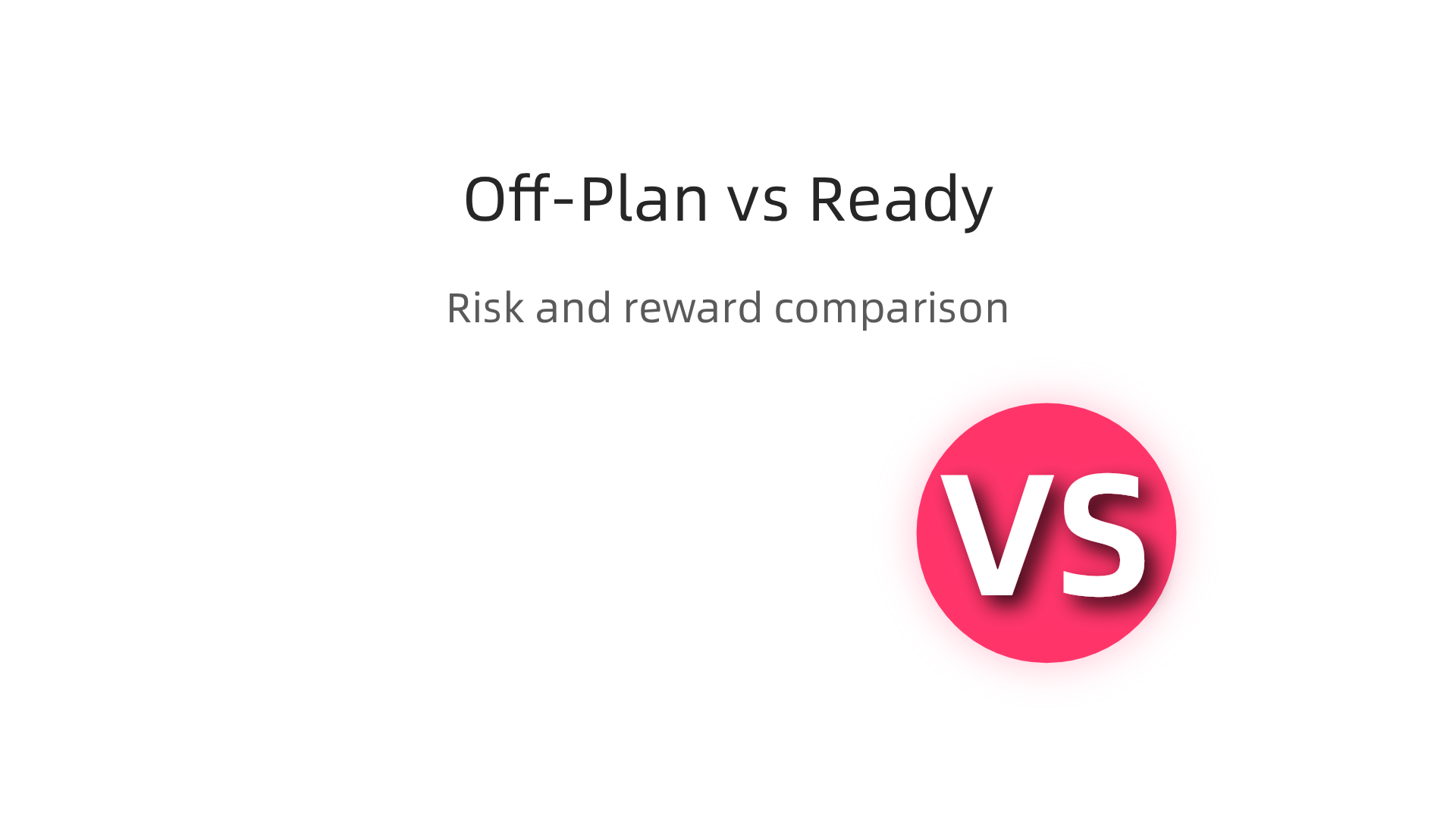
Off plan properties let you buy a unit before construction finishes. The appeal is clear. You often pay a lower price and get flexible payment plans tied to building milestones. Capital appreciation can be significant if the area grows. But you also face developer risk, potential project delays, and a longer wait before you see any rental income. Dubai has strong protections for off plan buyers. Every project must be registered with the Dubai Land Department, and your payments go into an escrow account that releases funds only when verified construction progress is made. Understanding how the UAE escrow law protects off plan property buyers helps you sleep better at night.
Ready properties are the opposite. You can walk in, get tenants quickly, and start earning rental income right away. The property already exists, so there is no guesswork about quality or handover dates. The downside is a higher entry price and sometimes lower capital appreciation than off plan deals. You also need to pay the full amount or arrange financing sooner.
Smart investors in 2026 do not pick one or the other. They blend both. You might buy an off plan unit in a fast growing area like Dubai South for future gains, while owning a ready apartment in Business Bay for steady cash flow. This balanced approach spreads your risk across different market cycles.
If you want to go deeper on evaluating properties and partners, read our due diligence guide to choosing a real estate investment company in Dubai. It walks you through the checks that protect your money.
And if you are curious about completely hands off exposure, look into how to invest in real estate investment trusts as a way to own a slice of Dubai real estate without managing any property yourself.
When you master both off plan and ready strategies, you turn estate investment real into a flexible, resilient portfolio that works in any market.
Key Due Diligence Steps for Off-Plan Investments
Before you sign anything, due diligence is not optional. It is your safety net.
Smart investors who master estate investment real know that checking the fine print early saves major headaches later.
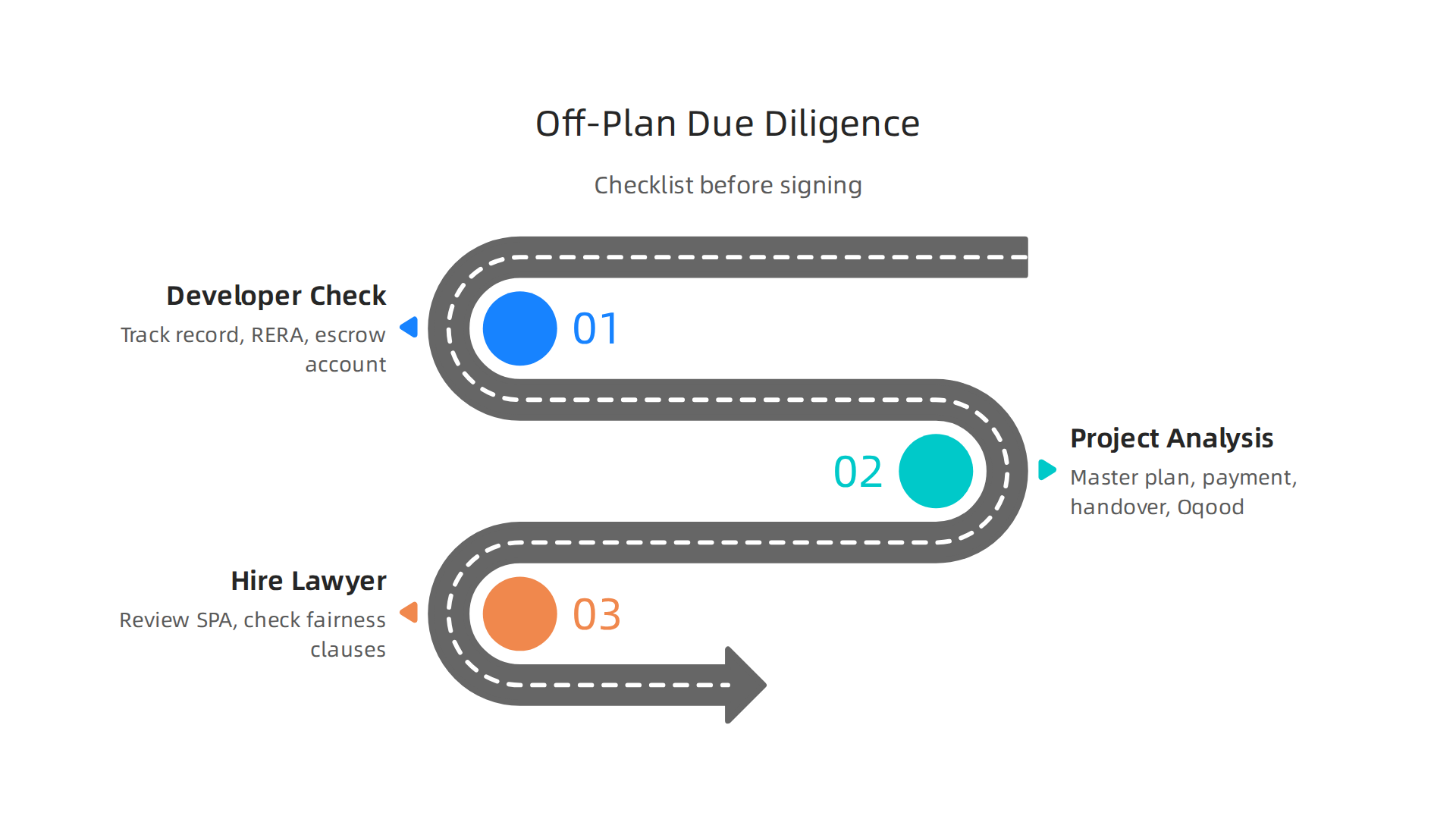
Start with the developer. Look up their track record. Have they delivered projects on time before? Use the Dubai REST app or the RERA website to confirm their registration. Every off-plan project must be registered with the Dubai Land Department, and your payments must go into a proper escrow account. You can verify this through RERA’s database. The 2026 UAE off-plan property step-by-step guide explains exactly how to check developer credentials and escrow compliance before you commit.
Next, analyze the project itself. Study the master plan, the payment schedule, and the handover timeline. When you buy off plan, you register the sale through the Oqood system. This certificate proves your ownership rights during construction. It also locks in the payment milestones and protects your position if the developer faces delays. Review the specific laws for buying off-plan property in Dubai to understand how Oqood safeguards your investment.
Finally, get your own lawyer. Do not rely on the developer’s team. Hire an independent legal expert to review the Sales Purchase Agreement or SPA.

They will check for fairness clauses, penalty terms for late handover, and your rights if you need to exit early. The new developer termination rules under the new law changed how contracts can be cancelled, so professional advice matters more than ever.
When you complete all three checks, you turn risk into confidence. And if you want personalized guidance through the process, you can connect with Ayaz Salman for a free Dubai real estate consultation to double check your next move.
2. Navigating Dubai’s Legal and Regulatory Framework (DLD, RERA, Ejari)
Once you finish your due diligence on a project, the next smart move is getting comfortable with the three bodies that run Dubai’s property market. The Dubai Land Department (DLD), RERA, and the Ejari system. Understanding how they work helps you protect every dirham in your estate investment real journey.
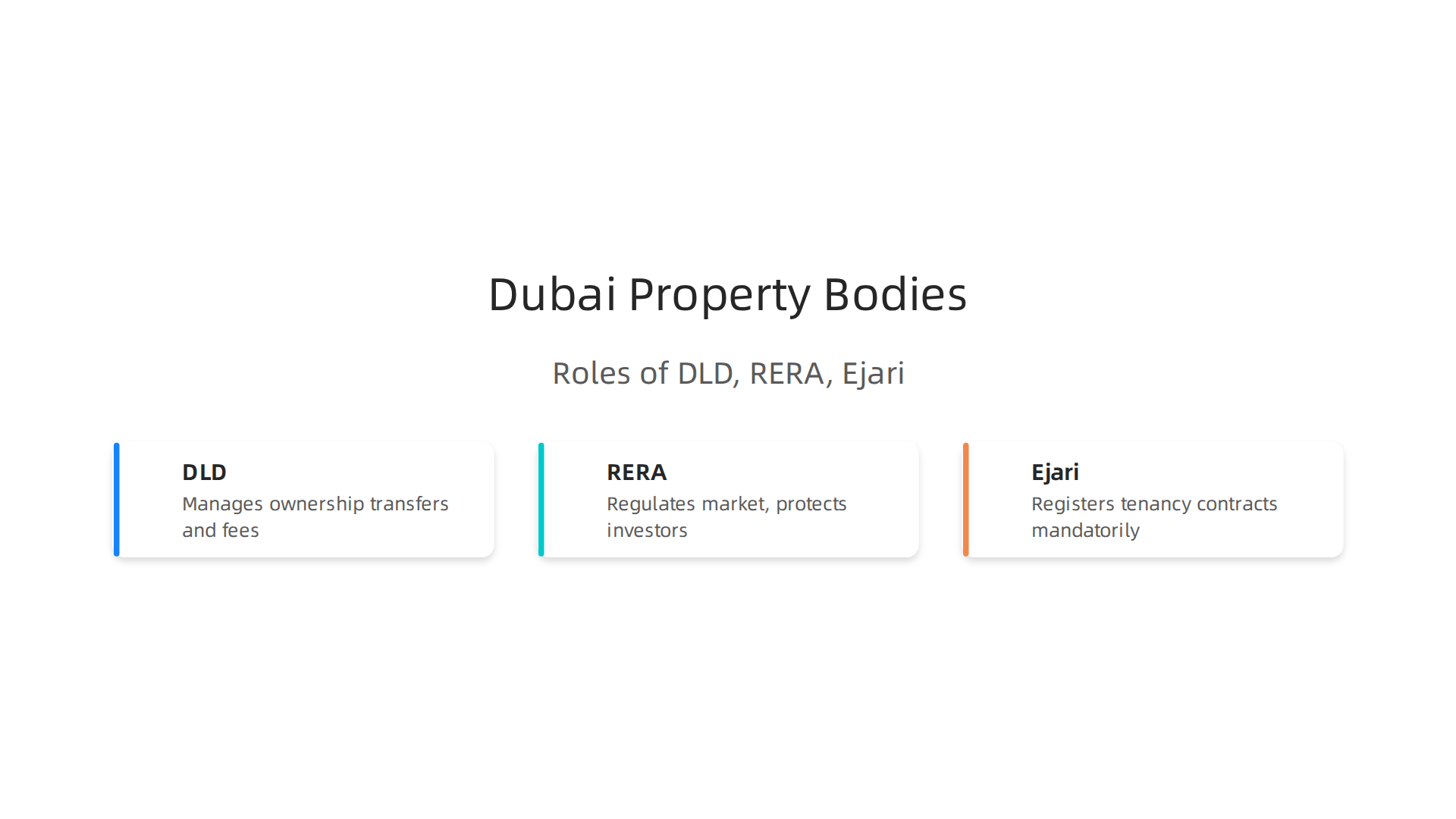
Dubai Land Department (DLD) handles all property ownership transfers. Every time you buy or sell, you pay a 4% transfer fee on the agreed purchase price. There is also a small administration fee of AED 580 for issuing the new title deed. These costs are non-negotiable, so you must budget for them upfront. For a property worth AED 1 million, for example, the DLD fee totals AED 40,580. The DLD Fees in Dubai guide breaks down every charge, including mortgage registration fees and off-plan registration costs. Knowing these numbers helps you calculate your true return.
RERA is the Real Estate Regulatory Authority under DLD. Its job is to protect investors by setting rules for agents, developers, and rental contracts. When you buy off plan, RERA makes sure your payments go into an escrow account so the money is used only for your project. RERA also handles rental dispute cases and issues the Oqood certificate that locks in your ownership during construction. The 2026 Dubai real estate laws article explains how RERA oversees escrow accounts and sets agent commission norms, usually around 2%.

Ejari is the mandatory system for registering tenancy contracts. If you plan to rent out your property, you must register the lease with Ejari. This costs around AED 155 online or AED 219.75 at a trustee office. Without Ejari, you cannot legally enforce your rental agreement or report rental income to the authorities. It directly affects how you track your yield. For a deeper look at how these laws fit into a larger plan, check out this Dubai real estate investment strategy for 2026.
When you know the roles of DLD, RERA, and Ejari, you move through the market with confidence. You avoid surprise fees, stay compliant, and keep your returns on track.
If you want a second set of eyes on your specific deal or contract, you can connect with Ayaz Salman for a FREE Dubai Real Estate Consultation. One quick chat can save you from costly mistakes.
Understanding Property Registration Fees and Taxes in 2026
One of the biggest perks of the Dubai market is its tax setup. There is no annual property tax. You pay a one time fee when you buy, and that is it. The main cost is the DLD Transfer Fee: 4% of the purchase price plus an AED 580 administration fee. For a AED 2 million property, that is AED 80,580. The DLD Transfer Fee Dubai guide explains exactly how this works. You must pay it within 60 days of the sale.
Value Added Tax (VAT) at 5% applies to commercial property rents and services. If you buy a shop or office, your rental income is subject to VAT. Residential properties are exempt, so your rental yield on a villa or apartment stays VAT-free.
You also need to budget for mortgage registration costs. That is 0.25% of the loan amount plus AED 290. Issuing a new title deed costs AED 580. And every property has common charges for maintenance of shared areas. These vary by building.
All of these fees eat into your profit. In any estate investment real deal, knowing these costs upfront helps you calculate your true net return. For a deeper look at how fees fit into your overall plan, this best book on investing in real estate can guide your strategy.
3. High-Yield Rental Strategies: Identifying Areas with Maximum ROI
Now that you know the upfront costs, let’s talk about the fun part. Making money. The whole point of any estate investment real plan is to pick a property that pays you back year after year. In Dubai, that means chasing high rental yields.

Here is the thing. Not all areas are equal. Some communities give you 8% to 10% gross yields. Others struggle to hit 5%. The difference comes down to location, property type, and tenant demand.
The top yield performers in 2026
Affordable mid-market communities are where the numbers shine. International City consistently delivers gross yields around 9% to 10%, according to the Best Areas to Invest in Dubai for ROI in 2026 report. Jumeirah Village Circle (JVC), Arjan, and Discovery Gardens also sit near the top, with yields between 7% and 9%. These areas attract strong tenant demand because prices are lower and people need affordable homes.
Luxury areas like Dubai Marina and Downtown Dubai tell a different story. They offer yields of 5% to 7%. The headline number is lower, but the rental income is often higher in absolute terms because the purchase price is so high. A 6% yield on a AED 3 million apartment is AED 180,000 a year. That beats AED 150,000 from a 10% yield on a AED 1.5 million unit.
Micro-location matters more than you think
Being close to a metro station, a school, or a commercial hub can push your yield up by 1% or 2%. Tenants pay a premium for convenience. A unit two minutes from the Dubai Metro will always rent faster than one a fifteen-minute walk away.
Short-term versus long-term strategy
Short-term holiday home rentals can generate higher gross yields, sometimes 12% to 15% in peak tourist spots. But they come with extra costs. You need a holiday home license from the Dubai Tourism Department. You pay for cleaning, utilities, and management between guests. Vacancy risk is higher outside the peak season.
Long-term leases give you lower headline yields but better stability. A single tenant stays for a year or more. Your management costs drop. Your cash flow becomes predictable.
For a deeper look at how to build a winning approach around these numbers, explore this Dubai real estate investment strategy for 2026 guide.
Picking the right area is the single biggest decision in your estate investment real journey. Focus on yield first, then micro-location, then lease type. That order has proven itself again and again.
Want personalized help matching your budget to a high-yield community? Get a FREE Dubai Real Estate Consultation with Ayaz Salman to find your best move.
4. Advanced Financing and Structuring for Portfolio Diversification
Once you have identified the high-yield areas, the next step is to plan how you will pay for your properties and protect your assets. In any serious estate investment real plan, your financing structure matters as much as the property itself.
Non-resident mortgages are available
Many people ask if they can get a mortgage as a foreign buyer. The answer is yes. UAE banks offer loans of up to 75% loan-to-value for non-resident investors. But the interest rates are usually higher than what residents get. You will need a down payment of at least 25% of the purchase price. It pays to compare offers from several banks.
Structuring through a corporate entity
Another smart move is to buy under a company name. Free zone companies in Dubai let you own property through a legal entity. This gives you two big advantages. First, you get tax benefits. Dubai has no property tax or capital gains tax, and a corporate structure can make it easier to manage multiple properties. Second, you protect your personal assets. If something goes wrong with one property, your personal savings are not at risk. For a full breakdown of how corporate tax applies to your investments, check out this guide on how UAE corporate tax affects your property investment structure.
Mix your payment methods
You do not have to use only cash or only a mortgage. Smart investors combine different payment tools. You can use cash for a quick purchase, then take a mortgage later against the property to free up cash for another deal. Developer payment plans also help. Many off-plan projects let you pay in installments over years with zero interest. This lowers your upfront cost and keeps your cash flow strong.
Dubai’s market remains one of the most attractive for global investors, as shown in this 2026 Dubai rental property investment guide. By using a mix of financing methods and a corporate structure, you can build a diversified portfolio that grows steadily and safely.
5. Leveraging Market Cycles: Timing Your Entry and Exit
Knowing when to buy and sell can make a big difference in your estate investment real returns. Dubai’s property market moves in cycles that historically last 7 to 10 years from peak to peak. We are now in 2026, and many experts believe we are in the middle of the current cycle. That means there are still good opportunities, especially during small price corrections.
Watch these key indicators
To time your moves well, keep an eye on three main signs. First, look at transaction volumes. When the number of sales starts to slow down after a big run, it may signal a cooling period. Second, watch off-plan launch numbers. Many new project announcements often happen at the top of a cycle. Third, check the price-to-rent ratio. If prices rise much faster than rents, the market may be getting expensive.
According to the latest Q1 2026 Dubai residential market report, sales prices grew by 9.6% year-on-year, which is the slowest pace since early 2023. This suggests the market is entering a more moderate phase.
Choose your property type based on the cycle
Advanced investors use cycle positioning to decide between off-plan and ready properties. In a corrective or slow phase, buying off-plan can be smart because prices are lower and developers offer better payment plans. This is called counter-cyclical investing. In a strong, rising market, ready properties often do better because you can rent them out right away and capture price gains. That is pro-cyclical investing.
To learn more about building a smart approach, check out this guide on how to build a winning Dubai real estate investment strategy.
If you want help figuring out where we are in the cycle right now and what move makes sense for you, reach out. Get a FREE Dubai Real Estate Consultation with an expert who can walk you through the latest numbers and match a property type to your goals.
6. Building a Trusted Advisory Network and Avoiding Pitfalls
Picking the right moment to buy or sell is only half the battle. The other half is building a team you can trust. Many first-time investors lose money not because of bad market timing, but because they relied on the wrong people.
The number one mistake: unregistered agents and social media tips
Dubai’s real estate market is tightly regulated, but that does not stop unlicensed individuals from offering advice. Falling for a smooth talker on Instagram or a "too good to be true" tip in a Facebook group can cost you everything. Always verify an agent’s credentials using RERA’s official portal. A straightforward way to check is through the A Complete Guide to RERA Dubai 2025 which explains how to use the Trakheesi system or the Dubai Brokers app to see if an agent is registered.

Your core advisory team
Smart estate investment real strategies depend on four key professionals:
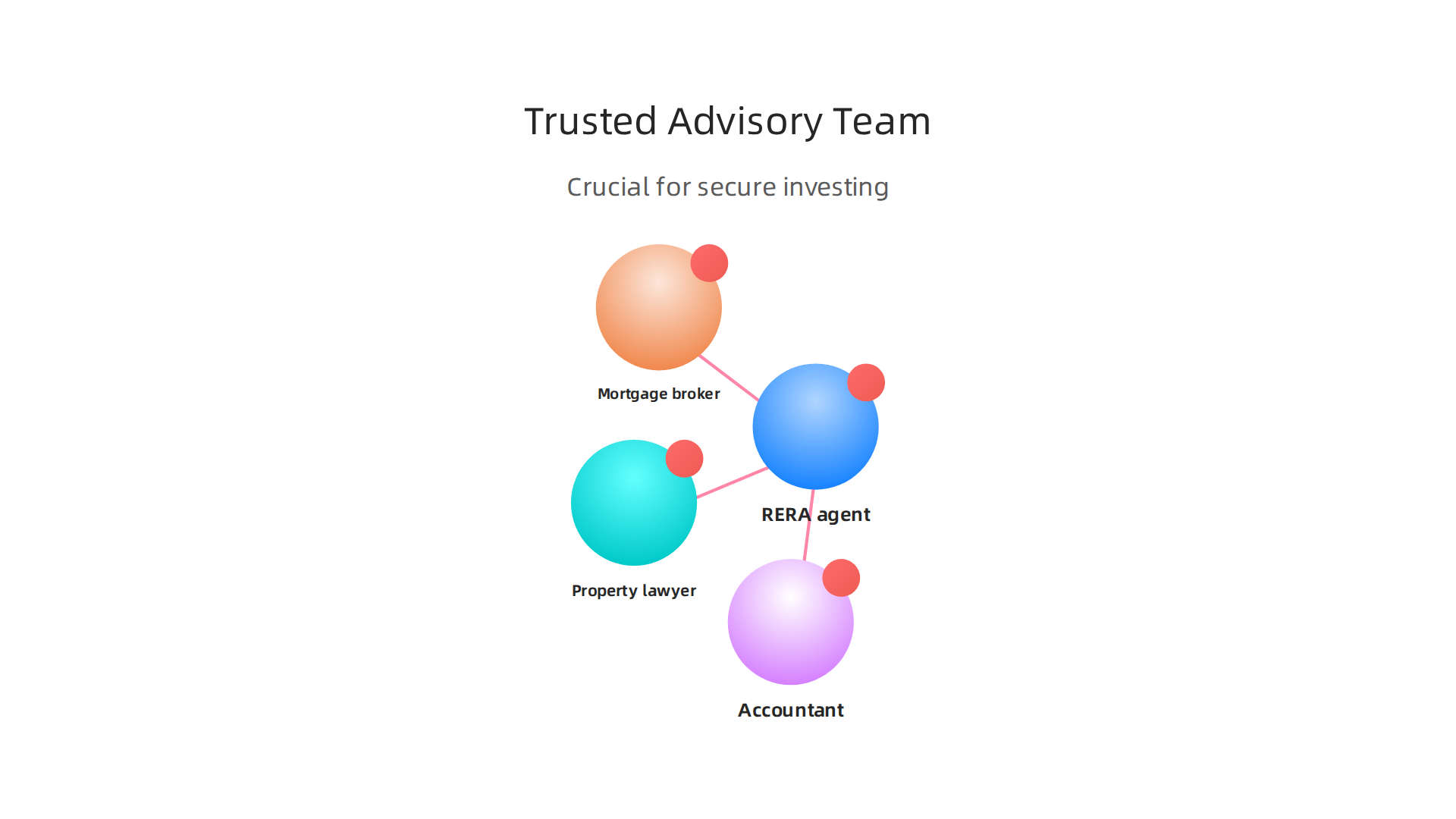
- A RERA-registered agent: This person should know the area you are targeting and have a proven track record.
- A property lawyer: They review contracts and protect your rights if something goes wrong. If you ever face a dispute, knowing how to file a complaint with RERA can save you. One expert explains the step by step process on how to resolve off plan property disputes through RERA.
- A mortgage broker: They compare loan options from different banks so you get the best rate. Some investors also explore investment platforms that offer fractional ownership, which a good broker can explain.
- An accountant: They help with tax planning and record keeping, especially if you own multiple properties.
Do your own homework too
Even with a great team, you need to verify the property itself. Check the developer’s history, visit the site, and ask for the owner association disclosure. This document reveals hidden fees and rules that can affect your returns.
For a deeper look at what to check before you sign, read this guide on how to do due diligence when choosing a real estate investment company in Dubai. A little extra effort up front can prevent a lot of regret later.
Summary
This guide explains how to invest in Dubai real estate in 2026 with a practical, risk‑aware approach. It compares off‑plan and ready properties, showing how escrow rules, Oqood registration and independent legal review protect buyers and shape returns. You’ll learn the key regulatory players (DLD, RERA, Ejari), the real costs to budget for, and which communities currently deliver the strongest rental yields. The article also covers advanced financing choices — non‑resident mortgages, corporate ownership and mixed payment strategies — plus how to use market cycle indicators to time buys and exits. It emphasises building a vetted advisory team and lists common pitfalls to avoid. Finally, it points to passive alternatives like REITs and provides links to step‑by‑step resources so you can act with confidence.