
How UAE Corporate Tax Affects Your Dubai Property Investment Structure
· 22 min read

Introduction
If you own rental properties in Dubai or plan to buy real estate here, you have probably heard about the new corporate tax in the UAE. Since 2023, the country introduced a federal corporate tax law that affects how property income is taxed. This change matters whether you live in the UAE or invest from abroad.
The UAE corporate tax law applies a 9% rate on taxable income above AED 375,000. But here is the thing: how this tax hits your property business depends on how you hold your real estate. Some structures are fully taxable, while others may qualify for exemptions. According to the official UAE government platform, certain investment funds and entities can apply for tax relief if they meet specific conditions.
This guide is built to give you a clear, unbiased overview of corporate taxes and their impact on real estate. We will walk through the rules step by step, from corporate tax registration requirements to smart business setup in Dubai options. Whether you are a small landlord or a large fund, you will get actionable insights to stay compliant, optimize your tax position, and avoid costly mistakes.
Real estate investing in Dubai still offers great opportunities, but the tax landscape has changed. Understanding the uae corporate tax law is now a must for protecting your returns.

Let us break it down together.
For personalized guidance on navigating your property investments under the new tax rules, feel free to connect with Ayaz Salman on WhatsApp for a free consultation.
Understanding the UAE Corporate Tax Framework: Key Provisions for Property Investors
The UAE corporate tax law lays out a clear system for how businesses get taxed. If you own property in Dubai, you need to understand this framework. It helps you stay on the right side of the rules and keep more of your money.
The Basic Tax Rate and Thresholds
The standard corporate tax in UAE is 9% on taxable income over AED 375,000. If your taxable income is below that amount, you pay 0% tax. This is a big deal for smaller landlords and property businesses. The UAE Ministry of Finance explains that the law covers all businesses and people doing business activities in the UAE. For a full breakdown of rates and how they apply to you, the Skrooge.ai guide on UAE Corporate Tax 2026 is a helpful resource.
Small Business Relief and Free Zone Exemptions
Do you run a small property business? You might qualify for small business relief. This relief lowers the paperwork burden for businesses with lower revenue. Also, if you hold your property through a free zone company, you could get a 0% tax rate on qualifying income. The official UAE government platform notes that certain investment funds and entities can apply for tax exemptions if they meet special conditions.
How Real Estate Income Gets Taxed
Different types of property income have different tax rules.
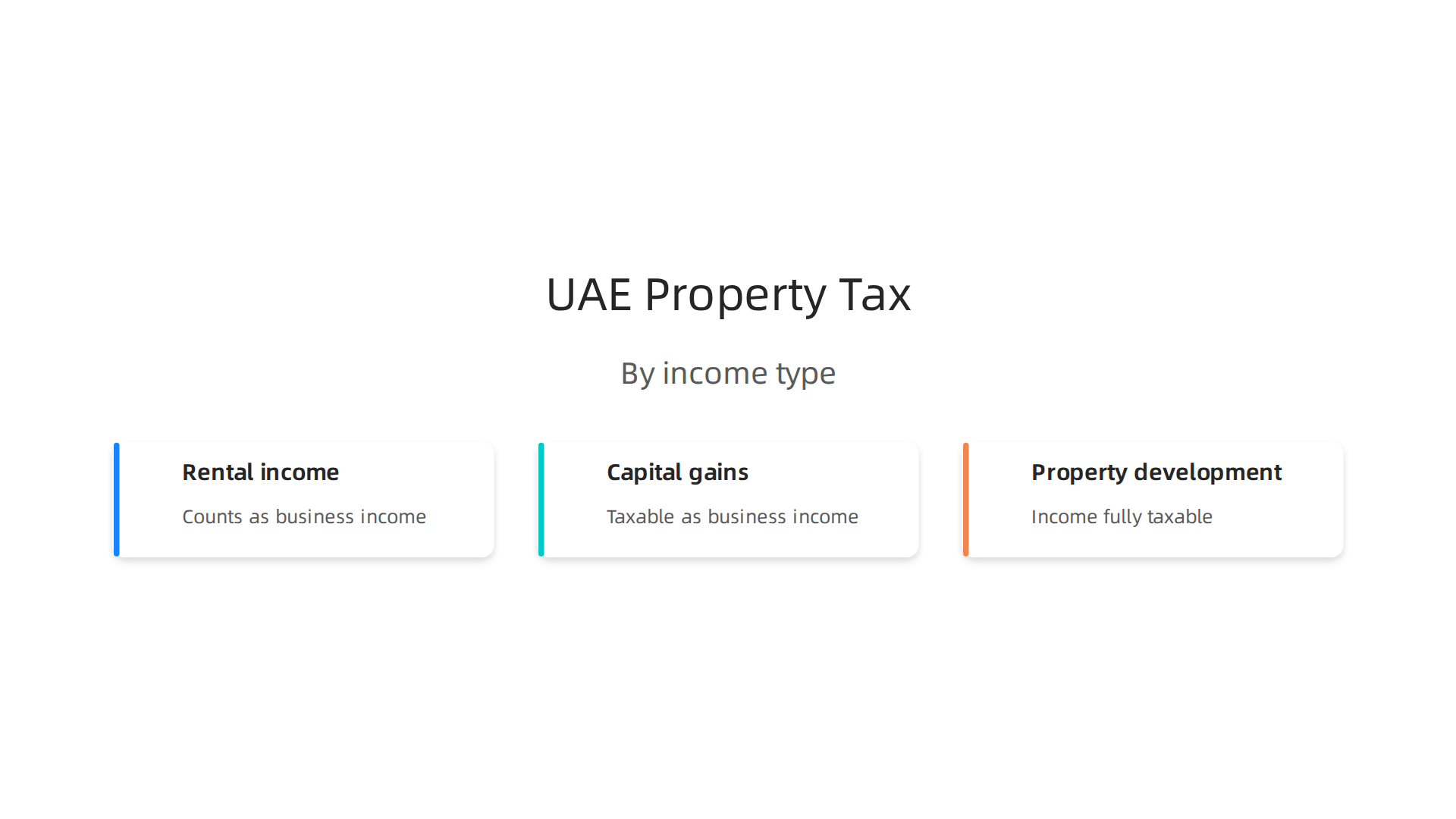
Here is a simple breakdown:
- Rental income: This counts as business income. You include it in your taxable income calculation.
- Capital gains from selling property: These gains are usually taxable as business income unless an exemption applies.
- Property development income: If you buy, build, and sell properties for profit, that income is fully taxable.
The Federal Decree Law gives the legal foundation for how these income types get classified and taxed.
Tax Residency and Permanent Establishment Rules
For foreign investors, two ideas matter a lot: tax residency and permanent establishment. If you are a tax resident of the UAE, you must pay corporate tax on your worldwide income from UAE business activities. If you have a permanent establishment in the UAE, income linked to that establishment is also taxable. This is key for investors who live outside the UAE but own property here.
Knowing your residency status and whether you have a permanent establishment can save you from surprise tax bills. The ClearTax FAQs on UAE corporate tax give a helpful overview of how these rules work.
Get Personalized Guidance
The rules around corporate taxes can feel confusing. But you do not have to sort through them alone. If you want custom advice on how the UAE corporate tax law affects your property investments, connect with Ayaz Salman on WhatsApp for a free consultation. He can help you understand your specific case and find the best path forward.
How UAE Corporate Tax Affects Property Investment Structures
The way you hold your property can change how much tax you pay. Under the corporate tax uae law, your ownership structure directly affects your tax bill. So you need to choose wisely.
Direct Individual Ownership vs. Corporate Ownership
If you own a property in your own name as an individual, your rental income counts as business income. That means it could be subject to corporate tax if your total taxable income from all business activities goes over AED 375,000. Since the UAE does not have a personal income tax, direct ownership might seem simple at first. But you still have to track your income and file a corporate tax return if you cross that threshold.
When you own property through a company like an LLC or a special purpose vehicle (SPV), the company becomes the taxpayer. The company must register for corporate tax, file returns, and pay tax on its profits. A mainland company pays 9% on net profits above AED 375,000. According to ManiInfo, free zone companies can get a 0% tax rate on qualifying income if they meet certain rules.
What Qualifying Income Means for Free Zone Entities
If you set up a free zone company to hold your property, you need to understand qualifying income. Rental income from properties located inside the free zone or from qualifying activities may get the 0% rate. BMS Auditing explains that free zone businesses are subject to 0% or 9% based on whether their income is qualifying. A key rule says no more than 5% of your total revenue can come from non-qualifying activities, as detailed by Shuraa Tax. So if you rent to mainland customers, that income might not qualify, and you could lose the 0% rate.
Holding Companies, Real Estate Funds, and Joint Ventures
For larger investors, the setup gets more complex. Holding companies that own property often have to pay tax on dividends or capital gains from selling shares. Real estate funds may qualify for exemption if they meet the conditions in the tax law. Joint ventures are usually treated as separate taxable entities unless they get an exemption. Each structure has different tax consequences, so you need to plan ahead.
Impact on Rental Yield and Exit Strategies
Your ownership choice directly affects your bottom line. A mainland company paying 9% tax will see lower net rental income compared to a free zone company paying 0% on qualifying income. That difference matters when you calculate your rental yield. For your exit strategy, think about capital gains. Selling a property held in a company may trigger tax at the corporate level. And when you take the money out as an individual, you might face additional taxes depending on your residency.
Getting the structure right from the start can save you a lot of money. If you are not sure which option works best for your situation, connect with Ayaz Salman on WhatsApp for a free consultation. He can help you compare your options and find the smartest path forward.
Business Setup Options in Dubai: Mainland, Free Zone, and Offshore – Tax and Regulatory Comparison
Choosing where to set up your business for property investment is a big decision. The corporate tax uae system treats mainland, free zone, and offshore companies very differently.
Get this wrong and you could pay more tax than you need to. Let’s look at each option side by side.
Mainland Company
A mainland company gives you full access to the local Dubai market. You can do business anywhere in the UAE without restrictions. But here’s the trade off. You pay 9% corporate tax on all net profits above AED 375,000. There’s no qualifying income break for mainland firms. According to ManiInfo, mainland companies are subject to a standard 9% tax rate. This applies to rental income, property sales, and any other business activity. So if you plan to own multiple properties and actively manage them, a mainland setup may mean a higher tax bill.
Free Zone Company
Free zone companies offer a big tax advantage. You can get 0% corporate tax on qualifying income. But qualifying income has strict rules. As BMS Auditing explains, free zone businesses are taxed at 0% or 9% based on whether their income qualifies. Rental income from properties inside the free zone or from qualifying activities may qualify. But if you rent to mainland customers, that income is non-qualifying. Shuraa Tax notes that no more than 5% of your total revenue can come from non-qualifying activities. Also, free zone companies cannot directly do business in the mainland market. They must use a distributor or a mainland partner. And you must show real business substance in the free zone, like an office and employees.
Offshore Company
An offshore company is different. It has no corporate tax liability in the UAE at all. Offshore entities are not considered taxable persons under the uae corporate tax law. But there is a catch. Offshore companies cannot own property directly in Dubai. They are mainly used to hold assets in other countries or to own shares in UAE companies that own property. If your goal is to hold Dubai real estate indirectly, an offshore setup might work. But you will need a separate structure to own the property itself.
How to Decide
Your choice depends on your goals.

If you want to actively manage a portfolio of Dubai properties and serve local tenants, a mainland company gives you flexibility but comes with 9% corporate taxes. If you can structure your income to be qualifying, a free zone company gives you a zero tax rate. But you must follow the substance rules and avoid mainland dealings. Offshore works best for passive holding of foreign assets.
The key is to match your business model with the right setup. This is not something to guess at. If you are thinking about buying your first property or adding to your portfolio, you need expert advice. The corporate tax registration process for each structure is different, and missing a step can cost you.
That is why I recommend getting a professional opinion. Connect with Ayaz Salman on WhatsApp for a free consultation. He can help you compare mainland, free zone, and offshore options based on your specific situation. A smart business setup in dubai starts with the right structure.
Tax Registration, Filing, and Compliance for Real Estate Businesses
Once you pick your business structure, you need to handle tax registration, filing, and compliance. The uae corporate tax law applies to most real estate activities. Here is exactly how to stay on the right side of the rules.
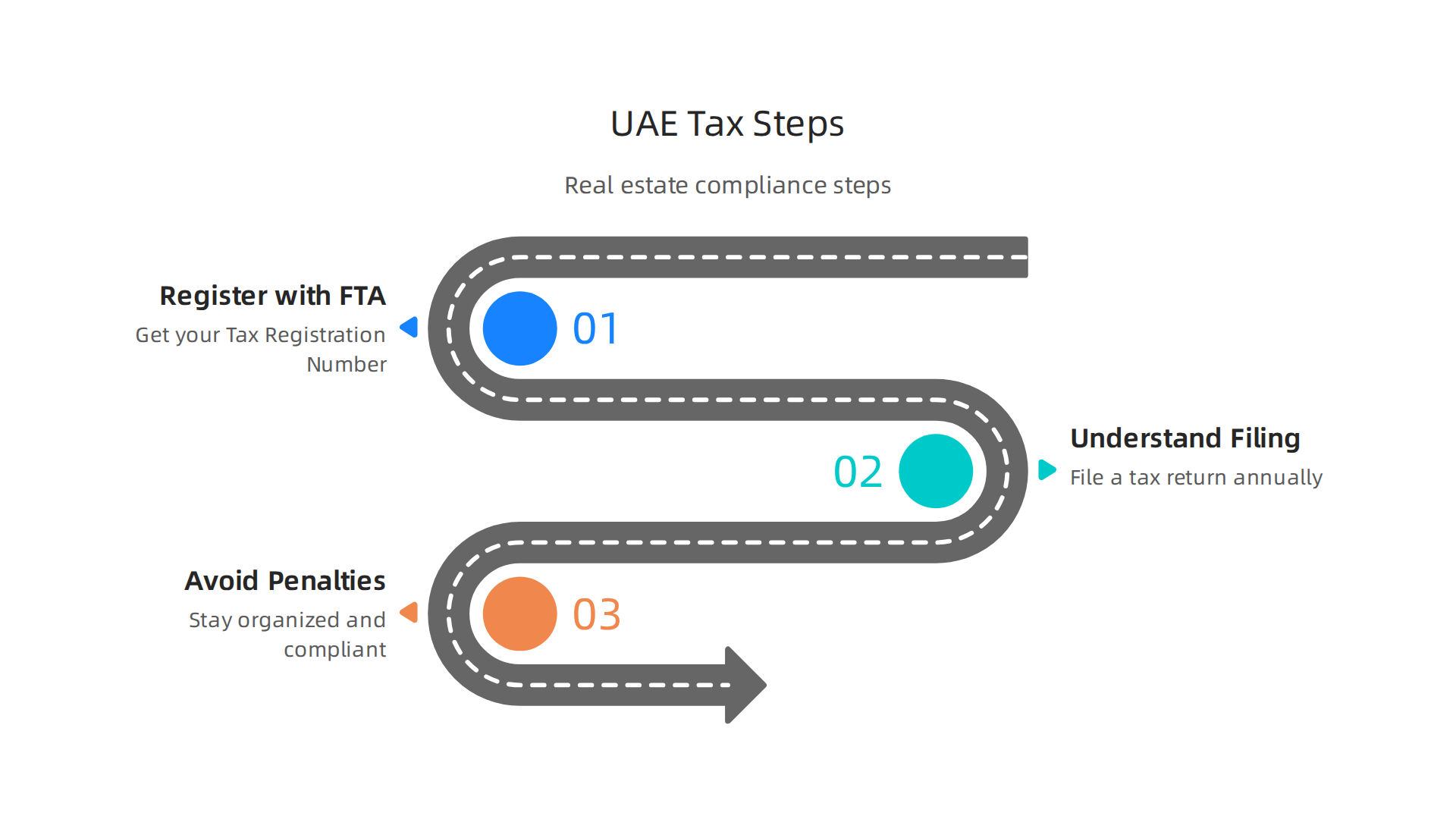
Step 1: Register with the FTA for Corporate Tax
You must register with the Federal Tax Authority (FTA) to get your Tax Registration Number (TRN). This is your first official step as a taxable person. The process is done online through the FTA portal. According to Skrooge’s 2026 guide, once you register, you enter a tax period right away. Do not delay this step. ADEPTS confirms there is a fixed AED 10,000 penalty for late registration in 2026. So mark your calendar and get it done.
Step 2: Understand Your Annual Filing Requirements
Every year, you must file a Tax Return. You have to do this within 9 months after your financial year ends. For example, if your year ends on December 31, 2025, your filing deadline is September 30, 2026. TapFiscal highlights this exact date for the current year. Most real estate businesses also need to submit audited financial statements. And if you do business with related companies, you need transfer pricing documentation. Pure Docs explains these requirements in detail. Keeping clean books all year makes this step much easier.
Step 3: Avoid Penalties for Non-Compliance
The FTA does not mess around. We already talked about the AED 10,000 late registration fee. But late filing and underpayment also bring heavy fines. You can lose a lot of money if you miss a date.
How do you avoid this? Stay organized. Use a simple checklist:
- Register for corporate tax registration on time
- Keep all receipts and invoices in one place
- Hire a good tax advisor who understands the uae corporate tax law
- File your return before the 9-month deadline
Paying your corporate taxes on time is not just a legal duty. It keeps your investment safe and your mind at peace.
Need Help Getting This Right?
Look, all these steps can feel heavy. You are here to invest in property, not to become a tax expert overnight. That is where a real professional helps the most.
Instead of guessing through the rules, connect with Ayaz Salman on WhatsApp for a free consultation. He can guide you through corporate tax uae registration and help you set up a fully compliant business setup in dubai. Or, feel free to explore more and Contact Us for tailored investment guidance.
Transfer Pricing and Economic Substance in Dubai Real Estate
So you have your business structure set and your tax registration sorted. But there are two more big compliance areas you need to understand. Many real estate investors miss them until it is too late.
Here is the thing. If you own multiple real estate companies like one for property management, another for leasing, and a third for development, you do business with yourself a lot. That is called a related party transaction. And the uae corporate tax law says these deals must be at arm’s length. That means you must charge the same price you would charge a stranger.
Why does this matter? Because if you pay too much rent to your own leasing company to lower your profit, the FTA will catch it. They look at these transactions closely. Pure Docs explains how transfer pricing rules work for UAE businesses in 2026. You need proper documentation for every related party deal.
Economic Substance for Free Zone Companies
A lot of real estate investors set up in free zones to enjoy the 0% corporate tax rate on qualifying income. But here is the catch. You must have real economic substance in the UAE. That means you cannot just have a mailbox and call it a day.
The economic substance rules require you to:
- Hold board meetings in the UAE
- Have employees working from your office
- Make key decisions from your Dubai location
- Show real business activity
Passive income like rental earnings gets extra attention. If the FTA decides your free zone company has no real activity here, they can deny your 0% rate. Suddenly you owe 9% on everything. That hurts.
Documentation and Penalty Risks
You cannot just say "we did arm’s length deals." You need proof. That means keeping transfer pricing documentation like a master file and local file. The rules can get complex fast.
Skrooge’s 2026 guide covers the full documentation requirements for staying compliant. Without proper records, you face penalties that eat into your profits.
Getting Expert Help
Honestly, these rules are not something you figure out on YouTube. One wrong transaction and you could owe thousands in back taxes and fines.
Instead of guessing, connect with Ayaz Salman on WhatsApp for a free consultation. He works with tax experts who understand real estate structures inside out. They can help you set up your corporate tax uae compliance correctly from day one. Or feel free to contact us for tailored guidance on your specific situation.
Common Pitfalls and How to Avoid Them: Expert Insights
Even with the best plans, real estate investors in Dubai make the same mistakes over and over. The good news? You can avoid them if you know what to watch for. Here are the three biggest traps and how to stay clear.
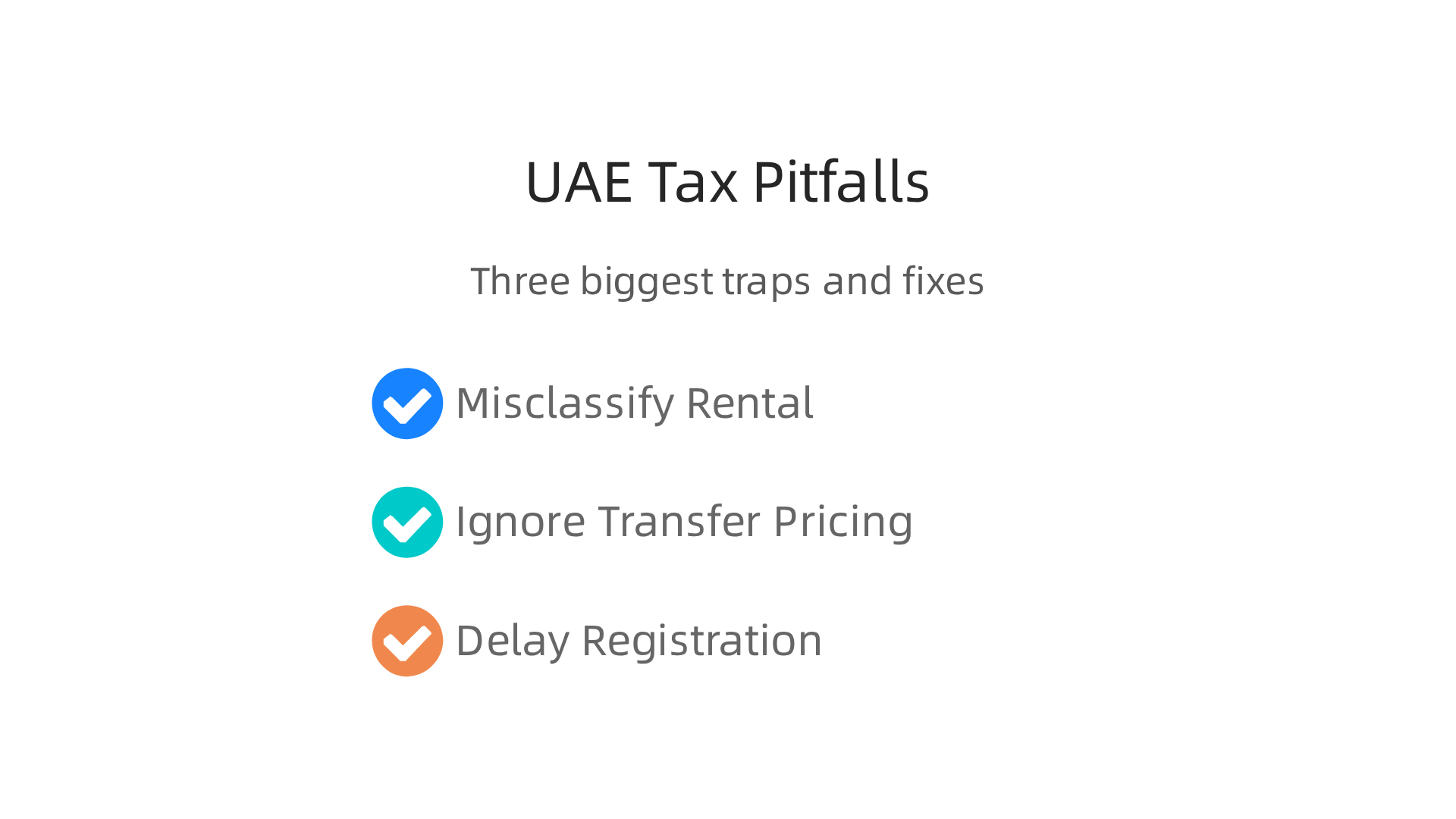
Mistake 1: Misclassifying Rental Income as Non-Taxable
This one catches a lot of people. You set up a free zone company, collect rental income, and assume it is all tax-free. But here is the thing. Not all rental income qualifies for the 0% rate.
If your free zone company does not have real economic substance, the FTA can treat your rental income as taxable. That means 9% corporate tax on everything you thought was safe. Alvarez & Marsal covers key UAE real estate tax investment considerations for 2026, including how substance rules affect your tax bill.
The fix is simple. Make sure your free zone company has a real office, real employees, and real decision-making happening in Dubai. No mailbox companies. No empty offices.
Mistake 2: Ignoring Transfer Pricing on Management Fees
You own a property management company and a leasing company. You charge management fees between them to lower your profit. That feels normal, right?
Wrong. The uae corporate tax law requires these related party transactions to be at arm’s length. If you charge your leasing company double the market rate for management services, the FTA will notice. And they will adjust your income and add penalties.
Keep proper documentation for every intercompany deal. Without it, you have no defense during an audit.
Mistake 3: Delaying Tax Registration Until After You Buy
Some investors wait until after they purchase a property to start their corporate tax registration. That is a costly mistake.
By then, you have already missed deadlines. The FTA charges penalties for late registration, and these add up fast. Deloitte’s UAE Corporate Tax webinar walks through common pitfalls that trip up real estate investors who register too late.
The rule is simple. Register before you buy. Get your tax number first. Then close the deal.
How to Stay Ahead
You do not have to figure this out alone. The rules change, the penalties are real, and one mistake can cost you thousands.
If you want to get your business setup in Dubai right from the start, connect with Ayaz Salman on WhatsApp for a free consultation. His team helps real estate investors like you avoid these exact pitfalls every day. Or contact us for personalized guidance on your situation.
Case Studies: Real-World Corporate Tax Scenarios for Dubai Property Investors
Now that you know the common pitfalls, let’s look at three real situations investors face. Each case shows how the corporate tax uae rules apply in practice. Your own investment might look similar to one of these.
Case A: A High-Net-Worth Individual Buying a Villa
You are a wealthy individual from Europe. You want to buy a AED 10 million villa in Palm Jumeirah. Should you buy it in your own name or through a free zone company?
If you buy as an individual, your rental income is not subject to corporate taxes. Individuals do not pay corporate tax on personal real estate income. Simple.
But here is the catch. If you buy through a free zone company hoping to get the 0% rate, you must meet the substance rules. That means a real office and real employees. The Alvarez & Marsal article on UAE real estate tax considerations confirms that free zone companies without economic substance risk having their income taxed at 9%.
For most individuals, buying in your own name is the simpler and safer route. Use a company only if you plan to hold multiple properties or need liability protection.
Case B: A Fund Setting Up a Real Estate Portfolio
Your investment fund wants to buy a portfolio of commercial buildings in Dubai. You plan to hold them long term.
The smart structure here is a mainland holding company with free zone special purpose vehicles (SPVs) under it. The mainland company handles fund management and administration. Each property sits inside its own free zone SPV.
Why? Because investment funds can be exempt from corporate tax uae under certain conditions. The PGP Law case study on UAE investment funds explains how properly structured funds may qualify for a full exemption. The SPVs can also apply for the 0% rate on qualifying income if they meet the free zone conditions.
The key is to keep the mainland company as the fund manager and ensure each SPV has real activity. This structure also helps with repatriating profits later.
Case C: An Overseas Developer Entering the Off-Plan Market
You are a developer from Saudi Arabia. You want to launch an off-plan project in Dubai. You need to think about corporate tax registration and profit repatriation from day one.
You will likely set up a mainland company to do business in Dubai. The mainland company pays 9% corporate tax uae on its profits. But you can reduce that by keeping project costs inside the company.
The harder part is getting your profits back to Saudi Arabia. Dividends paid to a foreign parent company may be subject to withholding tax, but the UAE does not currently impose one. Still, you need clear transfer pricing documentation for any services you charge between your Saudi parent and your Dubai subsidiary.
The Deloitte UAE Corporate Tax webinar walks through structuring for off-plan developers and common mistakes to avoid.
What These Cases Teach Us
Every investor’s situation is different. But one thing stays the same. You must plan your business setup in dubai structure before you sign any deal. Waiting until after you close will cost you time, money, and penalties.
If you want to set up the right structure for your real estate investment, connect with Ayaz Salman on WhatsApp for a free consultation. His team helps investors navigate the uae corporate tax law every day. They can help you choose the best entity type, register on time, and stay compliant from the start.
Future Outlook: Post-2026 Developments in UAE Corporate Tax and Real Estate
The UAE is still early in its corporate tax journey. The rules we have today in 2026 may not stay the same forever. Smart investors keep an eye on what is coming next.
Potential Changes on the Horizon
The UAE government wants to stay in line with global standards. Here are some changes that experts expect in the coming years.
A higher rate for large taxpayers. Right now, the rate is 9% on profits above AED 375,000. But big companies with very high profits might face a separate, higher rate in the future. This would match what other countries do.
Tighter economic substance rules. We already talked about substance requirements for free zone companies. These rules may get stricter. The Westgate Dubai guide on corporate tax for real estate holding companies notes that holding companies need real activity to benefit from lower rates. Expect more audits on this point.
Expansion of free zone qualifying activities. The list of activities that qualify for the 0% rate may grow or shrink. If you own a free zone company, track any updates to the qualifying income rules.
The Global Tax Wave: Pillar Two
The OECD has a plan called Pillar Two. It says large multinational companies should pay a minimum 15% tax no matter where they operate. This is called the global minimum tax.
The UAE has not fully adopted Pillar Two yet. But the King & Spalding playbook on GCC real estate explains that global tax trends are reshaping how institutional investors structure deals. If your real estate fund is part of a larger global group, Pillar Two may eventually affect your tax position.
For most individual investors, Pillar Two will not matter much. But for funds and large institutions, it is a big deal.
How to Prepare for What Is Coming
The best way to stay ready is to build flexibility into your structure now. Do not lock yourself into a setup that is hard to change later.
Here is what you can do today:
- Keep clean records. Good books and documents make it easier to adapt if rules change.
- Check your substance regularly. Make sure your free zone company has a real office and real employees.
- Watch for announcements. The UAE Central Bank quarterly economic review and reports from firms like PwC and Deloitte can help you spot trends early.
- Talk to a tax expert. A professional who follows the uae corporate tax law daily can warn you about changes before they happen.
The UAE real estate market is still growing strong. The market size is projected to reach USD 53.77 billion in 2026 according to Mordor Intelligence. That growth will attract more attention from tax authorities. Stay ahead of the curve.
If you want to future-proof your business setup in dubai and make sure your corporate tax registration is ready for whatever comes next, Contact Us for tailored investment guidance. Our team stays up to date on every shift in the corporate tax uae landscape.
Summary
This guide explains how the UAE corporate tax law introduced in 2023 affects property investors in Dubai, covering the 9% rate above AED 375,000, free zone 0% reliefs, and offshore exceptions. It walks through how different ownership structures—individuals, mainland companies, free zone entities, holding companies and funds—change your tax outcome, plus the qualifying income and economic substance rules that free zone firms must meet. You will learn the registration and annual filing process with the FTA, key compliance steps like transfer pricing documentation, and common pitfalls that trigger penalties. The article uses practical case studies (individual buyers, funds, developers) to show real-world consequences and structuring choices. It also outlines future risks such as stricter substance tests and global minimum tax developments, and recommends proactive record-keeping and expert advice so you can choose the right setup and protect your returns.